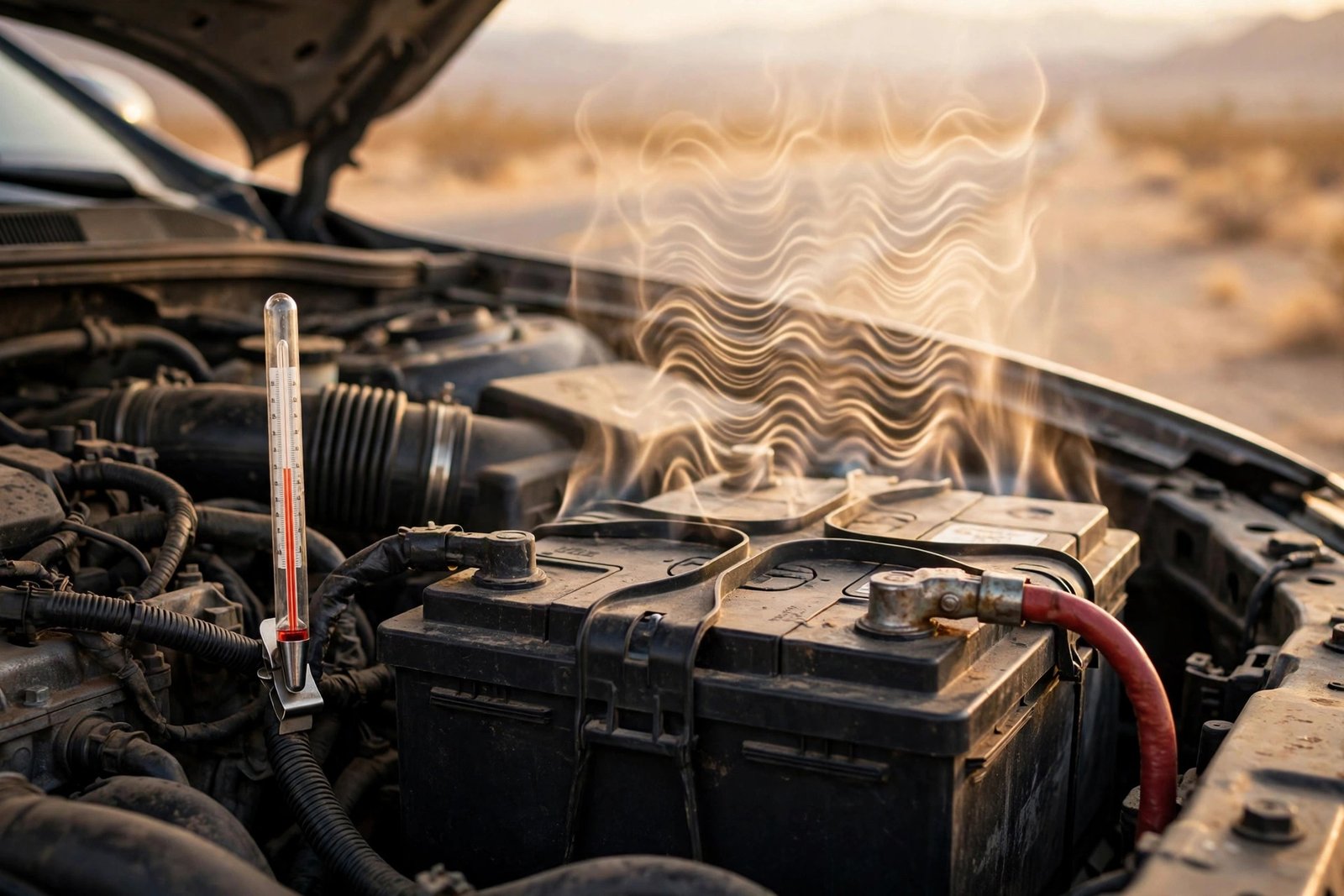
Everyone knows cold kills car batteries. Fewer drivers realize heat is the silent assassin — battery engineers will tell you that sustained high temperatures do more permanent damage to a battery than any winter. Chicago drivers experience both extremes: -15°F January mornings and 95°F July heat waves radiating off asphalt. If your battery died in August rather than January, heat was likely the culprit. Here’s how long car batteries actually last in hot climates, why heat destroys them, and how to maximize battery life wherever the thermometer climbs.
The Surprising Truth: Heat Kills More Batteries Than Cold
Cold reveals weak batteries; heat creates them. High temperatures accelerate the chemical reactions inside a battery — including the destructive ones: grid corrosion, water evaporation from the electrolyte, and plate sulfation. Every 15°F above 77°F roughly doubles the rate of these degradation reactions. A battery in Phoenix (average summer highs 106°F) typically lasts 2–3 years; the same battery in Minneapolis might last 5–6. Chicago sits in the middle — but Chicago summers still punish batteries, especially with urban heat island effects pushing parking-lot temperatures past 110°F.
The cruel irony: heat damage is invisible until winter. Summer corrosion and water loss weaken the battery silently; then the first cold snap demands full cranking power from a compromised battery, and it fails. That “winter battery death” was actually a summer murder with a delayed autopsy. The AAA notes that battery-related roadside calls spike in both extreme heat and extreme cold — two symptoms of the same underlying degradation.
Realistic Lifespans by Climate
- Extreme heat (Phoenix, Las Vegas, South Florida): 2–3 years. Annual testing after year two is essential.
- Hot summers, cold winters (Chicago, Dallas, Atlanta): 3–5 years. The thermal cycling of both extremes accelerates aging from both directions.
- Mild climates (San Diego, Seattle): 5–7 years. Batteries live their longest, quietest lives here.
- Cold-dominated (Minneapolis, Buffalo): 4–6 years. Cold preserves batteries chemically but demands maximum performance.
These are averages for quality batteries. Cheap batteries with thin plates and minimal reserve capacity die sooner everywhere; premium AGM batteries often exceed these ranges. And driving patterns matter as much as climate: short trips that never fully recharge, long sits between drives, and heavy accessory use all subtract months.
How Heat Destroys Batteries: The Mechanisms
Water Evaporation
Conventional flooded batteries lose water from the electrolyte in heat. As water evaporates, acid concentration rises, accelerating internal corrosion. Most modern batteries are “maintenance-free” (sealed), which just means you can’t add water back — the loss still happens, silently and irreversibly. This is why batteries in hot climates die suddenly rather than fading: they run fine until the electrolyte drops below the plates, then capacity collapses.
Grid Corrosion
The lead grids supporting the active plate material corrode faster in heat — a chemical reaction that doubles in speed roughly every 15–18°F. Corroded grids increase internal resistance (less cranking power) and eventually break, killing cells. It’s the same reason phone batteries swell and die faster in heat — different chemistry, same thermal enemy.
Vibration Plus Heat
Heat-softened internal components plus road vibration (Chicago potholes, again) is a brutal combination. Securing the battery with a proper hold-down matters more than most drivers realize — a bouncing battery in a hot engine bay dies young.
Maximizing Battery Life in Heat
- Park in shade or garages. The single biggest lever. An underground garage can be 30°F cooler than a sun-baked lot — that’s potentially a year of battery life. Keeping the garage usable for the car (not just storage) pays off here; organizing the garage so the car actually fits inside is battery maintenance.
- Use a heat shield or battery insulation blanket. $15–$30 wraps that reflect engine-bay heat away from the battery. Particularly valuable for batteries mounted near exhaust components.
- Keep terminals clean. Heat accelerates terminal corrosion; clean and protect them annually.
- Test annually after year two in hot climates (after year three in moderate ones). Free at most parts stores.
- Don’t skimp on replacement quality. In heat, the price difference between a budget battery and a quality one buys disproportionately more life.
- Minimize deep discharges. Leaving lights on or running accessories with the engine off in heat compounds the damage — the battery is already stressed.
Signs Heat Has Damaged Your Battery
Swollen or bloated battery case (heat + gas buildup — replace immediately, it’s a failure in progress), rotten-egg sulfur smell (overcharging or internal damage), corrosion blooming rapidly on terminals, slow cranking on merely warm mornings, and age — any battery past 3 years in a hot climate is suspect regardless of symptoms. Don’t wait for the tow truck to confirm.
AGM Batteries: Worth It in Heat?
Absorbent Glass Mat batteries handle heat significantly better: sealed design prevents water loss, compressed plates resist vibration, and lower internal resistance means less heat generated during charging. At $200–$300 versus $130–$180 for conventional, AGM is arguably more worth it in hot climates than cold ones — the premium buys the most life exactly where conventional batteries die youngest. The Department of Energy’s battery guidance details the technical advantages.
Your EV’s 12V Battery: The Forgotten Component
Electric cars still have a conventional 12V battery running the computers, lights, and accessories — and it fails like any other battery, sometimes stranding EV owners who assumed “electric” meant “no battery worries.” Heat degrades these auxiliary batteries exactly as described above, and EVs can be worse: the 12V charges from the main pack through a DC-DC converter, and if the car sits unplugged in heat, the 12V can die while the big battery sits full. Symptoms (unresponsive car despite charged main battery, weird error messages) confuse owners. The fix is the same: test annually, replace proactively at 3–4 years, and keep the car plugged in during extreme heat when possible. Battery thermal management protects the expensive pack; only your attention protects the $150 auxiliary.
Conclusion
Car batteries last 2–3 years in extreme heat, 3–5 in mixed climates like Chicago, and 5–7 where it’s mild — because heat accelerates every internal degradation reaction while silently evaporating electrolyte. The battery that “dies in winter” was usually killed in summer. Fight back with shade parking, annual testing after year two or three, clean terminals, and quality replacements (AGM if your climate is harsh). Heat is the invisible killer; attention is the antidote.
Frequently Asked Questions
Does heat or cold kill car batteries faster?
Heat causes more permanent damage — it accelerates corrosion, evaporates electrolyte, and degrades plates. Cold exposes the resulting weakness by demanding maximum cranking power. Most “winter failures” are actually heat-damaged batteries meeting their first real test.
How long should a car battery last in Texas or Florida?
Typically 2–3 years in extreme heat zones. Test annually after the second year and budget for proactive replacement around year three rather than waiting for failure.
Can I extend my battery life in hot weather?
Yes: park in shade/garages, use a battery insulation blanket, keep terminals clean, avoid deep discharges, ensure the hold-down is tight, and buy quality (preferably AGM) replacements.
Why did my battery die in summer if cold is the problem?
Because heat was the problem all along. Summer heat destroyed capacity silently; the battery simply crossed the failure threshold during hot weather instead of waiting for winter. Sudden summer death usually means advanced internal degradation.
Is a swollen car battery dangerous?
Yes. Swelling indicates internal gas buildup and plate damage — the battery is failing and in rare cases can leak acid or rupture. Replace a swollen battery immediately and handle it carefully.