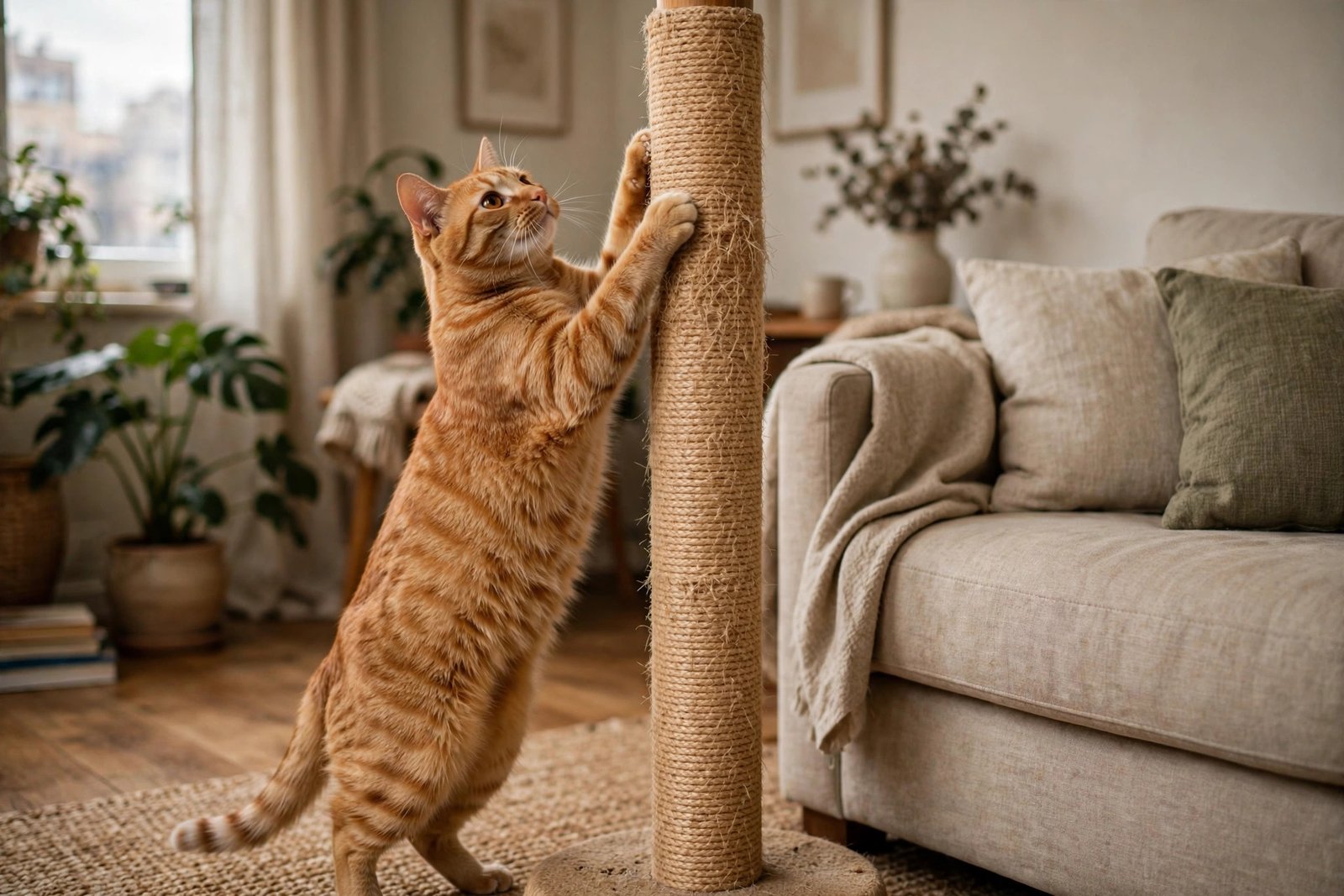
Your couch has a new modern art installation: claw marks. Your cat stares at you from atop the ruined armrest with the serene expression of an artist surveying a masterpiece. Before you despair — or declaw, which you should never do — understand this: scratching is not misbehavior. It’s a biological need as fundamental to cats as stretching is to you. The question isn’t how to stop the scratching. It’s how to move it somewhere you can live with.
Why Scratching Is Non-Negotiable for Cats
Cats scratch for four overlapping reasons, and understanding them changes the whole approach. First, claw maintenance: scratching sheds the dead outer sheath of the claw, keeping the sharp new claw underneath functional. Second, stretching: the full-body pull against a vertical surface stretches the back, shoulders, and forelegs — watch your cat’s blissful extension and you’ll see it’s basically yoga. Third, scent marking: paw pads contain scent glands, so scratching leaves both a visual and chemical “I live here” signature. Fourth, emotion: cats scratch more when excited, frustrated, or marking territory after a change — which is why scratching often spikes after you move apartments or bring home a new Chicago roommate.
This is why punishment fails so completely. Yelling at or squirting a cat for scratching is like punishing a human for stretching — it suppresses the symptom in your presence while the need builds until the cat scratches the moment you leave. The Humane Society’s cat care resources is blunt on this point: you cannot train the instinct out; you can only redirect it.
The Scratching Post Audit: Why Yours Isn’t Working
Most owners who say “my cat ignores the scratching post” have a post problem, not a cat problem. Run this audit:
Is It Tall Enough?
The number-one post failure. Cats need to stretch to full length — for an average cat, that means at least 30–32 inches of vertical scratching surface. The cute 18-inch mini post from the pet store is a decoration, not a tool. If your cat tries the post, finds it too short, and goes back to the couch arm (which is the perfect height), the cat is being rational.
Is It Stable?
A wobbling post is a rejected post. Cats put their full weight into a scratch; if the thing tips or sways, the cat learns it’s unsafe and never tries again. Wall-mounted scratchers or heavy-based towers that don’t budge are worth the extra money. In a Chicago rental where you can’t drill walls, a tall, heavily weighted tower is the answer.
Is the Material Right?
Sisal rope is the gold standard — rough, shreddable, satisfying. Carpet-covered posts confuse cats (why is this okay but the carpet isn’t?), and smooth wood is too slick for most cats. Cardboard scratchers are cheap, beloved, and horizontal — great as supplements. Observe what your cat currently targets: vertical couch arms mean buy vertical; the rug’s edge means add horizontal options.
Is It in the Right Place?
A scratching post exiled to the laundry room will gather dust. Cats scratch where they live: near sleeping spots (the wake-up stretch-scratch is ritual), near doorways and windows (territorial marking), and — critically — right next to the furniture they’re currently destroying. Put the new post directly in front of the scratched couch arm. Yes, it’s ugly for two weeks. Then you move it six inches a day toward its permanent spot.
Retraining the Habit: The Two-Week Protocol
Week one is management plus attraction. Make the furniture unappealing: double-sided sticky tape (StickyPaws) on the scratched areas, a throw blanket draped over the arm, or aluminum foil for the truly determined. Simultaneously make the post irresistible: rub it with catnip or silvervine, dangle a toy from the top, and reward every single interaction — a look, a sniff, one paw touch — with a treat. You’re building a new habit loop, and early repetitions need heavy pay.
When you catch the cat scratching furniture, don’t yell. Calmly interrupt (a hand clap or calling their name), then lure or carry them to the post and reward scratching there. The sequence matters: interrupt the wrong, reward the right, every time. The Ohio State Indoor Pet Initiative has excellent veterinary-reviewed resources on enrichment setups, including scratching stations. Most cats show a clear preference shift within 10–14 days of consistent redirection.
Trim the claws every 2–3 weeks. Blunt claws do less damage during the retraining period and make scratching less satisfying on furniture (less shred = less reward). If you’re nervous about cutting the quick, have your Chicago vet or groomer demonstrate once — it’s a five-minute lesson that pays off for years. Keeping a pet household clean gets easier too when claw trims are routine rather than emergency events.
When Scratching Means Something Bigger
A sudden spike in destructive scratching deserves investigation, not just retraining. Common triggers: a new pet or person in the home (territorial anxiety), a move, construction noise, or conflict with another cat. Multi-cat Chicago apartments are prime territory for scratch-marking wars — each cat over-marks the other’s spots, which is why introducing a new cat to your home gradually matters so much for the resident cat’s stress levels. Feliway diffusers, additional resources (one litter box per cat plus one, separate feeding stations), and vertical territory like cat shelves can defuse the underlying tension.
Medical causes are rarer but real: over-scratching one spot, especially with skin changes, can indicate allergies or pain. And senior cats sometimes scratch more due to cognitive changes or because arthritis makes their usual postures uncomfortable — a lower, horizontal scratcher can help an arthritic cat that abandoned its tall post.
The Declawing Conversation (Short Version: Don’t)
Declawing is not a nail trim — it’s the amputation of the last bone of each toe, equivalent to removing a human fingertip at the last knuckle. It causes chronic pain in a significant percentage of cats, commonly leads to litter box avoidance (digging hurts) and increased biting (their primary defense is gone), and is banned or restricted in a growing number of places. Chicago-area vets increasingly refuse to perform it electively. Every major veterinary and humane organization opposes it. The retraining protocol above works — use it.
Conclusion
Your cat isn’t destroying your furniture out of spite, boredom, or bad character. They’re performing essential claw maintenance, stretching, and scent-marking on the most conveniently shaped object in the room — which happens to be your couch. Give them something better shaped for the job: tall, stable, sisal, well-placed. Redirect patiently for two weeks, protect the furniture in the meantime, and trim those claws. The scratching won’t stop, and it shouldn’t — it’ll just move to where it belongs, and your couch can finally retire from modern art.
Frequently Asked Questions
How do I get my cat to use a scratching post instead of furniture?
Place a tall (30″+), stable, sisal post directly in front of the furniture being scratched, make the furniture unappealing with sticky tape, and reward every post interaction with treats. Most cats switch within two weeks of consistent redirection.
Why does my cat scratch right after waking up?
It’s a stretch ritual — the full-body pull against a vertical surface stretches the back and shoulders after sleep. Place a scratching post near your cat’s favorite sleeping spot to capture this natural habit where you want it.
Is it cruel to stop a cat from scratching?
Stopping all scratching would be, since it’s a biological need. But redirecting scratching to appropriate surfaces isn’t cruel at all — it’s the standard recommended approach from every major feline behavior organization. Punishment doesn’t work; redirection does.
Does declawing stop furniture scratching?
Technically the claws are gone, but declawing is toe-bone amputation that causes chronic pain, litter box avoidance, and increased biting in many cats. It’s opposed by veterinary organizations and increasingly refused by vets. Retraining with proper scratching posts is the humane and effective alternative.