You drive 40 miles round-trip daily from the suburbs into Chicago. Gas runs you $250+ a month, oil changes and brake jobs nickel-and-dime you, and every fill-up stings a little more. An electric car promises $40/month in “fuel” and almost no maintenance — but it also costs $8,000–$15,000 more upfront, and Chicago winters are notoriously unkind to battery range. So is buying an EV actually worth it for a daily commuter in Chicago? Let’s run the honest numbers — purchase price, fuel, maintenance, winter range loss, and charging logistics — and find the real break-even.
The Commuter’s Math: Fuel Savings Are Real
A 40-mile round-trip commute is 10,000+ miles/year just for work. At 28 mpg and $3.60/gallon, that’s ~$1,285/year in gas. The same miles in an EV at Chicago residential electricity rates (~$0.16/kWh) and 3.5 mi/kWh efficiency: ~$460/year. Annual fuel savings: ~$825. Over 8 years: $6,600 — and that’s before gas price increases, which historically outpace electricity.
But the bigger commuter savings are in maintenance: no oil changes ($70–$120 × 2/year), brake jobs stretched to 100,000+ miles thanks to regenerative braking, no transmission services, no spark plugs, no exhaust systems. AAA and Consumer Reports data suggest EV maintenance runs roughly half that of comparable gas cars — saving commuters $400–$600/year. Combined fuel + maintenance savings: $1,200–$1,400/year, or $10,000–$11,000 over 8 years. That covers most of the EV price premium — before incentives.
Incentives: The Game-Changer
The federal EV tax credit (up to $7,500 for qualifying new EVs, up to $4,000 for used) can erase the price premium entirely — if the vehicle qualifies and you have the tax liability. Illinois has offered additional rebates (check current availability — programs change). Many Chicago-area utilities offer time-of-use rates making overnight charging even cheaper. Always calculate with your eligibility: a qualifying EV with the full credit often costs less than the gas equivalent upfront, making the fuel savings pure profit from day one. The DOE’s EV resources track current qualifying vehicles.
The Chicago Winter Problem: Range Loss Is Real
Here’s the honest caveat: cold reduces EV range 20–40 percent. A 300-mile rated EV delivers 180–240 miles in a Chicago January — cabin heating is the big drain (heat pumps, now common, cut this significantly). For a 40-mile commute, even worst-case winter range leaves 4–5x margin. The math works fine. Where it gets uncomfortable: 150-mile-rated older/cheaper EVs in deep winter (90–110 real miles) leave thin margins for errands plus commute, and unheated outdoor parking compounds the loss.
Mitigations that actually work: precondition the cabin while plugged in (uses wall power, not battery), use heated seats instead of cabin heat, park in a garage, and keep the battery between 20–80 percent for longevity. Chicago EV owners who garage their cars and precondition report winter as a non-issue; those street-parking in -15°F without preconditioning feel every lost mile.
Charging Logistics for Commuters
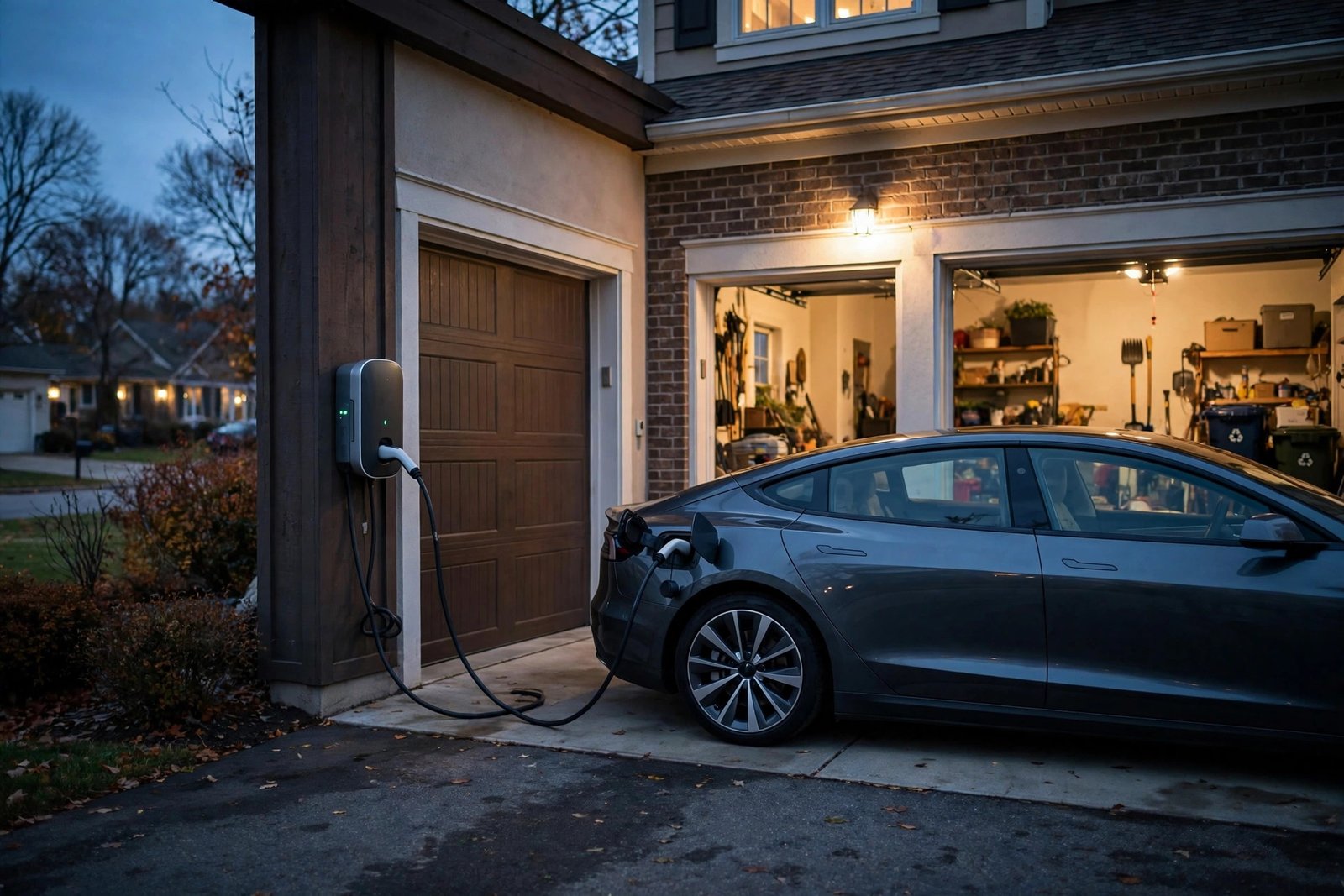
The commuter EV equation hinges on home charging. With a garage or driveway, a 240V Level 2 charger ($500–$1,500 installed; ComEd offers rebates periodically) adds ~25 miles of range per hour — overnight charging covers any commute effortlessly. Without home charging, the math deteriorates: public charging costs 2–3x residential rates and eats time. Apartment and condo dwellers should confirm charging access before buying — it’s the single biggest predictor of EV satisfaction. Chicago’s public charging network is growing but remains no substitute for home base charging on a daily driver.
Workplace charging is the cheat code: many downtown Chicago employers now offer it, effectively giving you free “fuel” for the return trip. Ask before you buy — it transforms the economics.
Total Cost Comparison: 8-Year Commuter Scenario
$42,000 EV (after $7,500 credit: $34,500 effective) vs. $30,000 gas equivalent, 12,000 miles/year:
- EV: $34,500 + $3,700 electricity + $3,200 maintenance + $1,200 charger = ~$42,600
- Gas: $30,000 + $10,300 fuel + $7,200 maintenance = ~$47,500
EV wins by ~$5,000 — and the gap widens if gas prices rise or you drive more. Without the tax credit, it’s roughly break-even to slightly favorable, with the EV pulling ahead on higher mileage. This is fundamentally a household budget question — framing it in your budget shows whether the higher payment/lower running costs fit your cash flow.
Try Before You Buy
Still uncertain about winter range or one-pedal driving? Rent an EV for a long weekend — Turo and major rental agencies offer them in Chicago. A $200 weekend experiment answers every question brochures can’t: real winter range, charging routine, and whether you actually enjoy the driving experience.
When an EV Is NOT Worth It for Commuting
- No home or workplace charging access. Public-charging-only EV life is expensive and inconvenient.
- Frequent 200+ mile winter road trips with tight schedules — charging stops add real time.
- You’d buy the cheapest short-range EV and street-park outdoors. The winter margin gets uncomfortably thin.
- You replace cars every 3 years. The savings compound over time; short ownership horizons favor leasing (EV leases are often excellent) or efficient gas cars.
ComEd Rates and EV Charging Programs
Chicago-area EV owners should investigate ComEd’s time-of-use and EV charging rates, which can cut overnight charging costs significantly versus standard residential rates — some plans price overnight electricity under $0.10/kWh, dropping a 40-mile commute’s “fuel” cost below $1.20/day. ComEd also periodically offers rebates on Level 2 home charger installations, worth several hundred dollars. The key step is calling before you buy the charger: rate plan enrollment affects which equipment qualifies, and an electrician can confirm whether your panel needs an upgrade (older Chicago homes with 60-amp service often do — budget $1,500–$3,000 for a panel upgrade if needed). Get the electrical assessment during your decision phase, not after the EV is in the driveway.
Conclusion
For a Chicago daily commuter with home charging, an EV is worth it: $1,200–$1,400/year in fuel and maintenance savings, federal incentives that often erase the price premium, and winter range that’s a non-issue for 40-mile commutes with preconditioning and garage parking. The break-even typically lands in years 3–5, after which every mile is profit versus gas. Without home charging access, wait — the infrastructure isn’t there yet for your situation. Run your miles, check your charging, claim your credits, and let the math decide. For most Chicago commuters who can charge at home, it already has.
Frequently Asked Questions
How much range do EVs lose in Chicago winter?
Typically 20–40 percent depending on temperature, heating use, and whether the car has a heat pump. A 300-mile EV delivers roughly 180–240 miles in deep winter — plenty for daily commuting with home charging.
How much does it cost to charge an EV at home in Chicago?
At ~$0.16/kWh residential rates, a 40-mile commute costs roughly $1.80/day — under $40/month. Time-of-use rates and ComEd programs can reduce this further with overnight charging.
Do EVs need less maintenance?
Yes — roughly half the maintenance cost of gas cars per Consumer Reports data. No oil changes, transmission services, or spark plugs; brakes last 100,000+ miles via regenerative braking. Tires may wear slightly faster due to weight and torque.
Can I own an EV in Chicago without a garage?
It’s harder: outdoor winter parking increases range loss, and without home charging you depend on public infrastructure at 2–3x the cost. It’s workable with nearby reliable charging and workplace charging, but home charging remains the key to EV economics.
Should I lease or buy an EV in 2026?
Leasing is attractive right now: battery tech is evolving fast, many leases bake in federal incentives as discounts, and you avoid long-term depreciation uncertainty. Buyers benefit most from keeping the car 8+ years to maximize fuel savings.