
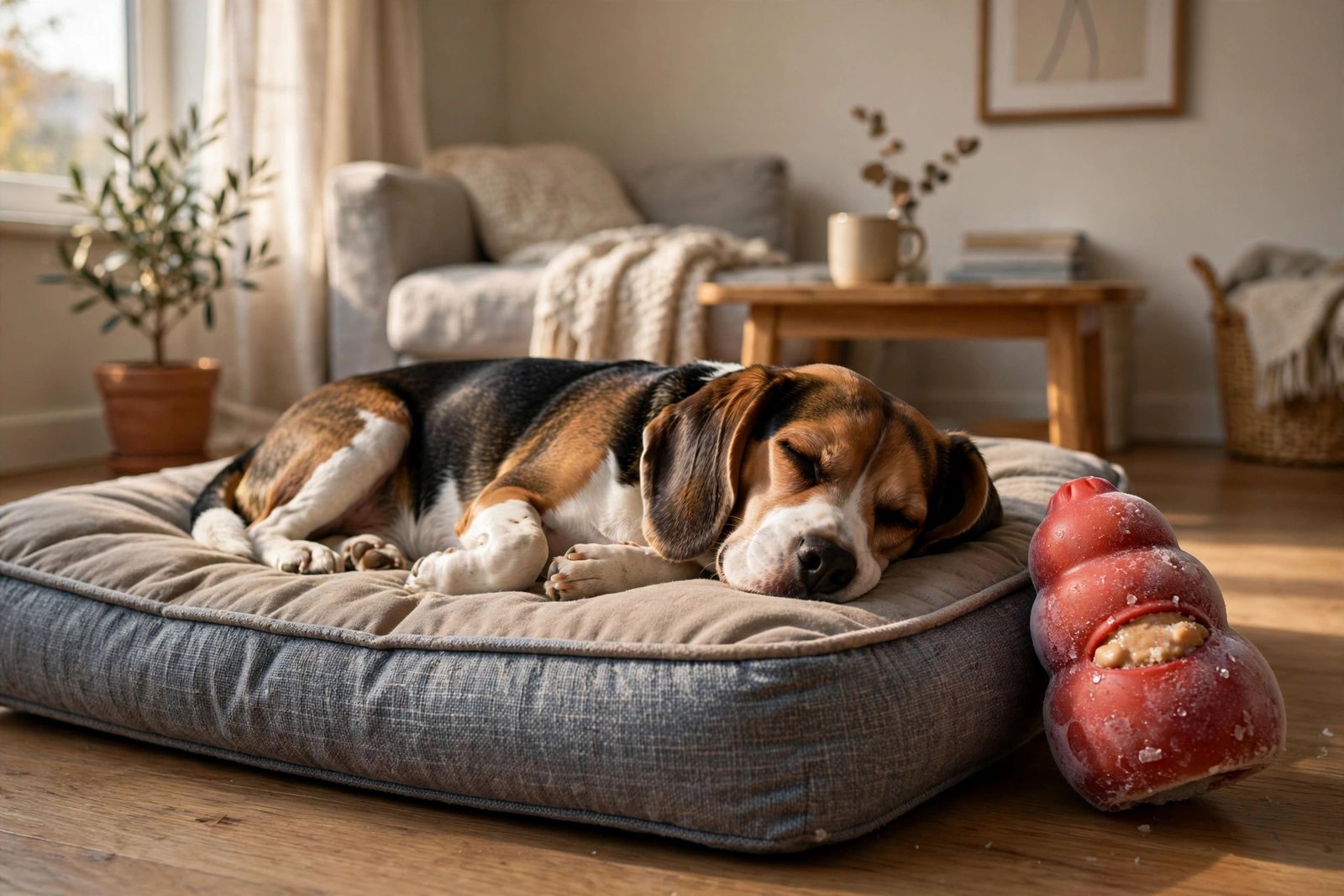
You leave for work at 8 a.m. and walk back in at 6 p.m. Your dog has been alone for ten hours, and the guilt is eating you alive — or maybe the couch cushions are, because that’s what your dog did with the ten hours. The 8-hour alone question is the defining dilemma of the Chicago working dog owner: is it fair, is it safe, and what does your dog actually experience during those long empty hours? The answer is nuanced, and it depends entirely on the dog, the setup, and what happens around those eight hours.
What 8 Hours Feels Like to a Dog
Dogs experience time differently — they live largely in the present, tracking your absence through scent decay (your smell fading on the couch) rather than clock-watching. Research on separation shows most dogs settle into rest within 30–60 minutes of the owner’s departure, assuming no separation anxiety. The middle hours are typically sleep. It’s the transitions — departure and return — that spike stress.
That said, 8 hours pushes biological limits for many dogs. The general veterinary guideline: adult dogs can hold their bladder 6–8 hours; beyond that, you’re asking for discomfort or accidents. Puppies under 6 months max out at roughly one hour per month of age. Senior dogs with weakening bladders, dogs with medical conditions, and small breeds with tiny bladders all have shorter limits. A healthy adult dog can do 8 hours occasionally; doing it five days a week for years is a different proposition.
The Honest Assessment: Can YOUR Dog Handle It?
Run this checklist honestly:
Age and health: Healthy adult (1–8 years) with no medical issues? Probably fine with the right setup. Puppy, senior, diabetic, or on diuretics? No — 8 hours is too long, full stop.
Behavior when alone: Set up a cheap camera for a week. A dog that sleeps, chews a toy, and looks out the window is coping. A dog that paces, drools excessively, destroys door frames, howls for hours, or injures themselves has separation anxiety — and leaving that dog alone for 8 hours isn’t a schedule problem, it’s a welfare problem that needs a desensitization protocol and possibly vet-prescribed medication.
Breed and energy: A mellow adult Greyhound or senior Basset Hound handles alone time far better than a young Border Collie or Husky. High-energy working breeds left alone 8 hours daily without adequate exercise develop the classic triad: destruction, barking complaints from Chicago neighbors, and escalating anxiety.
What’s around the 8 hours: This is the real variable. A dog that gets a solid morning workout, a midday break, and an engaged evening does vastly better than one whose 8 alone hours sit between a rushed 10-minute morning walk and an owner who works late. The ASPCA’s pet care resources stress that total daily enrichment matters more than any single stretch of alone time.
Making 8 Hours Work: The Setup
If your dog passes the assessment, optimize everything:
The Midday Break (Highest Impact)
A dog walker or neighbor visit at the 4-hour mark transforms the equation: 8 hours becomes two 4-hour stretches, well within every healthy adult dog’s comfort zone. In Chicago, midday dog-walking services are abundant and this single intervention resolves most alone-time problems. If budget is tight, even a trusted neighbor letting the dog out for 15 minutes helps enormously. For puppies and seniors, this isn’t optional — it’s required.
Morning Depletion
A tired dog sleeps; a wired dog destroys. A 30–45 minute morning session — brisk walk, fetch, training — before you leave is the difference between a dog that naps until noon and one that spends the morning rehearsing anxiety. Keeping an apartment dog content through long days starts with this morning investment; skip it and everything else works half as well.
The Environment
Safe confinement beats whole-house freedom for most dogs — a dog-proofed room or generously sized pen prevents both destruction and dangerous ingestion. A consistent cleaning schedule for pet households keeps that confinement zone healthy rather than grimy. Leave a frozen Kong (peanut butter + kibble, frozen overnight), a snuffle mat, and safe chews. Rotate toys so they stay novel. Leave calm background noise — talk radio or classical music masks hallway sounds that trigger barking. And in a Chicago apartment, window access is enrichment gold: a perch with a street view is dog television.
When 8 Hours Is Not Okay
Be honest about the red lines. If your dog has separation anxiety (not just boredom — true panic), 8 hours alone is inhumane without treatment; the dog experiences those hours as genuine suffering. If your work regularly stretches to 10–12 hours, the math doesn’t work for most dogs — that’s when doggy daycare 2–3 days a week or a different arrangement becomes a responsibility, not a luxury. Puppies under 6 months cannot do 8 hours, period; if your schedule can’t accommodate midday breaks for a puppy, the timing isn’t right for a puppy.
Also watch the creeping pattern: it starts as occasional long days, becomes the routine, and two years later you have an obese, anxious, under-socialized dog. The 8-hour day works only as part of a genuinely enriched life — weekends at the park, training classes, adventures. A dog whose entire existence is alone-workdays plus couch-evenings is surviving, not thriving.
Alternatives Worth Considering
Doggy daycare 2–3 days a week breaks up the week beautifully and provides socialization most owners can’t replicate — the AKC’s expert advice library has practical guides on evaluating daycare quality. A midday walker covers the bladder math. Dog-sharing with a trusted neighbor (your dog days at their place, theirs at yours) works surprisingly well. And for remote-work days, even working from home twice a week changes the weekly average dramatically. Chicago’s dog infrastructure — walkers, daycares, parks — is genuinely excellent; use it.
Conclusion
Is 8 hours alone safe for a dog? For a healthy adult dog with a midday break, morning exercise, and an enriched evening — yes, it’s one of the most common and workable arrangements in America. Without the midday break, it’s tolerable but suboptimal. For puppies, seniors, anxious dogs, or 10+ hour days — no, and no setup tricks change that. The camera doesn’t lie: check what your dog actually does all day, build the support structure the footage says they need, and judge the arrangement by your dog’s behavior, not your guilt. A sleeping, settled dog is your answer.
Frequently Asked Questions
Can I leave my dog alone for 8 hours while at work?
A healthy adult dog can handle 8 hours with proper setup, but a midday potty break at the 4-hour mark makes it dramatically better. Puppies (one hour per month of age), seniors, and dogs with separation anxiety cannot do 8 hours without a break or intervention.
How do I know if my dog has separation anxiety vs. boredom?
Film them. Bored dogs chew things and nap; anxious dogs panic — drooling, pacing, howling for hours, destroying exit points like doors, or injuring themselves. Anxiety needs a desensitization protocol and possibly medication; boredom needs exercise and enrichment.
Is doggy daycare better than leaving my dog home alone?
For social, high-energy dogs, 2–3 daycare days a week plus home days is an excellent mix. But daycare isn’t right for every dog — fearful, reactive, or senior dogs often find it overwhelming. Match the solution to the individual dog.
What should I leave for my dog during an 8-hour workday?
A frozen stuffed Kong, safe long-lasting chews, rotated toys, background noise, and window access. Confine to a dog-proofed room or pen rather than the whole house. The single highest-impact addition is a midday walker visit.


