Your brakes have started squealing at every stoplight on Michigan Avenue. Is it the $25 wear indicator saying “replace soon,” or the $800 rotor-destroying grind of metal on metal? Brakes are the one system where guessing wrong has real consequences — for your wallet and your safety. Chicago’s stop-and-go traffic, lake-effect winters, and road salt make brakes work harder here than in most cities. Here’s how to read every symptom, know exactly when replacement is due, and avoid both premature replacement and dangerous delay.
How Brakes Wear: The Basics
Disc brakes (on most modern cars) work by squeezing pads against rotors. Pads are the sacrificial part — designed to wear down over 25,000–70,000 miles depending on driving style, vehicle weight, and conditions. Rotors wear slower but eventually thin, warp, or score. Chicago’s reality: frequent stop-and-go, heavy salt exposure (corroding components), and temperature swings shorten brake life versus highway cruising in mild climates. Aggressive drivers can halve pad life; gentle drivers can double it.
Symptom 1: Squealing or Squeaking
A high-pitched squeal when braking is often the built-in wear indicator — a small metal tab engineered to contact the rotor when pads reach minimum thickness, producing an unmistakable warning sound. It’s the brakes telling you they’re due. However, squealing can also come from glazed pads, morning moisture (harmless — disappears after a few stops), or cheap aftermarket pads. Rule: consistent squeal that persists after warm-up = inspect within days. Intermittent morning squeak that vanishes = monitor.
Symptom 2: Grinding
Grinding — a harsh metal-on-metal growl — means the pads are completely worn and the backing plate is chewing your rotors. This is urgent: every mile driven grinds the rotors thinner, turning a $250–$400 pad replacement into a $500–$800 pad-plus-rotor job. If you hear grinding, minimize driving and get to a shop immediately. There’s no “a little grinding is fine” — it’s the most expensive sound your brakes make.
Symptom 3: Vibration or Pulsation
A pulsing brake pedal or vibrating steering wheel during braking usually indicates warped rotors (technically, uneven rotor thickness from heat cycling). Chicago’s cycle of hard stops and cold water/salt exposure promotes warping. Minor pulsation means resurfacing or replacement is due soon; severe shaking means soon is now. Note: vibration while driving (not braking) points to wheel balance or alignment instead.
Symptom 4: Longer Stopping Distances
If you’re pressing harder than usual to achieve the same stop, or the pedal feels like it travels further, your pads are thin or there’s a hydraulic issue. This is a safety-critical symptom — braking performance degrades gradually enough that drivers unconsciously compensate until it’s dangerous. Trust the change, not your adaptation to it.
Symptom 5: The Car Pulls When Braking
Pulling to one side under braking suggests a sticking caliper, collapsed brake hose, or uneven pad wear. A stuck caliper also causes one wheel’s pads to wear dramatically faster and can overheat the rotor — you’ll sometimes smell it. This needs prompt professional diagnosis; it’s beyond DIY for most owners.
Symptom 6: Warning Lights
The brake warning light (often (!) in a circle) can mean worn pads (on cars with pad sensors), low brake fluid, or parking brake engagement. Check the parking brake first (we’ve all done it), then fluid level, then get an inspection. ABS light plus brake light together means get to a shop immediately — you’ve potentially lost anti-lock function.
How to Visually Check Pad Thickness Yourself
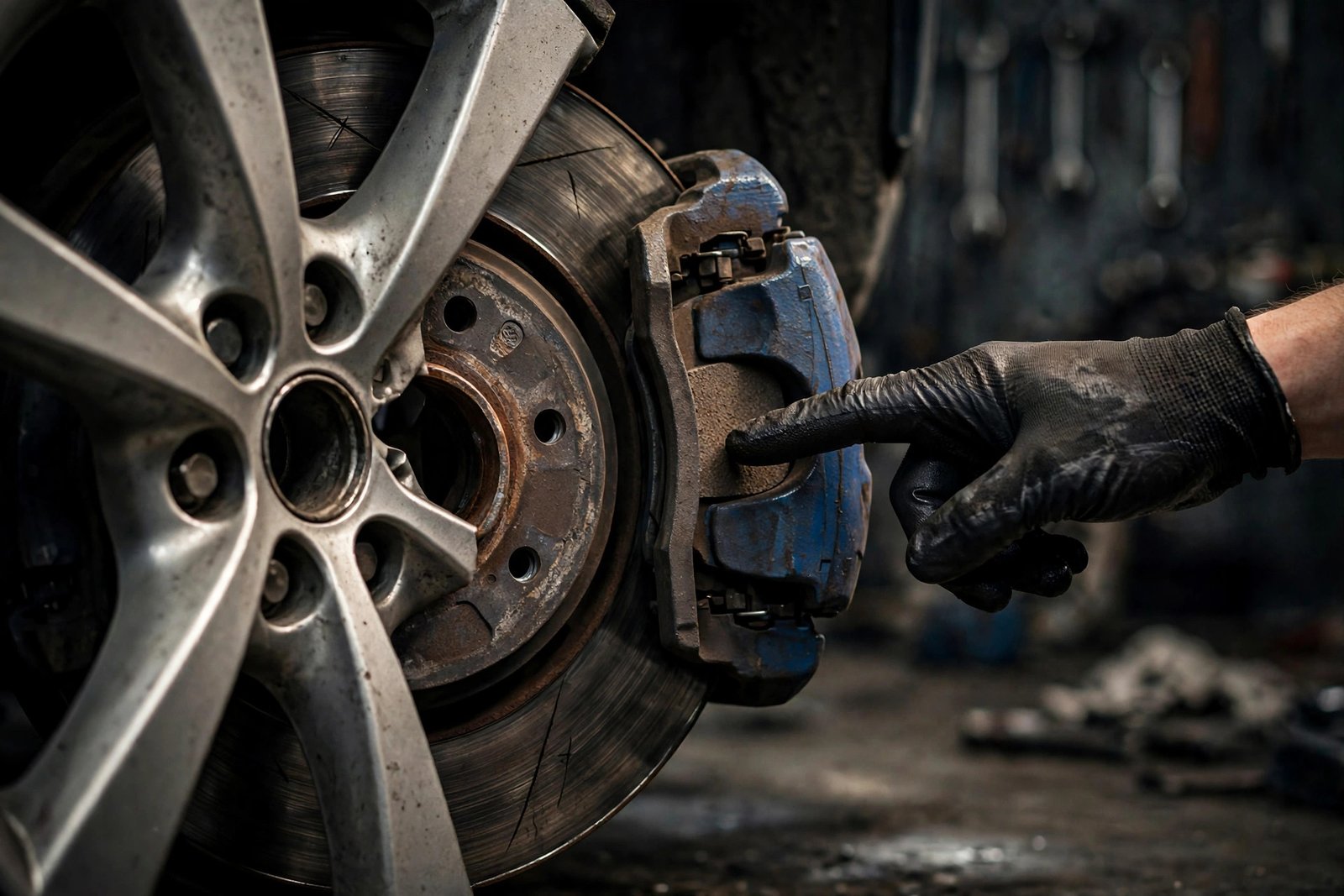
You don’t need a lift. Through most alloy wheel spokes, you can see the brake caliper and the pad’s friction material pressed against the rotor. New pads show ~12mm of material; replacement is due at 3–4mm (about the thickness of two stacked quarters is getting close; one quarter is urgent). Many shops offer free brake inspections — take them up on it, but get a second opinion before authorizing big work. Diagnosing wear versus damage is the same judgment call as deciding whether a roof needs replacing or repair: measure, don’t guess.
What Replacement Costs in Chicago
- Pads only (per axle): $150–$300 at an independent shop; $250–$450 at a dealer.
- Pads + rotors (per axle): $300–$600 independent; $500–$900 dealer.
- Full four-wheel brake job: $600–$1,200 independent; $1,000–$1,800+ dealer.
Always replace pads in axle pairs (both fronts or both rears) — never one side. Resurfacing rotors ($30–$60 each) makes sense only if they have enough thickness remaining; many modern rotors are too thin to resurface safely, making replacement the honest recommendation. Get the old parts back or ask to see them — reputable shops show you the worn components. Keep receipts organized with your other car records in an organized garage workspace.
Extending Brake Life
Coast to decelerate instead of late braking; maintain following distance to avoid hard stops; downshift on long descents; remove unnecessary weight; and flush brake fluid every 2–3 years (moisture-contaminated fluid corrodes calipers from inside — Chicago humidity accelerates this). These habits easily add 15,000–25,000 miles to pad life.
Chicago Road Salt vs. Your Brakes
Chicago’s winter road salt is brutal on brake components beyond the pads: caliper slide pins corrode and seize (causing uneven pad wear and pulling), rotors develop heavy surface rust that pits if the car sits, and brake lines themselves corrode — a genuine safety issue on older vehicles. Countermeasures: wash the undercarriage regularly in winter (including the wheel wells where salt cakes onto calipers), don’t let the car sit for weeks without driving (movement keeps calipers exercised and rotors clean), and have brake lines inspected annually on cars over 8 years old — a rusted line bursting under hard braking is catastrophic. The NHTSA has investigated brake-line corrosion failures in salt-belt states; AAA recommends the same annual underbody inspections. Your brakes fight Chicago winters on two fronts — friction wear and chemical attack. Maintain for both.
Conclusion
Your car needs new brakes when you hear persistent squealing (wear indicators), any grinding (urgent), feel pulsation, notice longer stops, see sub-4mm pads, or get a brake warning light. In Chicago’s harsh braking environment, inspect annually and don’t nurse grinding brakes — every mile multiplies the repair bill. Brakes are the wrong place to economize on timing, but the right place to economize on shopping: independent shops do excellent brake work for 30–40 percent less than dealers. Listen to the squeal, respect the grind, and stop — reliably — for years.
Frequently Asked Questions
How long do brake pads last?
Typically 25,000–70,000 miles depending on driving style, vehicle weight, and conditions. Chicago stop-and-go traffic and road salt push toward the shorter end; gentle highway drivers see the longer end.
Can I drive with grinding brakes?
Only to the nearest shop. Grinding means pads are gone and metal is destroying your rotors — every mile adds cost and reduces braking effectiveness. It’s genuinely unsafe beyond short, careful trips.
How much does a brake job cost in Chicago?
$150–$300 per axle for pads at independents ($250–$450 dealers); $300–$600 per axle for pads plus rotors. Full four-wheel jobs run $600–$1,200 at independent shops.
Should I replace rotors with pads?
Inspect them: replace if below minimum thickness, deeply scored, or warped. Many modern rotors can’t be resurfaced safely due to thin design — in those cases replacement with pads is the correct call, not upselling.
Why do my brakes squeak in the morning?
Light surface rust forms on rotors overnight (especially in humid Chicago air); the first few stops scrape it off, causing brief squeaking. If it persists past warm-up, it’s wear indicators or glazed pads — get them checked.