It’s 2 a.m. Your new puppy has been crying in the crate for 40 minutes, and you’re lying awake torn between two terrible options: let him “cry it out” (and feel like a monster while the neighbors hate you) or let him out (and teach him that crying works). Every Chicago puppy owner in an apartment has lived this exact night. The good news: crate crying is fixable, usually within a week, with methods backed by veterinary behaviorists. The bad news: most owners accidentally make it worse first. Here’s the science-based playbook.
Why Puppies Cry in the Crate: It’s Not Defiance
Your puppy isn’t manipulating you — he’s a baby animal experiencing genuine distress. At 8–12 weeks, puppies have spent every night of their life sleeping piled with littermates and their mother. The crate is isolation, darkness, and unfamiliar smells. Crying is a biologically programmed distress call: in the wild, a separated puppy who doesn’t vocalize dies. Understanding this reframes the problem: you’re not fighting bad behavior, you’re teaching a baby that the crate is safe. That takes patience, not punishment.
Common crying triggers: loneliness/isolation distress (the big one), needing to potty (young puppies physically can’t hold it long — see the schedule below), excess energy (a wired puppy can’t settle), discomfort (too hot/cold, needs water, crate too big/small), and learned behavior (previous nights taught him crying = release).
Rule Out Physical Needs First: The Potty Math
Before any training, respect biology. A puppy can hold their bladder roughly one hour per month of age, plus one — an 8-week-old manages ~3 hours max; a 12-week-old ~4 hours. If your puppy cries at 1 a.m. and last pottied at 10 p.m., he probably genuinely needs to go. The protocol: carry (don’t walk — walking wakes them fully) to the potty spot, boring 3-minute potty break (no play, minimal talking), straight back to the crate. No drama, no punishment for accidents, no 20-minute play session that teaches “crying = party.”
The Training Protocol: Days 1–7
Daytime: Make the crate amazing
Crate training happens during the day, not at 2 a.m. Feed every meal in the crate (door open). Toss high-value treats in randomly for discovery. Play crate games: treat in, puppy goes in, treat, puppy comes out — building the association “crate = good things.” Never use the crate for punishment, ever — it must remain the safe den. Size matters: just enough to stand, turn, and lie down. Too big, and the puppy potties in one corner and sleeps in the other (use the divider panel). Too small is cruel.
Nighttime: Proximity and patience
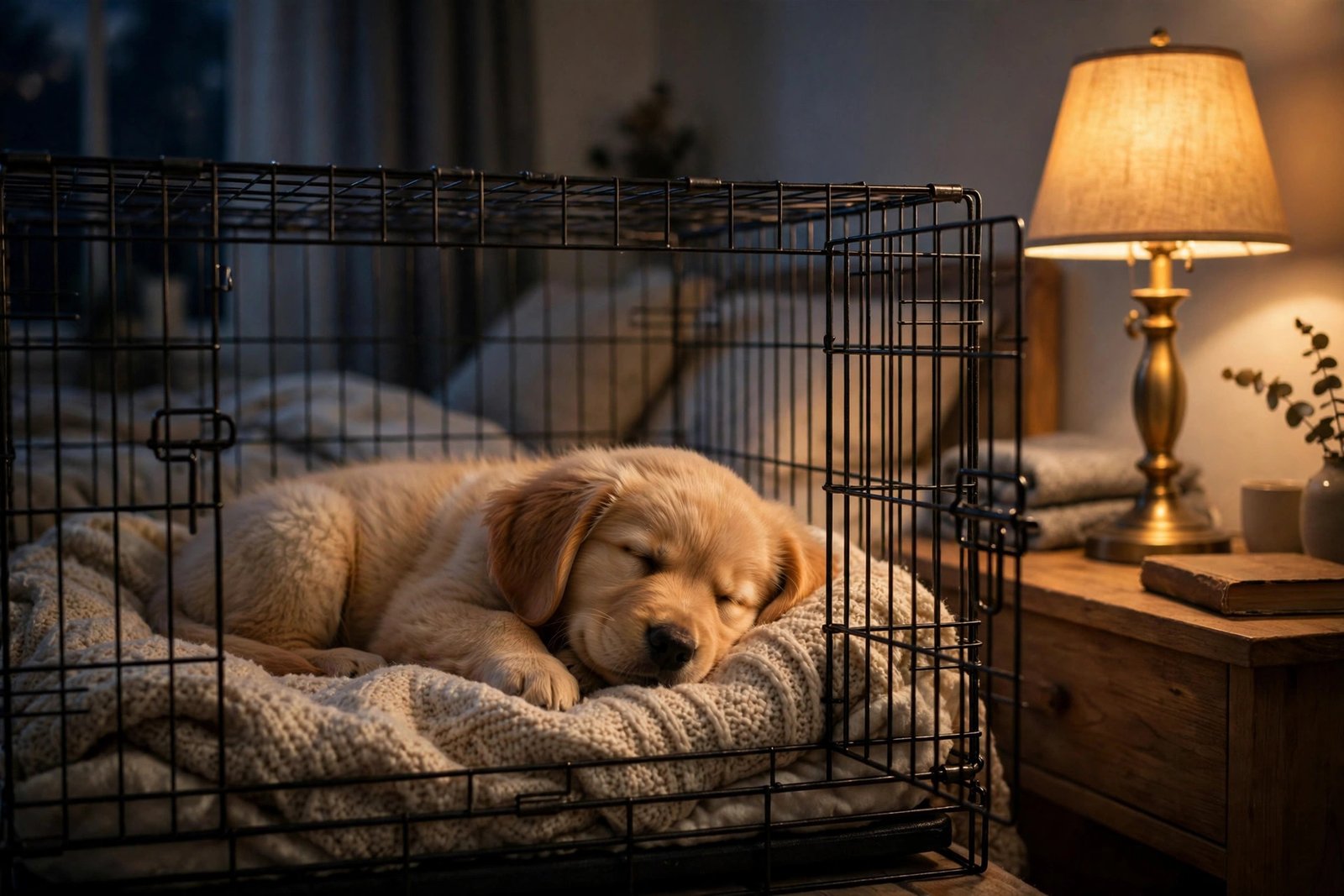
Nights 1–3: Put the crate next to your bed. Your presence, scent, and the ability to dangle fingers through the bars dramatically reduces isolation panic. This isn’t spoiling — it’s scaffolding. Cover three sides with a blanket (den-like, draft-free) leaving the front ventilated.
When crying starts: Wait 3–5 minutes first — many puppies fuss briefly then settle, and intervening too fast teaches that 30 seconds of crying works. If crying escalates past 5 minutes, check needs (potty? water? too hot?), address minimally, and resettle. A calm “shhh” and fingers through the bars often suffices. Avoid full wake-ups, bright lights, and play.
Nights 4–7: Gradually move the crate further from the bed — a few feet per night toward its permanent spot. Most puppies adapt within a week when the transition is gradual.
The settle routine
Dogs learn through patterns. Build a 15-minute pre-crate routine: final potty break, brief calm play or chew, then crate with a special “crate-only” treat (a frozen Kong stuffed with peanut butter is the gold standard — it takes 20+ minutes to finish and creates powerful positive association). Same order, same time, every night. Predictability is calming.
What NOT to Do
- Don’t punish crying. Yelling, banging the crate, or spray bottles increase anxiety — the opposite of what settles a puppy. Fear and sleep don’t mix.
- Don’t do prolonged “cry it out.” Brief fussing (under 5 minutes) is fine to wait through; extended distress flooding (30+ minutes of panic) can create lasting crate aversion and separation anxiety. There’s a difference between protest and panic — learn it.
- Don’t exercise right before bed. A wild play session at 10 p.m. creates an overtired, wired puppy. Last vigorous play should end 1–2 hours before bedtime, followed by calm wind-down.
- Don’t give up on night 2. Most owners quit the protocol just before it works. Nights 2–3 are typically the worst; improvement usually starts night 4–5.
Chicago Apartment Realities
Thin walls and noise-sensitive neighbors add pressure. Mitigate: warn neighbors in advance (“new puppy, training in progress, should resolve within a week” — most people are understanding when warned), use white noise machines (helps puppy and neighbors), and consider a Snuggle Puppy (the heartbeat toy — genuinely effective for young puppies). If crying persists beyond 10–14 days of consistent protocol, consult your vet — persistent distress can signal medical issues (UTIs cause frequent nighttime waking) or developing separation anxiety needing professional guidance. The ASPCA’s behavior resources offer excellent supplementary guidance.
When to Worry: Crying vs. Clinical Distress
Normal protest: whining/barking that de-escalates within 5–15 minutes, puppy settles and sleeps. Concerning: drooling excessively, panting heavily, trying to escape frantically (bent crate bars, bloody paws/nose), or crying that never de-escalates across multiple nights. The latter warrants veterinary behaviorist consultation — true separation anxiety is a medical condition, not a training failure. Don’t wait months hoping it resolves.
Broader puppy-raising success also depends on daytime wellbeing — keeping a small dog happy in an apartment covers the enrichment and routine that make nighttime settling dramatically easier. A fulfilled puppy sleeps; a bored one cries.
Crate Training Supplies: What You Actually Need
The right gear makes crate training dramatically easier. Essentials: a properly sized wire crate with a divider panel (buy for the adult size, divide for the puppy), a washable crate pad or old blankets (skip expensive beds until housetraining is reliable), a frozen-Kong supply (the gold-standard crate treat), a white noise machine (masks household sounds and helps neighbors), and enzymatic cleaner for the inevitable accidents — regular cleaners leave scents that invite repeat offenses. Optional but valuable: a Snuggle Puppy heartbeat toy for the first weeks, and a crate cover for den-like darkness. The American Kennel Club’s puppy resources offer excellent supply checklists. And remember that daytime routine drives nighttime success: puppies who get proper exercise, training, and companionship during the day — the fundamentals of keeping a pet household running smoothly — settle faster at night. Tired, fulfilled puppies sleep; under-stimulated ones rehearse their opera skills at 2 a.m.
Conclusion
Stop the 2 a.m. crying with: daytime crate-positive training (meals and Kongs in the crate), the crate beside your bed for the first nights, a 3–5 minute wait before intervening, boring middle-of-the-night potty breaks, gradual distance increases, and a consistent settle routine. Never punish, never flood with prolonged cry-it-out, and respect the bladder math. Most puppies sleep through the night within 7–10 days of consistent protocol. You’re not choosing between your sleep and your puppy’s wellbeing — the right method delivers both.
Frequently Asked Questions
How long will my puppy cry in the crate at night?
With consistent training, most puppies reduce crying significantly within 4–7 nights and sleep through within 7–14 nights. Persistent crying beyond 2 weeks of proper protocol warrants a vet check for medical or anxiety issues.
Should I let my puppy cry it out in the crate?
Brief fussing (under 5 minutes) can be waited out — many puppies self-settle. But prolonged panicked crying (30+ minutes) should not be ignored; it risks creating crate aversion and separation anxiety. Intervene calmly, check needs, and resettle.
Where should the puppy crate be at night?
Next to your bed for the first several nights, then gradually moved to its permanent location over a week. Proximity reduces isolation distress dramatically in the critical early nights.
How often does a puppy need to potty at night?
Follow the formula: one hour per month of age plus one. An 8-week-old needs a break every ~3 hours; a 16-week-old every ~5 hours. Always offer a boring potty break before assuming crying is behavioral.
What if my puppy cries for hours despite training?
See your veterinarian to rule out medical causes (UTIs, pain, parasites), then consult a certified veterinary behaviorist if it’s behavioral. True separation anxiety is a medical condition requiring professional treatment, not tougher training.