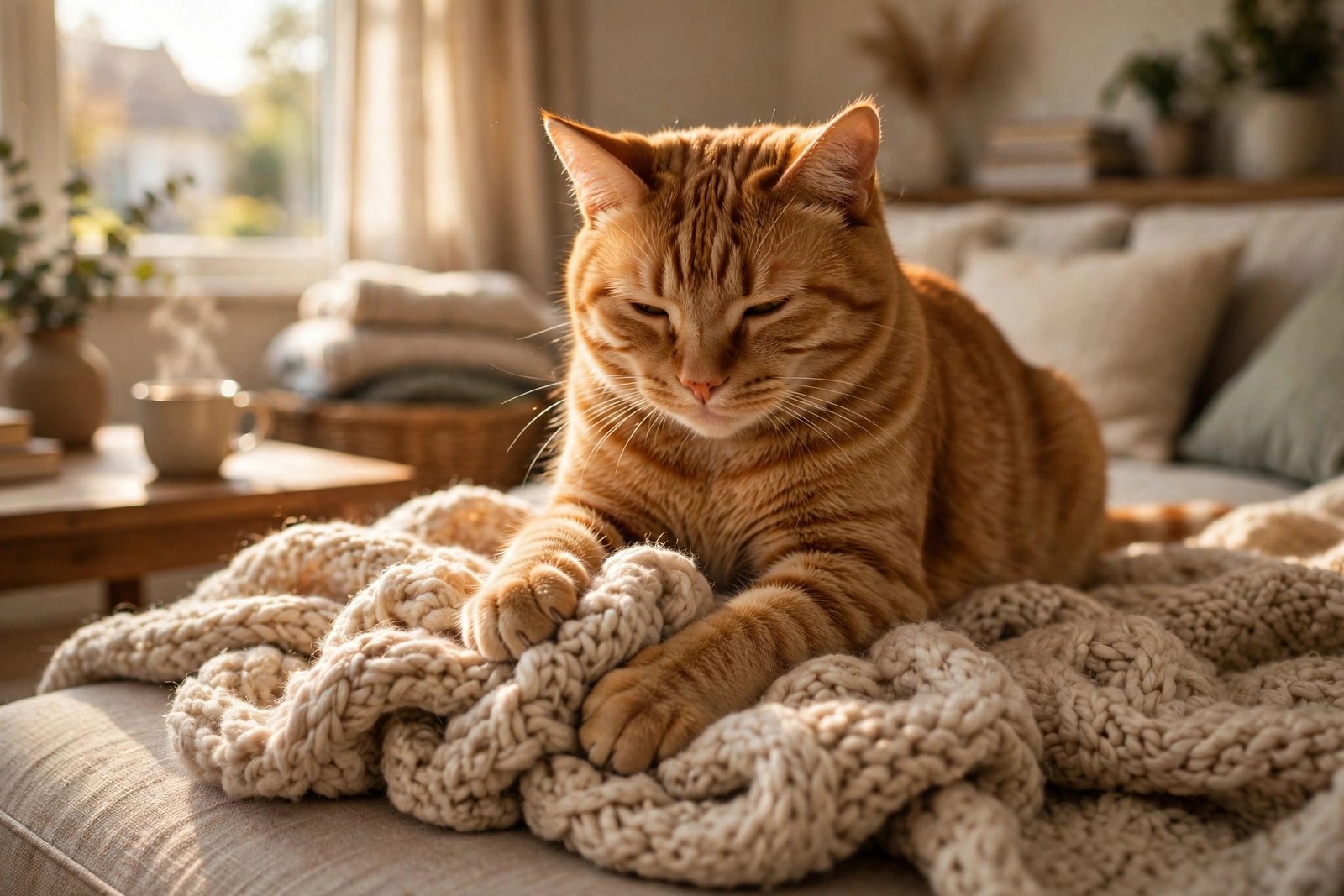
Your cat is perched on your lap, rhythmically pushing her paws into the blanket — left, right, left, right — while purring like a tiny motorboat. It’s adorable, slightly weird, and universal: nearly every cat owner has wondered why cats knead blankets (and laps, and pillows) while purring loudly. The behavior, sometimes called “making biscuits,” is one of the most endearing mysteries of cat ownership — except it’s not really a mystery. Science has solid answers, and they’re sweeter than you’d expect.
The Nursing Instinct: Where Kneading Begins
The primary explanation is beautifully simple: kneading is a neonatal behavior that never fully disappears. Newborn kittens knead their mother’s belly to stimulate milk flow while nursing — the rhythmic pushing triggers milk letdown. The behavior is wired into the brain during the first weeks of life, paired with the ultimate comfort experience: warmth, food, and maternal presence.
Adult cats who knead while purring are essentially revisiting that earliest comfort. The purring is the giveaway — cats purr when content (among other states), and the knead-purr combination signals a cat experiencing deep, nursing-associated contentment. Your lap has become, in your cat’s emotional world, the safe warm place. It’s a compliment of the highest order. This is also why introducing a new cat properly matters so much — a cat who feels safe enough to knead is a cat who has truly settled in.
The Scent-Marking Theory: Kneading as Communication
Cats have scent glands in their paw pads. When they knead, they’re depositing their scent onto the surface — marking it as theirs. In the wild, ancestral cats kneaded tall grass to create a sleeping nest, simultaneously flattening the area and marking it. Your cat kneading your favorite blanket is, in part, claiming it: “this human, this blanket, this spot — mine.”
This also explains why cats often knead their owner’s lap specifically before settling down for a nap. They’re preparing the nest and marking their person in one ritual. Multi-cat households may notice competitive kneading — each cat over-marking the same prime blanket. It’s territorial, but the affectionate kind.
Stretching and Physical Comfort
There’s a biomechanical component too: kneading stretches the muscles in the paws, legs, and shoulders. Cats often knead after naps — the feline equivalent of your morning stretch. The rhythmic motion increases blood flow to the paws and feels physically good, which is why the behavior is self-reinforcing even without emotional content. Older cats with arthritis may knead less (it hurts) or more gently — a change in kneading patterns can actually be an early indicator of paw or joint pain worth mentioning to your vet.
Why the Loud Purring Accompanies It
Purring during kneading isn’t coincidental — it’s part of the package. Cats purr at 25–150 Hz, frequencies associated in research with bone and tissue healing (some researchers theorize purring is self-therapeutic). During kneading, purring signals the contentment state that triggers the behavior. The combination — rhythmic kneading plus resonant purring — is essentially a cat’s meditation: self-soothing through repetitive motion and vibration. Cats also purr when stressed or in pain (self-comfort), so context matters: kneading + purring + relaxed body (soft eyes, loose posture) = happiness. Kneading + tension would be unusual and worth noting.
Why Some Cats Knead More Than Others
- Early weaning: Cats weaned very young tend to knead more intensely — some behaviorists link prolonged kneading (with suckling on blankets) to early maternal separation. It’s not a disorder; it’s a coping style.
- Breed tendencies: Siamese, Burmese, and other “dog-like” affectionate breeds are enthusiastic kneaders. It’s personality as much as biology.
- Individual comfort: Some cats are just kneaders; others rarely do it. Neither is abnormal. A cat who never kneads isn’t unhappy — they self-soothe differently.
- Stress kneading: Cats may knead more during household changes (moves, new pets, new schedules) as self-comfort. An increase paired with other stress signs (hiding, appetite changes) deserves attention; kneading alone is fine.
Managing the Claws: Kneading Without Pain
The one downside: kneading with unsheathed claws on bare skin hurts. Solutions that respect the behavior:
- Keep claws trimmed. Regular trimming (every 2–3 weeks) dulls the daggers without stopping the kneading. It’s the single best fix.
- Place a thick blanket on your lap preemptively when the kneading starts. Most cats happily transfer to the blanket.
- Never punish kneading. Scolding or pushing the cat away punishes an affection behavior — it damages trust without teaching anything. Redirect, don’t reprimand.
- Soft paws (nail caps) are an option for persistent lap-kneaders, applied every 4–6 weeks.
Think of it from the cat’s perspective: she’s showing you her deepest contentment, and you’re her chosen safe place. A blanket barrier preserves the ritual painlessly. For broader feline happiness, understanding what cats need to thrive helps you read all their behaviors — kneading included — in context.
When Kneading Might Signal a Problem
Kneading is almost always benign, but consult your vet if: a cat who never kneaded suddenly starts obsessively (compulsive behavior can follow stress or neurological issues), kneading is accompanied by drooling excessively or suckling nonstop (possible anxiety or early-weaning issues needing management), or kneading stops abruptly in an enthusiastic kneader (could indicate paw/joint pain). These are exceptions — the vast majority of kneading is pure contentment.
Decoding Other Common Cat Behaviors
Kneading is just one entry in the feline body-language dictionary. Slow blinking at you signals trust and affection (try slow-blinking back — cats often reciprocate). Head-butting (bunting) deposits facial pheromones, marking you as safe territory. The upright tail with a slight quiver means genuine happiness to see you. And that 3 a.m. sprint around the house? Normal crepuscular energy — cats are wired to hunt at dawn and dusk. Understanding these signals transforms the human-cat relationship from coexistence to genuine communication. The Cornell University College of Veterinary Medicine’s feline behavior resources offer science-based explanations, and the ASPCA’s cat care guides cover everything from enrichment to health. The more fluently you read your cat, the earlier you spot the subtle behavior changes that signal health issues — attentive observation is the best preventive medicine.
Conclusion
Cats knead blankets and purr loudly because the behavior is a leftover nursing instinct wired to their earliest comfort, reinforced by scent-marking, physical pleasure, and self-soothing. It’s one of the clearest signals a cat can give that they feel safe, content, and bonded to you. Manage the claws with trimming and lap blankets, never punish it, and accept the rhythmic paw-pressing for what it is: your cat telling you, in their oldest language, that you’re home.
Frequently Asked Questions
Why do cats knead with their paws?
It’s a neonatal nursing behavior — kittens knead their mother’s belly to stimulate milk flow. Adult cats retain it as a comfort behavior, often combined with purring, scent-marking through paw glands, and physical stretching.
Does kneading mean my cat is happy?
Almost always yes — kneading with purring, relaxed body language, and soft eyes signals deep contentment. It’s one of the strongest affection indicators in cat behavior.
Why does my cat knead me specifically?
You’re their safe place. Kneading on a person combines the nursing-comfort association with scent-marking (“you’re mine”) and nest-preparation before settling. It’s a profound compliment.
How do I stop my cat’s kneading from hurting?
Trim claws every 2–3 weeks, place a thick blanket on your lap when kneading starts, and never punish the behavior. Nail caps are an option for persistent cases. Redirect, don’t reprimand.
Is it normal if my cat never kneads?
Completely normal. Kneading frequency varies by individual, breed, and early life experience. A non-kneading cat isn’t unhappy — they simply self-soothe in other ways.