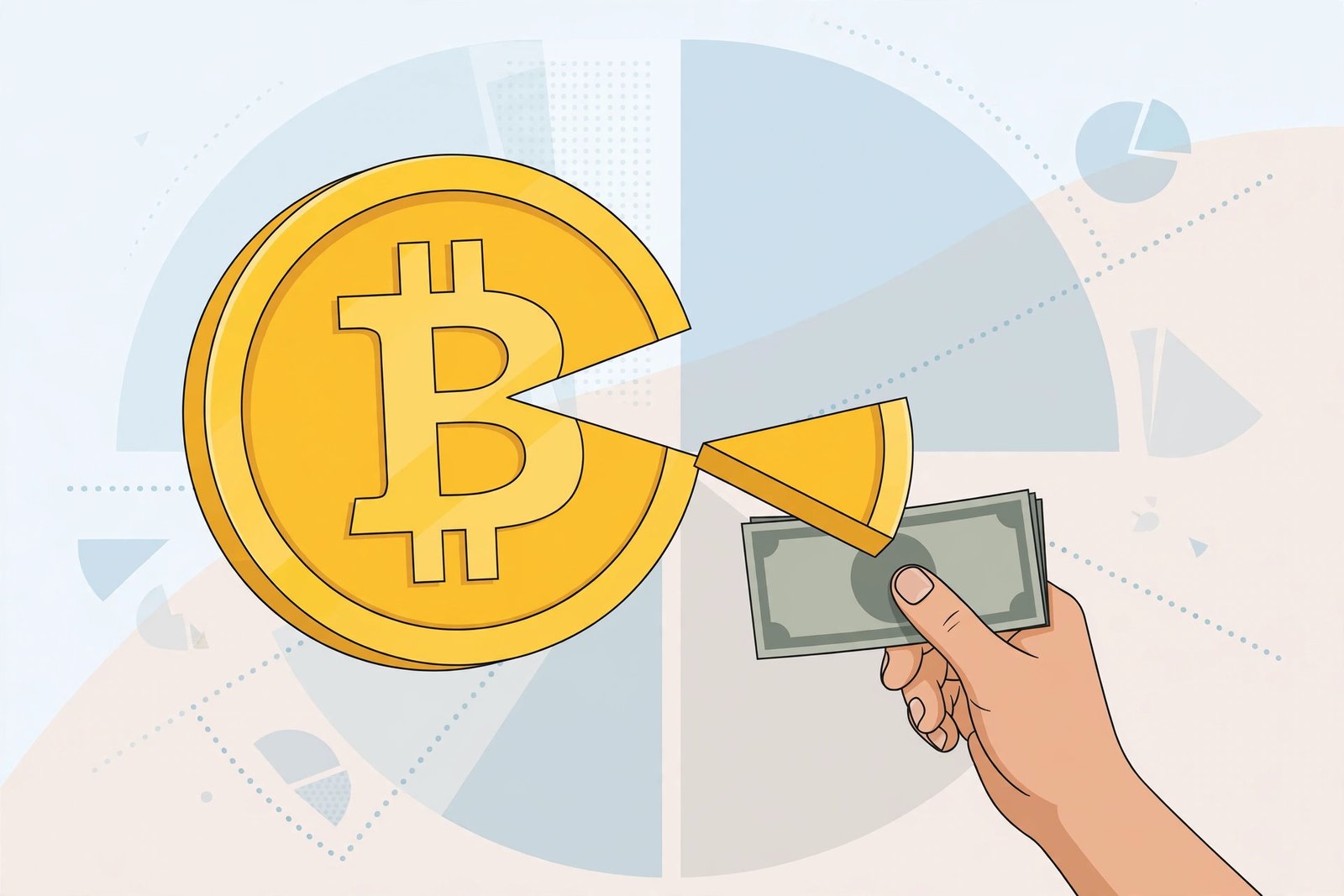
Fifty dollars won’t buy you a Bitcoin — but it was never supposed to. Bitcoin is divisible to eight decimal places, meaning your $50 buys you roughly 50 millionths of a coin (about 5,000 satoshis, the smallest unit, named for Bitcoin’s pseudonymous creator). The idea that you need to buy “a whole Bitcoin” is the most persistent myth in crypto, and it keeps Chicago beginners standing on the sidelines while telling themselves they’re priced out.
Here’s the full picture: how fractional Bitcoin works, where to buy small amounts without fees eating you alive, and why starting with $50 might be the smartest move you make.
Yes — Bitcoin Was Designed for This
Bitcoin’s divisibility isn’t a hack; it’s foundational. One Bitcoin equals 100,000,000 satoshis (“sats”), just as one dollar equals 100 cents — except with six more decimal places. When you buy $50 of Bitcoin on any major exchange, you’re buying ~0.0005 BTC, recorded to the satoshi in your account. There’s nothing second-class about it: your fraction appreciates at exactly the same percentage rate as a whole coin. If Bitcoin doubles, your $50 becomes $100, whether you own 0.0005 BTC or 5 BTC.
This is why Bitcoin’s per-coin price is psychologically misleading. New investors see “$100,000 per Bitcoin” and feel priced out, while happily buying fractional shares of expensive stocks through apps like Robinhood. It’s the same concept — and the percentage math is identical. What matters is how much you invest and how the asset performs, never how many whole units you own.
Where to Buy $50 of Bitcoin in Chicago
Nearly every on-ramp supports small purchases, but fees matter enormously at this size — a $3 fee on $50 is 6%, gone before you start. Ranked for small buyers: Strike and Cash App offer some of the lowest fees on small Bitcoin buys (often under 1%), making them ideal for $50 starters. Kraken’s standard interface runs ~0.25% — excellent, though the interface assumes slight familiarity. Coinbase’s simple buy interface is the easiest but priciest for small amounts (spread plus fee can exceed 3% on $50) — fine for learning, worth graduating from.
Avoid Bitcoin ATMs for $50 buys: 8–15% fees turn your fifty into forty-three before you’ve begun. And skip platforms with minimum purchase requirements above your budget or withdrawal minimums that trap small balances — always check: can I withdraw my $50 (plus gains) without a $25 minimum-withdrawal fee eating half of it? Also confirm the platform actually serves Illinois without restrictions; most majors do, but smaller apps sometimes geofence features. The CFPB’s virtual currency guidance is a useful pre-purchase read on fee transparency rights.
Why $50 Is Actually the Perfect Starting Amount
Small starting amounts have underrated advantages. First, tuition: you’ll learn wallets, addresses, fees, and volatility with $50 at risk instead of $5,000 — every beginner mistake is 100x cheaper. Second, psychology: $50 lets you experience a 30% drawdown ($15) without panic, building the emotional calluses that larger positions require. Third, habit: a $50 weekly buy is $2,600 a year — real money, built painlessly — and it teaches the dollar-cost averaging discipline that outperforms most active strategies.
The key is treating the $50 as education money with upside, not as a lottery ticket. You’re not trying to turn $50 into $50,000 (you won’t); you’re buying a hands-on education in the asset class plus a small stake in its future. That framing prevents both reckless YOLO-ing and paralyzing over-research. And fund it from real spare cash — our guide to the 50/30/20 budgeting rule shows where a weekly $50 investing slice comes from. If finding the $50 is the hard part, small spending leaks are usually the answer — see how to save money on groceries without couponing for painless ways to free up exactly this kind of cash.
What $50 Actually Becomes: Honest Math
Let’s kill the fantasy and honor the reality. If Bitcoin averages 30% annual growth for a decade (optimistic but historically plausible), your $50 becomes roughly $690 — a fantastic return that won’t change your life. If it averages 10%, you get $130. If it crashes 80% and never recovers, you get $10. None of these outcomes matter much in absolute dollars, and that’s the point: the $50 was never about the $50.
What does change lives is the habit the $50 starts. A beginner who puts in $50 weekly for five years at historical average returns builds a five-figure position from $13,000 of contributions — real money, earned through discipline rather than timing. Every long-term crypto success story you’ve heard started with an amount that felt embarrassingly small. The embarrassment fades; the compounding doesn’t. Start with what you have, automate the habit, and let time do what timing can’t.
Growing From $50: The Sensible Path
Once you’re comfortable, the natural next step is recurring buys — $25 or $50 weekly on autopilot. Resist the urge to “go bigger” after your first green week; euphoria is when beginners make their worst sizing decisions. A good rule: increase your recurring amount only after surviving your first 20%+ drawdown without panic-selling or losing sleep. That drawdown is your graduation exam, and it’s free.
As your stack grows past a few hundred dollars, level up your security proportionally: enable two-factor authentication everywhere, consider moving holdings off the buying app into a wallet you control, and learn about seed-phrase backup before you need it. The Investor.gov crypto guide covers the investor-protection basics every small buyer should know. Small beginnings deserve the same security seriousness as large ones — habits formed at $50 protect you at $50,000.
Conclusion
You absolutely can buy fractional Bitcoin with $50 in Chicago — Bitcoin was engineered for exactly this, down to the satoshi. Use a low-fee app like Strike or Cash App, treat the purchase as education with upside, automate small recurring buys, and let the habit compound. Nobody’s first $50 made them rich; but thousands of Chicagoans’ first $50 taught them the discipline, mechanics, and emotional control that eventually did. The whole coin was never the point. Starting was — and starting small is starting smart.
Frequently Asked Questions
Can I buy fractional Bitcoin with just $50?
Yes — Bitcoin divides into 100 million satoshis, so $50 buys a fraction (about 0.0005 BTC at $100K/BTC). Your fraction gains value at the same percentage rate as whole coins.
What is a satoshi?
The smallest unit of Bitcoin: 0.00000001 BTC, or one hundred-millionth of a coin. Named after Bitcoin’s creator, Satoshi Nakamoto. All Bitcoin transactions ultimately settle in satoshis.
Where’s the cheapest place to buy $50 of Bitcoin?
Strike and Cash App typically offer the lowest fees on small buys (often under 1%). Kraken is cheapest among full exchanges (~0.25%). Avoid Bitcoin ATMs (8–15% fees) for small purchases.
Is $50 enough to start investing in Bitcoin?
For learning, absolutely — it’s the ideal tuition-sized stake. For wealth building, $50 alone won’t move the needle, but $50 weekly ($2,600/year) invested consistently becomes meaningful over time.
Do I pay taxes on a $50 Bitcoin purchase?
The purchase itself isn’t taxed, but selling later (even a fraction) triggers capital-gains reporting. Keep records from your first buy — the IRS treats every sale as a taxable property disposition.