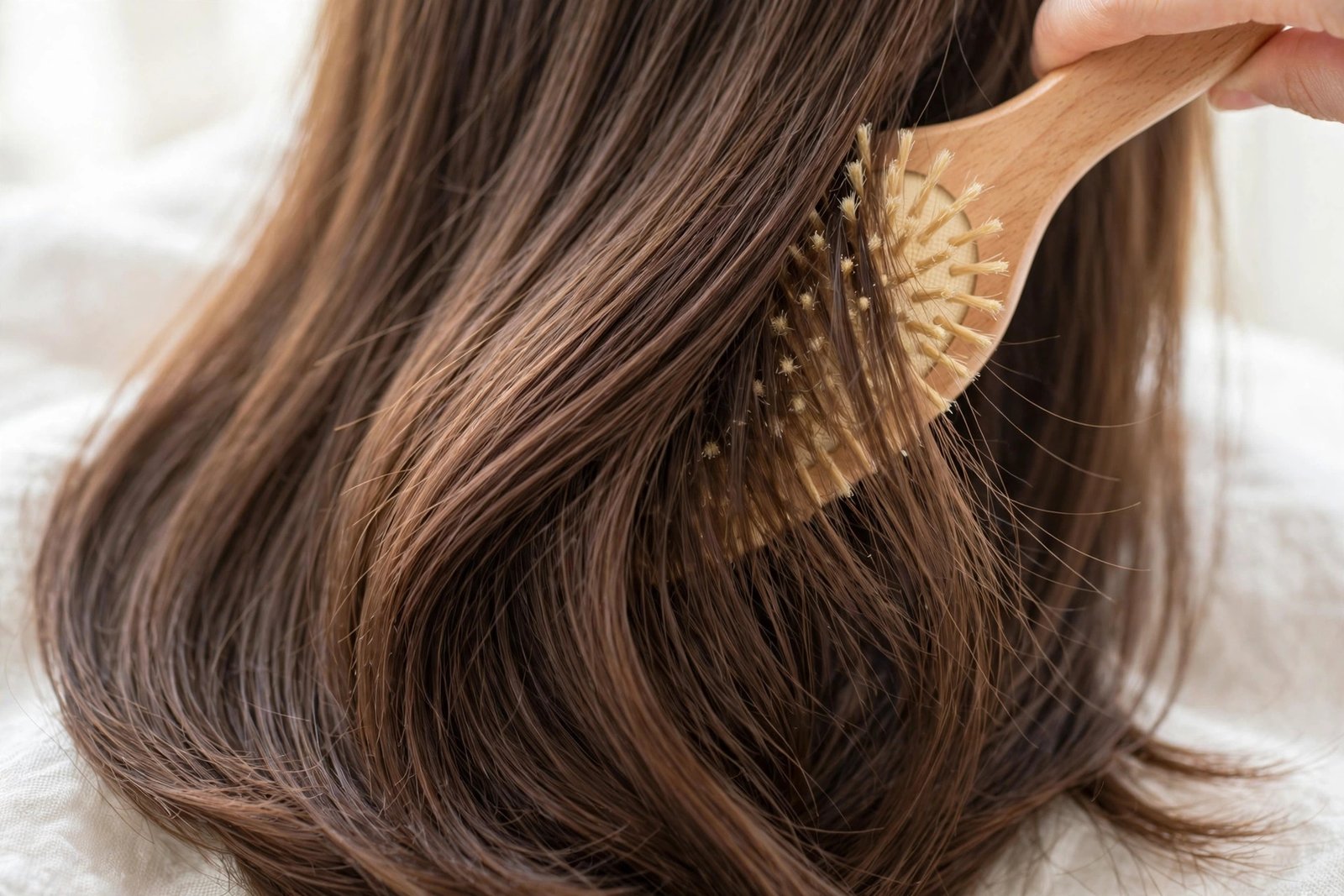
Your ends are fried — bleach, heat, color, or just years of ponytails — and every stylist says the same thing: “We need to cut it all off.” But what if you love your length? Growing out damaged hair without the big chop is absolutely possible. It requires a strategy shift: you stop trying to “fix” dead ends and start protecting new growth while gradually retiring the damage. Think of it as a managed transition, not a rescue mission.
Here’s the complete playbook: the trim-not-chop schedule, what bond repair can and can’t do, the routine that stops new damage, Chicago winter protection, and how to style the awkward in-between stages without hating your reflection.
Accept the Physics: Dead Ends Can’t Be Revived
Hair is dead protein — once the cuticle is shattered and the cortex exposed, no product truly repairs it. Cleveland Clinic’s guide to damaged hair causes is blunt about this: conditioners and masks improve the feel and appearance of damage, but they don’t rebuild the hair shaft. This isn’t bad news — it’s liberating. Stop chasing miracle repairs and redirect that energy to the only strategy that works: protect the healthy new growth coming in while gradually trimming away the damage.
Bond-repair treatments (the famous in-salon and at-home bond builders) deserve an honest note: they genuinely help by reconnecting broken disulfide bonds inside the hair, which improves strength and elasticity. They’re the closest thing to real repair that exists. But they work best on moderately damaged hair and can’t resurrect severely fried ends. Use them as part of the transition, not as an alternative to trimming.
The Trim-Not-Chop Schedule
Here’s the math that saves your length: hair grows about half an inch per month. If you trim a quarter inch every 8–10 weeks — “dusting” the very ends — you net about an inch of healthy growth every four months while the damaged portion steadily shrinks. In a year, you’ve replaced roughly three inches of damage with healthy hair without ever having short hair. Find a stylist who understands dusting and explicitly say “maintenance trim, maximum a quarter inch” — and watch like a hawk, because scissor-happy stylists are the number-one derailer of grow-out plans.
Between appointments, search-and-destroy missions keep you sane: once a month, in good light, snip individual split ends you spot. It prevents splits from traveling up the shaft, which is how minor damage becomes “we have to cut six inches.” This fifteen-minute habit does more for length retention than any product.
The Routine That Stops New Damage
Growing out damage while creating new damage is running on a treadmill. The American Academy of Dermatology on repairing damaged hair recommends the core changes: cut heat styling to the minimum and always use heat protectant when you do, switch to silk or satin pillowcases to reduce friction breakage, detangle gently from ends to roots with a wide-tooth comb on conditioned hair, and retire tight ponytails and harsh elastics for loose styles and silk scrunchies.
Wash smarter too: shampoo the scalp, not the lengths — the suds running down are enough for the ends. Deep-condition weekly, focusing product on the mid-lengths and ends where damage lives. And embrace the clean-beauty shift toward gentler hair formulations: sulfate-free shampoos and silicone-conscious routines reduce the strip-and-coat cycle that masks damage while worsening it. Treat your hair with the philosophy in treating damaged hair with the same gentleness as sensitive skin — damaged hair is, functionally, sensitized hair.
Supplements, Diet, and Realistic Expectations
Hair grows from the inside, so the grow-out has a nutritional dimension — with realistic limits. No supplement speeds growth beyond your genetic rate (roughly half an inch monthly), but deficiencies can slow it: iron, vitamin D, and protein shortfalls all show up as sluggish growth and increased shedding. If your growth seems stalled, a basic blood panel is more useful than another “hair gummy.” Collagen supplements are popular but the evidence for hair growth specifically is thin; adequate dietary protein does the same job with better science behind it.
Set expectations honestly: you cannot grow out severe damage in three months, and anyone promising that is selling something. What you can do is make measurable monthly progress — photograph your ends in the same lighting on the first of each month, and you’ll see the healthy growth line advancing. That visible progress is what keeps people committed through the awkward middle. Most successful grow-outs report the turning point around month four or five, when the majority of the length finally feels like “their” hair again rather than damage they’re managing.
Chicago Winter: The Grow-Out Killer
Chicago winter is uniquely hostile to a grow-out: dry heated air sucks moisture from already-porous ends, wool coats and scarves create friction breakage at exactly the length you’re trying to save, and hats cause static that leads to snapping. Winterize the plan: wear hair in protective styles (loose braids, low buns) tucked inside your coat rather than under it, use a heavier leave-in conditioner or hair oil on the ends from November through March, and run a humidifier where you sleep. A silk-lined winter hat prevents the hat-hair breakage cycle that undoes months of progress.
Styling the Awkward Middle
The grow-out has ugly phases — thin ends, uneven texture, the top healthy and the bottom frazzled. Camouflage is a legitimate strategy: layered cuts remove bulk from damaged ends while keeping overall length, curtain bangs or face-framing layers draw the eye upward, and texture (loose waves, braids) hides uneven ends far better than stick-straight styles. Silk press or blowout addicts: try heatless styling methods during the transition — your ends will thank you, and you’ll be shocked how good flexi-rod or braid-out waves look.
Conclusion
Growing out damaged hair without cutting it all off is a managed transition: dust a quarter inch every 8–10 weeks, snip splits monthly, use bond repair for moderate damage, and ruthlessly eliminate new damage with gentler washing, less heat, silk pillowcases, and protective winter styling. In a year, inches of damage become inches of healthy hair — and you never had to go short. The big chop is a valid choice, but it’s not the only choice. Patience and protection will get you there with your length intact.
Frequently Asked Questions
How long does it take to grow out damaged hair?
It depends on how much damage you’re retiring: replacing 3–4 inches of fried ends takes roughly a year with quarterly dusting. The damage visibly improves within 2–3 months as the worst ends come off and new habits take hold.
Do bond-repair products actually work?
Yes, within limits — they reconnect broken internal bonds, improving strength and elasticity in moderately damaged hair. They can’t rebuild severely destroyed ends, but they’re excellent for protecting the transition zone between healthy roots and damaged lengths.
Should I stop coloring while growing out damage?
Ideally, yes — or switch to demi-permanent color and root-only touch-ups instead of pulling color through the lengths. Every full-length color session resets your progress on the ends you’re trying to save.
Why does my hair break more in winter?
Cold air holds less moisture and indoor heating drops humidity further, leaving hair drier and less elastic. Dry hair snaps under stress that healthy-moisturized hair would flex through — hence heavier conditioning and protective styles in winter.