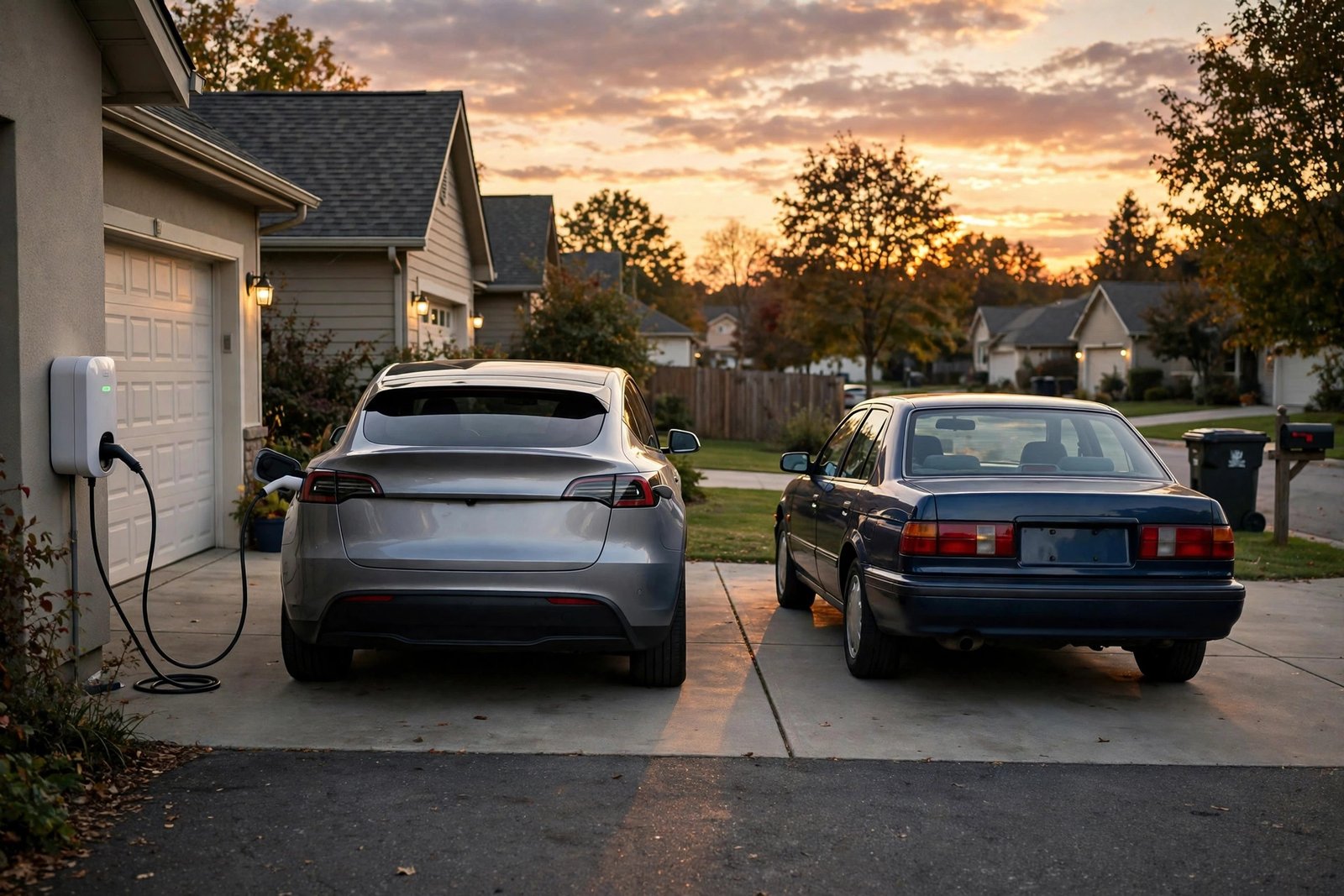
Sticker shock cuts both ways now. Electric cars still cost more upfront than their gas equivalents, but electricity is cheaper than gasoline, EVs need less maintenance, and tax credits can erase thousands. So which actually costs less over the years you own it? In 2026, with the EV market matured and Chicago’s specific wrinkles (brutal winters, ComEd rates, salt-season driving), the answer is finally clear enough to calculate.
Here’s the full total-cost-of-ownership comparison: purchase, fuel/charging, maintenance, insurance, winter range reality, and the break-even math for Chicago drivers.
Purchase Price: The Gap Narrows
In 2026, mainstream EVs (think Chevy Equinox EV, Hyundai Kona Electric, Tesla Model 3) start in the low-to-mid $30,000s — still roughly $5,000–$10,000 more than comparable gas cars. But the federal EV tax credit (up to $7,500 for qualifying new EVs, with income and assembly caps) plus occasional Illinois incentives can erase most of that gap at purchase. Used EVs are the market’s hidden bargain — steep depreciation on 2–3 year old models makes them dramatically cheaper than new, with plenty of battery life remaining.
The honest framing: if you qualify for the full credit, purchase-price parity is essentially here for mainstream segments. If you don’t, gas still wins upfront by several thousand. Run your specific numbers with the fueleconomy.gov vehicle cost calculator, which compares total ownership costs side-by-side with your actual driving patterns.
Fuel vs. Charging: Where EVs Win Big
This is the EV’s home turf. At Chicago-area residential electricity rates (~$0.15–$0.20/kWh with ComEd), driving 12,000 miles/year in an EV getting 3.5 miles/kWh costs roughly $515–$685/year in electricity. The same miles in a 30-mpg gas car at $3.50/gallon costs $1,400/year. Annual fuel savings: $700–$900, every year, compounding over ownership.
Home charging is the key — it’s the cheapest “fuel” available. Apartment dwellers relying on public fast charging pay 2–3x more per kWh, which significantly erodes the advantage. Before buying, honestly assess your charging situation: a garage or driveway with a 240V outlet (installation typically $500–$2,000) unlocks the full savings; street parking with no home charging makes the math much tighter. The Department of Energy’s vehicle technologies resources detail charging options and costs comprehensively.
Maintenance: The Quiet Savings
EVs have roughly 20 moving parts in the drivetrain versus 2,000+ in a gas car. No oil changes, no transmission services, no exhaust systems, no spark plugs — and regenerative braking means brake pads last 2–3x longer. Studies consistently show EV maintenance costs running 30–50% below gas cars over 5–8 years, saving $3,000–$6,000.
The caveats: tires wear faster on EVs (instant torque + heavy batteries — budget for more frequent replacements, especially with Chicago potholes), and out-of-warranty battery replacement is expensive ($10,000–$20,000) — though battery warranties run 8 years/100,000 miles federally, degradation is gradual not sudden, and actual battery failures are rare. For the road-trip dimension of ownership, our guide to planning a cross-country road trip on a budget covers the charging-network reality of long EV drives.
The Chicago Winter Factor (Be Honest About It)
Cold is the EV’s kryptonite: expect 20–40% range loss in subzero Chicago winters (battery chemistry slows, cabin heating drains power). A 300-mile EV becomes a 180–210 mile EV in January. For daily commuting and city driving, this rarely matters — you charge nightly and never notice. For the twice-yearly drive to visit family 250 miles away, it means planning charging stops.
Mitigations that work: garage parking (even unheated helps enormously), preheating while plugged in, heated seats instead of cabin heat, and winter tires (which you’d want anyway). Heat pumps (standard on newer EVs) cut the penalty significantly versus older resistive-heater models. Don’t let winter alone decide — but don’t ignore it either. And the home-charging angle connects to household energy broadly: our best energy-efficient upgrades for older homes covers the panel and efficiency improvements that pair well with home EV charging.
The Break-Even Math
Typical scenario: $7,000 EV price premium (after credits) versus $800/year fuel savings plus $500/year maintenance savings = ~5.4 year break-even. With the full tax credit erasing the premium, EVs win from day one. High-mileage drivers (20,000+/year) break even in 2–3 years; low-mileage drivers (under 8,000/year) may never break even on cost alone.
Insurance runs slightly higher for EVs (expensive battery = expensive repairs), which trims the advantage modestly. Resale values are the wild card — improving as the used market matures, but still softer than Toyota/Honda gas equivalents. Total verdict for most Chicago drivers with home charging: EVs cost less over 6+ years of ownership, break even sooner for high-mileage drivers, and the gap widens every year as gas prices fluctuate and electricity stays comparatively stable.
Used EVs: The Value Play
The sharpest EV economics in 2026 aren’t in new cars — they’re in 2–3 year old used EVs, which have depreciated 30–50% while retaining most of their battery life. A three-year-old EV with 200+ miles of original range often sells for less than a comparable used gas car, yet costs half as much to run. For Chicago buyers, this is the sweet spot: the previous owner absorbed the depreciation, you harvest the fuel and maintenance savings.
Buy used EVs smartly: check the battery health report (most EVs display state-of-health; aim for 90%+), prefer models with heat pumps for Chicago winters, verify the charging port standard matches your home setup plans, and check whether any federal used-EV credit applies (up to $4,000 for qualifying used EVs under $25,000 — a genuinely great deal). Have a mechanic familiar with EVs inspect it, focusing on suspension and tires (heavy EVs wear these faster) rather than the drivetrain. The used EV market is where the technology’s economics shine brightest — new EVs compete with gas cars, but used EVs often beat them outright from day one.
Conclusion
In 2026 Chicago, an electric car with home charging typically costs less than a comparable gas car over 6+ years — the fuel savings ($700–$900/year) and maintenance savings (30–50% less) overcome the purchase premium, especially with tax credits. Without home charging, or for very low-mileage drivers, gas often still wins on pure cost. Factor in winter range loss honestly, run your numbers on fueleconomy.gov, and remember: the cheapest car is still the one you already own. But when it’s time to buy, the EV math has never been stronger.
Frequently Asked Questions
What is the real cost of owning an electric car vs gas in Chicago?
Over 6+ years with home charging, EVs typically cost less — saving $700–$900/year on fuel and 30–50% on maintenance, overcoming a $5,000–$10,000 purchase premium (often reduced by tax credits). Without home charging, gas usually wins.
How much does winter reduce EV range in Chicago?
Expect 20–40% range loss in subzero temperatures. A 300-mile EV delivers ~180–210 miles in January. Garage parking, preheating while plugged in, and heat pumps mitigate the loss.
How long until an EV pays for itself?
Typically 4–6 years for average drivers with home charging; 2–3 years for high-mileage drivers; potentially never for very low-mileage drivers. Full tax credits can make EVs cheaper from day one.
Are EV batteries expensive to replace?
Yes ($10,000–$20,000), but federally warranted for 8 years/100,000 miles, degradation is gradual, and actual failures are rare. Most owners never face replacement.
Can I own an EV in Chicago without home charging?
It’s possible but erodes the cost advantage — public fast charging costs 2–3x home rates. Street parkers should weigh this carefully; the EV math is strongest with home charging.