Checking your car’s oil level takes 90 seconds, costs nothing, and can save you a $5,000 engine. Yet most drivers never do it — they assume the dashboard will warn them, or that modern cars don’t consume oil. Both assumptions are wrong: many cars burn oil normally between changes, and by the time the oil pressure light illuminates, damage is often already done. Here’s how to check your oil level correctly — the right way, not the rushed way — and how to read what the dipstick is telling you.
When and Where to Check
Check your oil when the engine is warm but has been off for 5–10 minutes. This is the detail most people get wrong. Checking ice-cold means oil hasn’t fully drained to the pan (reads low); checking immediately after shutting off means oil is still circulating up top (also reads low). The sweet spot: drive normally, park on level ground — this matters enormously, as even a slight slope skews the reading — wait 5–10 minutes, then check.
How often? Monthly at minimum, and before any long trip. Cars with over 75,000 miles, turbocharged engines, or known oil consumption should be checked every other fuel fill-up. It takes less time than pumping gas.
The Correct Procedure, Step by Step
- Park on level ground and wait 5–10 minutes after driving.
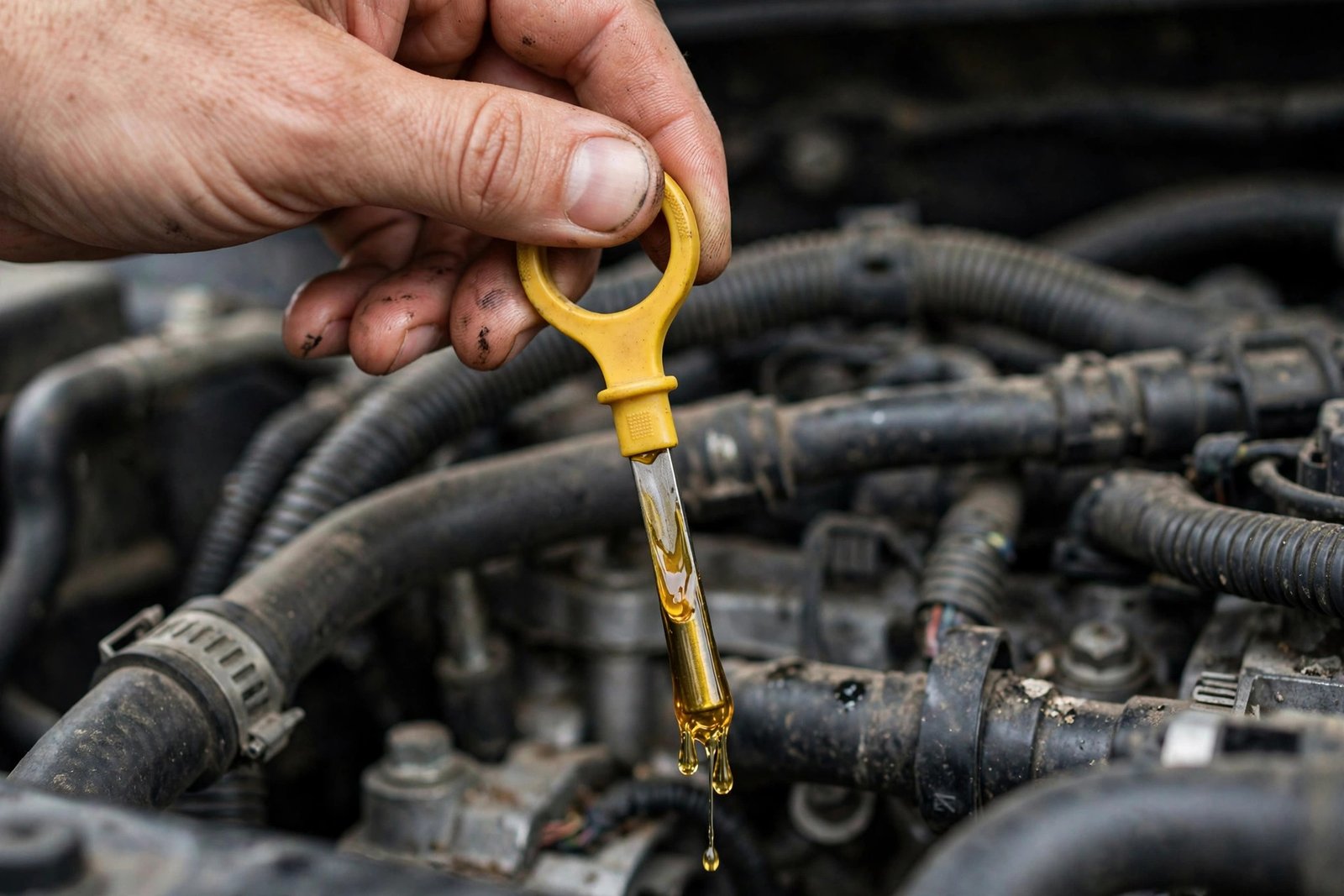
- Open the hood and locate the dipstick — typically a bright yellow or orange loop handle. (Some newer BMWs, Audis, and Mercedes use electronic sensors instead; check your manual.)
- Pull the dipstick fully out and wipe it completely clean with a lint-free rag or paper towel.
- Reinsert it all the way — push until it seats fully. A partially inserted dipstick gives a false low reading.
- Pull it out again and read the level without flipping it over (flipping lets oil run and smears the reading).
- Read both sides — take the lower of the two readings as accurate.
The single most common mistake is reading the first pull without wiping. That first pull shows oil splashed up the tube during driving — meaningless. The wipe-and-reinsert is the entire point of the procedure.
Reading the Dipstick: What You’re Looking At
Most dipsticks have two marks — dots, holes, or a crosshatched zone — indicating the acceptable range, typically representing about one quart from bottom to top.
- Level in the crosshatch/at the top mark: Perfect. Note the color while you’re here (see below).
- Level midway: Fine, but you’re down half a quart. Top up if you’re heading into a long interval.
- At or below the bottom mark: Add a quart immediately. Driving a quart+ low accelerates wear on every moving part.
- No oil on the dipstick at all: You’re 2+ quarts low. Add oil before driving anywhere — or better, don’t drive; get oil to the car.
Reading the Color and Consistency
Rub a drop between thumb and forefinger:
- Amber/translucent: Fresh, healthy oil.
- Dark brown/black but smooth: Normal for oil mid-interval — color alone doesn’t condemn oil; modern detergents darken as they clean.
- Gritty or metallic particles: Concerning — metal wear debris. Get it checked promptly.
- Milky or foamy: Coolant mixing with oil — potential head gasket failure. Serious; see a mechanic immediately.
- Smells like gasoline: Fuel dilution — common in short-trip winter driving, but persistent fuel smell warrants diagnosis.
Topping Up: Doing It Right
If you’re low, add the correct oil — check your owner’s manual or oil cap for the specification (e.g., 5W-30, 0W-20). Using the wrong viscosity in modern engines with tight tolerances and variable valve timing causes real harm. Add half a quart at a time through the oil filler cap (not the dipstick tube), wait a minute, and recheck. Overfilling is also harmful — excess oil foams, overwhelming the crankcase ventilation. Never exceed the top mark.
Keep a quart of your car’s specified oil in the trunk — it’s $8–$12 insurance. And if you find yourself adding a quart every 1,000 miles or less, that’s excessive consumption worth diagnosing; many manufacturers consider up to a quart per 1,000 miles “normal” (a controversial stance), but trending consumption deserves attention. Setting up a proper workspace makes all of this easier — organizing your garage on a budget means your oil, funnel, and rags are actually findable when you need them.
Electronic Oil Sensors: The New Normal
Many newer European cars eliminated the dipstick entirely, using electronic level sensors read through the infotainment system. These work — but only when the car decides to measure (usually requiring specific conditions: warm engine, level ground, idle for several minutes). They also fail silently; a bad sensor reads “OK” forever. If your car has both a sensor and a dipstick, trust the dipstick. If it’s sensor-only, check the reading monthly per the manual’s procedure and be extra attentive to leaks (cardboard under the engine overnight is the old-school backup).
Why This Matters More Than You Think
Oil is the engine’s blood: it lubricates, cools, cleans, and protects. Running low starves bearings of lubrication — the kind of damage that doesn’t trigger a warning until it’s catastrophic. The oil pressure light is not a “check oil soon” reminder; it’s a “shut off the engine now” emergency. By the time it illuminates at highway speed, you’re often looking at thousands in damage. Ninety seconds with a dipstick is the cheapest engine insurance in existence. Build it into your routine alongside budgeting for regular maintenance — an engine that lasts 200,000 miles is worth tens of thousands in deferred car payments.
How Chicago Winters Affect Your Oil Choice
Chicago’s temperature extremes make oil viscosity choice more consequential here than in mild climates. The “W” in 5W-30 stands for winter — the lower the first number, the better the oil flows when cold. That’s why most modern cars specify 0W-20: at -15°F, it reaches critical engine parts dramatically faster than thicker oils. Never substitute a thicker oil “for summer” unless your manual approves — modern engines with variable valve timing depend on precise oil flow characteristics. The Department of Energy’s motor oil guide explains viscosity ratings clearly, and the American Petroleum Institute’s certification marks (the “donut” on every bottle) tell you the oil meets your engine’s required performance standard. In Chicago, the right oil isn’t just maintenance — it’s cold-start insurance.
Conclusion
Checking your oil correctly means: level ground, warm engine rested 5–10 minutes, pull-wipe-reinsert-read, and interpreting both level and condition. Do it monthly, top up with the manufacturer-specified oil, and investigate consumption trends or alarming colors promptly. It’s the simplest, highest-value maintenance habit a car owner can have — 90 seconds that stands between you and a $5,000 engine rebuild. Pop the hood this weekend; your car will thank you with another 100,000 miles.
Frequently Asked Questions
Should I check oil when the engine is hot or cold?
Warm but rested: drive normally, then wait 5–10 minutes on level ground. Ice-cold reads artificially low (oil hasn’t drained down); immediately-after-shutdown also reads low (oil still circulating).
How often should I check my oil level?
Monthly for most cars; every other fill-up for high-mileage (75,000+), turbocharged, or oil-consuming engines; and always before long road trips.
What does it mean if my oil looks milky?
Milky or foamy oil indicates coolant mixing with oil — often a failing head gasket. This is serious: continued driving can destroy the engine. Have it diagnosed immediately.
Can I mix different brands of motor oil?
Yes, if the viscosity and specification match (e.g., two 5W-30 full synthetics meeting the same API standard). In an emergency, the right viscosity matters far more than the brand. Don’t mix conventional and synthetic routinely, though it’s not catastrophic.
My car has no dipstick — how do I check the oil?
Use the electronic measurement in your infotainment or instrument cluster, following the manual’s procedure (usually: warm engine, level ground, idle several minutes). Check monthly, and watch for leaks manually since sensors can fail silently.