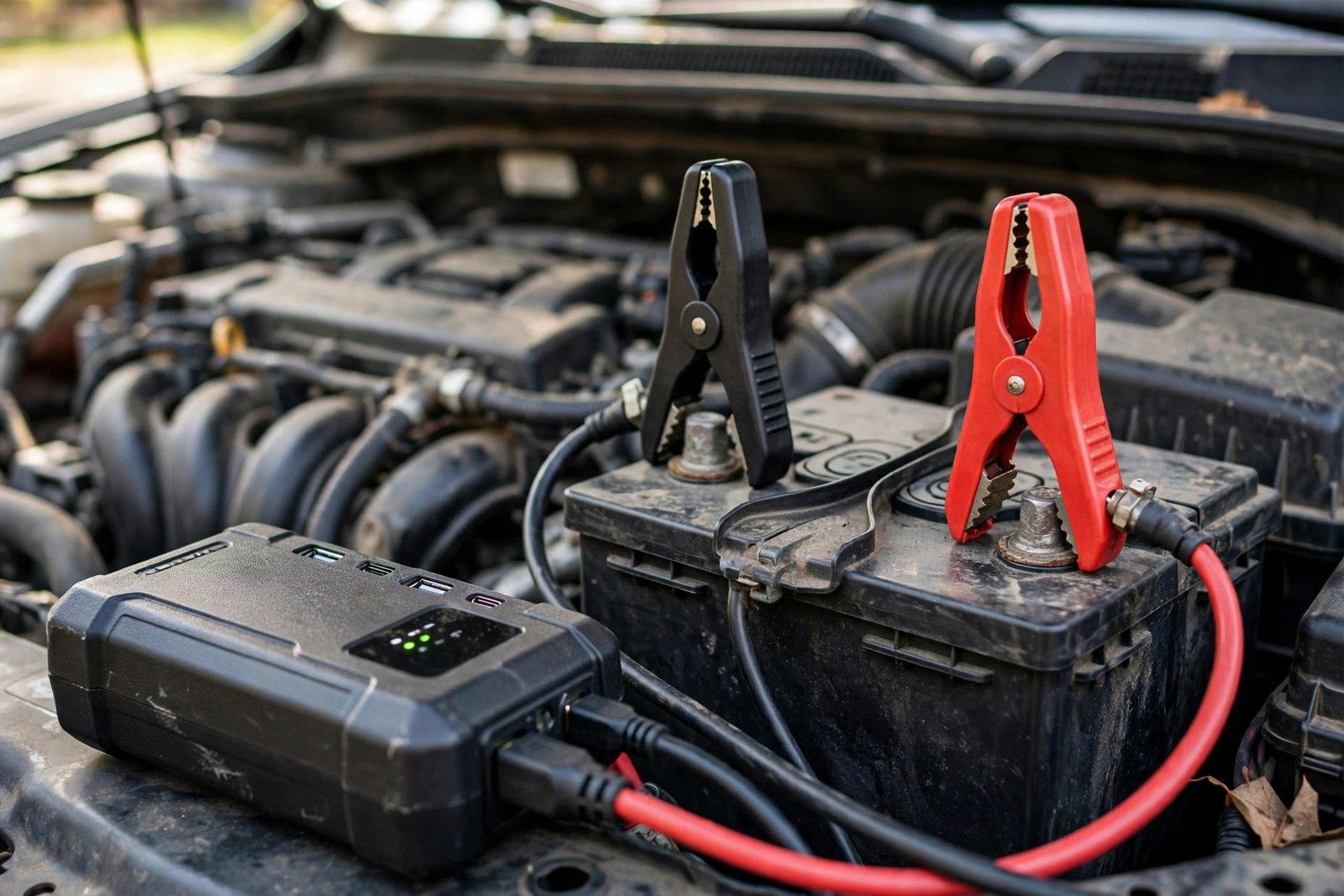
Dead battery. Empty parking lot. No one around to help — or you don’t want to wait an hour for roadside assistance in a Chicago January. Jump-starting a car by yourself is entirely possible, safe when done correctly, and a skill every driver should have. The key word is correctly: wrong cable order can fry electronics, and batteries can produce explosive hydrogen gas. Here’s the safe solo procedure, the portable jump starter alternative, and the mistakes that damage cars.
Option 1: The Portable Jump Starter (Best Solo Method)
A lithium jump starter pack ($60–$100) is the 21st-century answer to dead batteries. It holds a charge for 6–12 months, fits in your glove box, and needs no second vehicle. Procedure:
- Confirm the pack is charged (check it seasonally — cold saps stored charge too).
- Turn everything off in the dead car: lights, radio, blower, heated seats.
- Connect red clamp to the dead battery’s positive (+) terminal.
- Connect black clamp to the negative (−) terminal (or an unpainted metal ground point on the engine block).
- Turn on the jump pack (most have a power/boost button).
- Wait 30–60 seconds, then start the car.
- Remove clamps in reverse order (black first, then red) with the engine running.
- Drive for 20–30 minutes to recharge the battery — idling alone won’t do it.
Every Chicago driver should own one of these. It’s the difference between a 5-minute fix and a ruined morning. Keep it charged and keep it in the car — a jump pack in your organized garage doesn’t help you at the grocery store. The same battery-awareness instincts behind knowing when batteries are dying apply here: if you’re jump-starting monthly, the battery needs replacing, not rescuing.
Option 2: Jumper Cables With a Second Vehicle
No jump pack? You’ll need a Good Samaritan or roadside assistance. The correct order is non-negotiable — memorize it:
- Position the cars close enough for cables to reach, engines OFF, both in Park with parking brakes set. Cars should not touch.
- Red to dead: Connect the red (+) clamp to the dead battery’s positive terminal.
- Red to donor: Connect the other red (+) clamp to the good battery’s positive terminal.
- Black to donor: Connect the black (−) clamp to the good battery’s negative terminal.
- Black to ground: Connect the remaining black clamp to an unpainted metal surface on the dead car’s engine block — a bolt, bracket, or strut tower — at least 18 inches from the battery. NOT to the dead battery’s negative terminal.
- Start the donor car, let it run 2–3 minutes.
- Start the dead car. If it doesn’t start in 10 seconds of cranking, wait a minute and try once more. Don’t grind the starter.
- Remove in exact reverse order: ground clamp first, then donor black, then donor red, then dead red — with both engines running.
Why the ground point matters: Batteries vent hydrogen gas. The final connection can spark — connecting it away from the battery keeps sparks away from explosive gas. This isn’t theoretical; battery explosions cause real injuries every year.
After the Jump: Critical Next Steps
- Drive 20–30 minutes (highway speeds ideal) to recharge. Short trips after a jump guarantee another dead battery tomorrow.
- Don’t turn the car off until you’ve driven enough — restarting a barely-charged battery may fail.
- Get the battery tested within days. A battery that died once without an obvious cause (lights left on) is telling you it’s dying. Free testing at parts stores takes 5 minutes.
- Check the charging system. If a new-ish battery keeps dying, the alternator may be failing — a $400–$700 repair that jump-starting can’t fix.
Mistakes That Damage Cars
- Reversed polarity: Connecting positive to negative can fry the ECU, alternator diodes, and fuses in seconds — a $1,000+ mistake. Double-check every clamp.
- Jumping a frozen or damaged battery: If the case is swollen, cracked, or leaking, do NOT jump it — replace it. Jump-starting a frozen battery risks explosion.
- Voltage mismatch: Don’t jump a 12V car with a 24V truck system.
- Leaving electronics on: Voltage spikes during connection can damage sensitive electronics. Everything off during the procedure.
- Hybrid/EV 12V systems: Hybrids have a small 12V auxiliary battery that can be jumped normally, but never attempt to jump the high-voltage traction battery — that’s dealer-only territory with lethal voltages.
When Jump-Starting Won’t Help
If the starter cranks strongly but the engine won’t catch, it’s not the battery — it’s fuel, spark, or a sensor issue. If you hear a single loud click, suspect the starter motor. If jump-starting produces zero response (no lights, no crank), check cable connections and consider that the battery may be internally failed — no amount of jumping revives a battery with a broken internal connection. At that point, it’s replacement time, not rescue time.
Jump-Starting in Extreme Cold: Extra Steps
At -15°F, everything about jump-starting gets harder: batteries produce half their power, oil thickens, and cables stiffen. Extra steps for deep cold: warm the jump pack inside your coat for 10 minutes before use (lithium packs perform poorly when frozen), allow longer charge time before cranking (2–3 minutes connected), and turn off everything electrical — including the blower motor you’ll desperately want. If the car still won’t turn over, the issue may be beyond the battery: thickened oil can prevent cranking in extreme cold, in which case a block heater (not more jumping) is the answer. The AAA reports that battery-related calls spike 2–3x during polar vortex events — mostly from batteries that were marginal in fall. And the DOE’s battery guidance confirms what Chicagoans learn the hard way: a battery testing at 80% in October is a dead battery in January. Test in fall, replace proactively, and keep the jump pack warm.
Conclusion
Jump-starting solo is safe and simple: portable jump pack (red to positive, black to negative, start, remove in reverse), or cables with a donor car (red-dead, red-donor, black-donor, black-to-ground-away-from-battery, reverse to remove). Drive 30 minutes after, get the battery tested, and replace it if this becomes routine. The $80 jump pack in your trunk is the cheapest roadside insurance you’ll ever buy — especially when the alternative is waiting in a Chicago winter for help that takes an hour to arrive.
Frequently Asked Questions
What order do jumper cables go in?
Red to dead battery positive, red to donor positive, black to donor negative, black to an unpainted ground point on the dead car’s engine (away from the battery). Remove in exact reverse order.
Can I jump-start a car by myself?
Yes — a portable lithium jump starter ($60–$100) lets you jump-start with no second vehicle. It’s safer and faster than cables, holds charge for months, and fits in a glove box.
How long should I drive after jump-starting?
20–30 minutes of actual driving (not idling) to meaningfully recharge the battery. Short trips after a jump often lead to another dead battery the next morning.
Can jump-starting damage my car?
Yes, if done wrong: reversed polarity can destroy electronics ($1,000+), and sparking near a venting battery risks explosion. Follow the correct order, keep electronics off, and never jump a swollen, cracked, or frozen battery.
Why does my battery keep dying after jump-starting?
Either the battery itself is worn out (most common — get it tested free at parts stores) or the charging system (alternator) is failing. Repeated jumps treat the symptom; testing finds the cause.