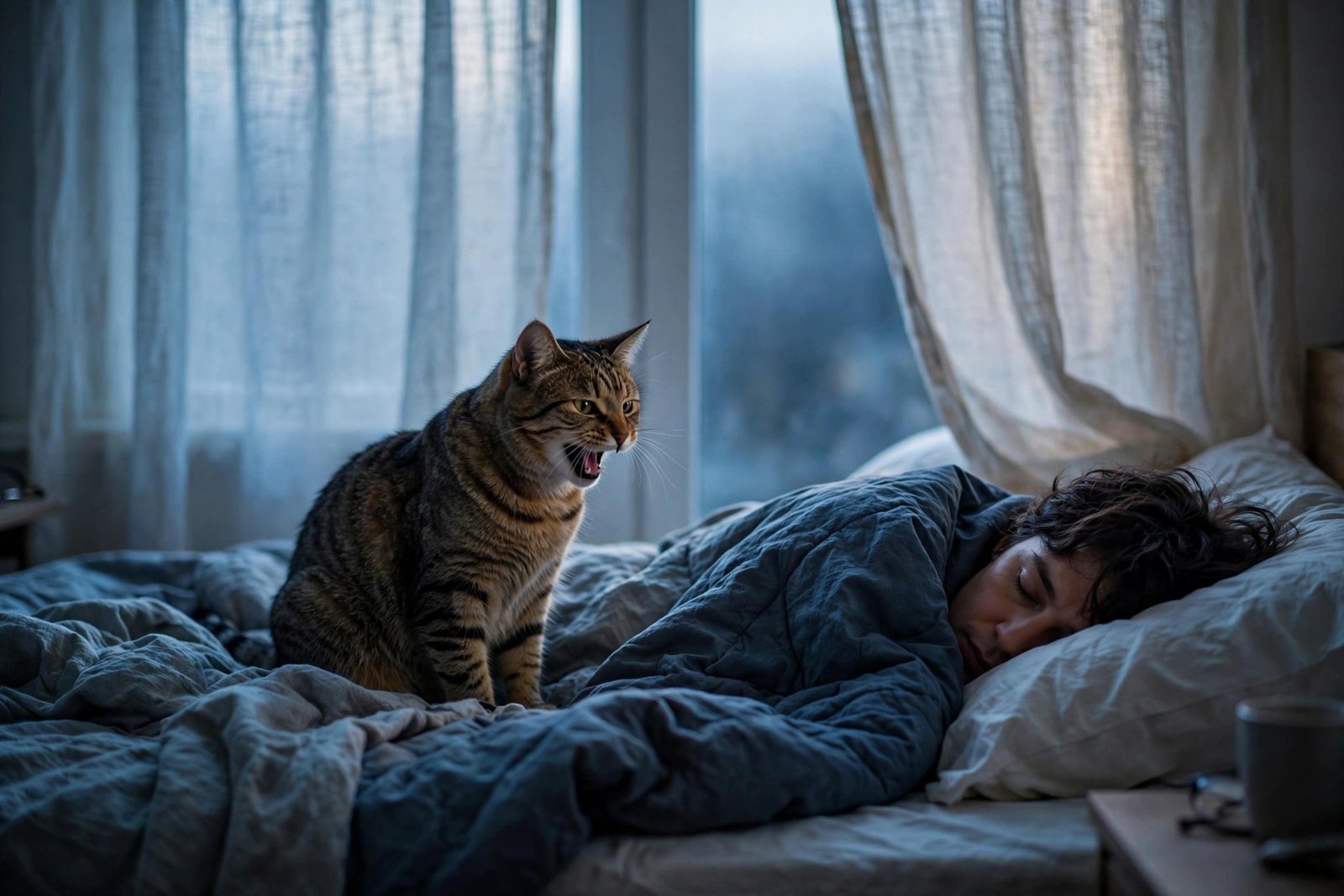
It’s 4 a.m. Your cat is sitting on your chest, meowing directly into your face like a furry alarm clock with no snooze button. You’ve tried earplugs, closed doors (cue the door scratching), and pleading. The 4 a.m. wake-up call is the most universal cat complaint in existence, and it’s not random — it’s the collision of feline biology with your sleep schedule. The good news: it’s fixable. The bad news: the fix requires changing your evening routine, not just the cat’s.
Why 4 A.M.? The Biology Behind the Wake-Up
Cats are crepuscular — biologically wired for peak activity at dawn and dusk, the hunting hours of their wild ancestors. That 4–5 a.m. burst of energy isn’t misbehavior; it’s thousands of years of evolution telling your cat it’s time to hunt. In the wild, dawn is when prey is active. In your Chicago apartment, dawn is when your face is available.
Compounding this, cats are routine machines. If you have ever — even once — gotten up at 4 a.m. and fed the cat, you’ve taught them that 4 a.m. meowing produces breakfast. Cats don’t understand “that was a one-time thing.” They understand cause and effect with perfect clarity: meow at human → food appears. Every accidental reinforcement (getting up to feed them, yelling at them, even pushing them off the bed — all attention) strengthens the 4 a.m. habit.
The Evening Reset: Move Dinner and Play
The core fix is restructuring the last two hours of your evening around the cat’s biology instead of fighting it.
The Hunt-Catch-Kill-Eat-Groom-Sleep Sequence
Feline behaviorists teach this sequence because it mirrors the natural cycle: hunt (play), catch/kill (the toy “dies”), eat (dinner), groom, sleep. Most owners do it backwards — they feed dinner at 6 p.m., then wonder why the cat is wide awake at 4 a.m. Instead: at 9–10 p.m., run a vigorous 15–20 minute interactive play session (wand toy, not a laser pointer — lasers give no “catch” satisfaction and can increase frustration). Let the cat “kill” the toy decisively at the end. Then immediately serve dinner — ideally the largest meal of the day, or an automatic feeder portion. A cat that has hunted, killed, and eaten a full meal will groom and crash. You’ve just moved the crepuscular energy burst to 10 p.m. instead of 4 a.m.
Shift the Feeding Schedule
If you feed breakfast at 6:30 a.m. when you wake, the cat learns that your waking = food, and 4 a.m. lobbying moves your wake-up earlier. Break the link: use an automatic feeder set for 5–6 a.m. so breakfast comes from the machine, not from harassing you. The ASPCA’s cat behavior resources recommend timed feeders for exactly this kind of schedule-driven behavior. The cat still eats at dawn (satisfying biology) but learns that you are not the vending machine. Within 2–3 weeks, most cats redirect their dawn routine to the feeder and leave you completely alone.
The Extinction Protocol: Surviving the Transition
Here’s the hard part. Once you stop reinforcing 4 a.m. wake-ups, the behavior gets worse before it gets better — the “extinction burst.” The cat tries harder: louder meows, more insistent pawing, knocking things off the nightstand. This is normal and temporary, typically peaking around days 3–5 and fading by week two. If you cave on day four, you’ve just taught the cat that persistence at level 10 works — and the next extinction attempt will be harder.
During the transition: keep the bedroom door as you normally would (suddenly closing it adds a new protest — door scratching — on top of the old one), use earplugs or white noise, and give zero response. Not a word, not a shove, not a glance. Any response is reinforcement. Keeping the household routine consistent — same play time, same feeder schedule — is what makes the new pattern stick.
Rule Out the Medical and Environmental Causes
Not all 4 a.m. wake-ups are behavioral. Senior cats (10+) that suddenly start nighttime yowling need a vet check — hyperthyroidism, hypertension, cognitive dysfunction, and pain all cause nighttime vocalization, and these are medical, not training, problems. Cornell University’s veterinary resources on senior cat health describe these conditions and their warning signs. A cat that has slept through the night for years and suddenly doesn’t is communicating something.
Environmental triggers matter too: a new cat visible through the window at dawn (territorial alarm), birds nesting outside the bedroom window in spring, or a changed household schedule. Blackout curtains solve the bird problem. And if you recently adopted, the 4 a.m. concerts may be adjustment anxiety — introducing a new cat to your home gradually, with proper safe-room setup, prevents the stress behaviors that include nighttime vocalizing.
What About the Door Scratchers?
If you close the bedroom door, many cats simply transfer the campaign to the door — scratching, rattling the handle, yowling in the hallway. Options: a deterrent like double-sided sticky tape on the door’s lower panel, a white noise machine inside the bedroom to mask the hallway concert, or — the option behaviorists quietly prefer — letting the cat in but making you boring. A cat allowed on the bed who discovers you are an unresponsive lump at 4 a.m. (extinction protocol applies here too) usually gives up faster than one waging war on a closed door. The closed door only works if the cat can’t hear you reacting behind it.
Conclusion
The 4 a.m. wake-up is biology plus accidental training: a crepuscular hunter whose dawn energy you’ve been rewarding with breakfast and attention. Reset the evening — vigorous play at 10 p.m., big meal right after, automatic feeder for dawn breakfast — then endure the extinction burst with total non-response for two weeks. Rule out medical causes in seniors. Most Chicago cat owners who run this protocol report sleeping soundly through the entire night within a month. Your cat won’t stop being crepuscular. They’ll just stop thinking you’re part of the dawn hunt.
Frequently Asked Questions
Why does my cat wake me up at 4am every day?
Cats are crepuscular (most active at dawn and dusk), and if 4 a.m. meowing has ever produced food or attention, they’ve learned it works. The fix: evening play session + late dinner to shift their energy earlier, an automatic dawn feeder so you aren’t the food source, and zero response to wake-up attempts for 2 weeks.
Should I get an automatic feeder to stop early wake-ups?
Yes — it’s the single highest-impact tool. Set it for 5–6 a.m. so dawn breakfast comes from the machine, breaking the cat’s association between harassing you and getting fed. Most cats redirect to the feeder within 2–3 weeks.
Will ignoring my cat at 4am actually work?
Yes, but expect an extinction burst — worse behavior for 3–5 days before it fades. Any response (yelling, feeding, pushing them away) resets the clock. Total non-response for two weeks, combined with the evening routine reset, resolves most cases.
My senior cat just started yowling at night — is it behavioral?
Probably not — sudden nighttime vocalization in cats over 10 warrants a vet check for hyperthyroidism, high blood pressure, cognitive dysfunction, or pain. Medical causes come first; training second.