
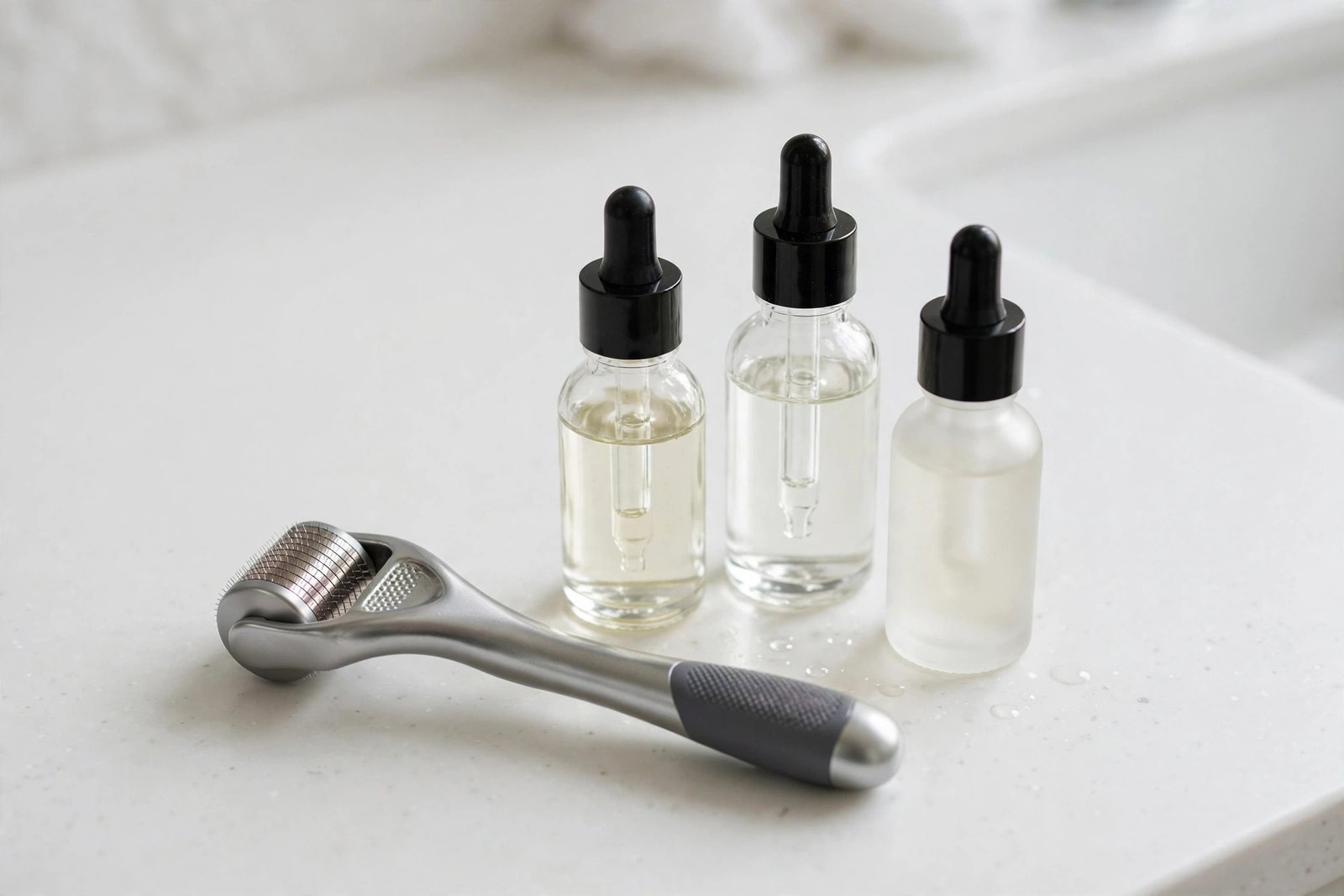
Microneedling rollers cost $20 on the internet. Professional microneedling costs $200–$700 per session in Chicago. The promise is the same — tiny needles triggering collagen production for smoother, firmer skin. So is the at-home version a brilliant bargain or a dangerous gamble? Dermatologists have strong, specific opinions here, and the answer depends entirely on needle depth — the variable most at-home users don’t understand. Here’s the complete safety breakdown.
How Microneedling Works (and Why Depth Is Everything)
Microneedling creates controlled micro-injuries in the skin, triggering the wound-healing cascade: inflammation, then proliferation (new collagen and elastin), then remodeling. It’s genuinely effective for acne scars, fine lines, and texture — with a solid evidence base from dermatology research. But the effect is depth-dependent: needles must reach the dermis (where collagen lives) to trigger meaningful remodeling.
Here’s the critical number: at-home rollers and stamps are limited to 0.25mm needles (legally and practically — deeper at-home use is dangerous). At 0.25mm, needles barely penetrate the epidermis. They enhance product absorption (genuinely useful) but don’t reach the dermis — so they don’t trigger the collagen induction that defines real microneedling. Professional treatments use 0.5mm–2.5mm needles, adjusted to the treatment area, reaching the dermis where remodeling happens. The at-home and professional versions share a name but deliver fundamentally different treatments.
At-Home Microneedling: What’s Safe and What’s Not
Relatively safe at home: 0.25mm rollers/stamps used on clean skin, with proper sanitization, for enhanced product absorption. The risks at this depth are low — mild redness, minimal downtime. Think of it as a delivery enhancer, not a collagen treatment, and set expectations accordingly.
Dangerous at home: anything deeper. The internet sells 0.5mm–2.0mm devices directly to consumers, and using them without training risks: infection (non-sterile technique driving bacteria into deep punctures), scarring (too much pressure or too many passes tears rather than punctures), hyperpigmentation (especially in medium to deep skin tones — post-inflammatory hyperpigmentation from deep at-home needling is a real and common complication), and nerve or vascular injury in thin-skinned areas. Dermatologists regularly treat the aftermath of aggressive at-home needling.
The hygiene problem: rollers are notoriously hard to sanitize properly. The tiny needles trap skin cells, serum residue, and bacteria; alcohol soaks don’t fully sterilize the crevices. Reusing a contaminated roller means stamping last week’s bacteria into this week’s micro-wounds. Professionals use single-use sterile needle cartridges — there’s no at-home equivalent for rollers. The American Academy of Dermatology’s microneedling guidance emphasizes sterile technique as a core safety requirement professionals follow.
What Professionals Do Differently (Beyond Depth)
It’s not just longer needles. Professional microneedling includes: proper skin assessment (active acne, rosacea flares, and certain conditions are contraindications — needling over active breakouts spreads bacteria); medical-grade topical numbing (deep needling without it is genuinely painful); sterile single-use cartridges; controlled speed and pressure via pen devices (far more consistent than hand-rolled pressure); appropriate needle depth mapped to facial zones (thinner skin around eyes gets shallower treatment); and post-procedure protocols including growth factors or PRP in some practices.
Professionals also know when not to needle: keloid-prone patients, those on blood thinners or isotretinoin, active skin infections, and unstable melasma (needling can worsen it). These contraindication screens are part of what you’re paying for — the judgment, not just the needles.
The Honest Cost-Benefit Math
At-home 0.25mm: ~$20–$40 for the device, useful for product absorption, minimal collagen effect, low risk with good hygiene. Think of it as a $30 skincare booster, not a $300 treatment replacement.
Professional: $200–$700 per session in Chicago, 3–6 sessions for acne scars or significant texture improvement, real dermal remodeling with published evidence, managed risk. Expensive because it’s a medical procedure with medical-grade safety.
The false economy: buying a 1.0mm roller to “get professional results at home” and ending up with hyperpigmentation or scarring that costs far more to treat than the professional sessions would have. Mayo Clinic’s cosmetic procedure resources help evaluate which skin treatments have real evidence behind them — microneedling does, but specifically the professional kind.
Microneedling vs. The Alternatives
How does professional microneedling compare to other collagen treatments? Versus lasers: microneedling has less downtime and lower hyperpigmentation risk, especially for medium to deep skin tones — fractional lasers are more powerful but riskier for melanin-rich skin. For deep acne scars, lasers or combination therapy often outperform needling alone. Versus chemical peels: peels address surface texture and pigmentation; needling addresses deeper dermal remodeling — they’re complementary, not competitive, and many dermatologists alternate them. Versus retinoids: tretinoin is the daily driver of collagen maintenance; microneedling is the periodic intensive. They work beautifully together (not on the same day) — the retinoid maintains, the needling remodels. Versus radiofrequency microneedling (Morpheus8 and similar): RF needling adds heat energy for more dramatic tightening at higher cost and downtime — the next step up when traditional needling plateaus. A good dermatologist matches the tool to the concern rather than selling one device for everything.
If You Do It at Home: The Safest Possible Protocol
Stick to 0.25mm maximum. Never use on active breakouts, irritated skin, rosacea flares, or around the eyes. Sanitize before and after every use (70% isopropyl alcohol soak for 10 minutes, air dry — and replace the roller every 10–15 uses, since needles dull and bent needles tear). Apply to clean skin, use gentle pressure (no pressing hard — let the needles’ weight do the work), roll in one direction per area (not back-and-forth sawing), follow with hydrating (not active) products, and always use SPF diligently afterward — needled skin is more sun-sensitive, and UV on healing micro-wounds invites pigmentation.
And support healing with rest: quality sleep drives the repair processes that microneedling is trying to trigger — the procedure creates the signal, but your body does the rebuilding overnight.
Conclusion
At-home microneedling at 0.25mm is safe-ish for product absorption but doesn’t deliver the collagen induction the treatment is famous for — that requires professional depths (0.5mm+) with sterile technique, proper assessment, and trained hands. Deeper at-home needling risks infection, scarring, and hyperpigmentation that cost more to fix than professional sessions. See a pro for real results (acne scars, texture, firmness); use the home roller, if at all, as a modest absorption booster with strict hygiene. The bargain isn’t a bargain if it damages the skin you’re trying to improve.
Frequently Asked Questions
Is at-home microneedling safe?
At 0.25mm needle depth with proper hygiene, relatively safe for enhancing product absorption — but it doesn’t reach the dermis, so it won’t build collagen like professional treatments. Deeper at-home devices (0.5mm+) carry real risks of infection, scarring, and hyperpigmentation.
What’s the difference between at-home and professional microneedling?
Depth (0.25mm home vs. 0.5–2.5mm professional), sterility (reused rollers vs. single-use cartridges), assessment (contraindication screening), and consistency (hand pressure vs. controlled pen devices). They share a name but deliver different treatments with different evidence levels.
Can microneedling help acne scars?
Yes — professional microneedling has good evidence for atrophic acne scars, typically requiring 3–6 sessions. At-home 0.25mm rollers don’t reach the depth needed for scar remodeling. Deep scars may need combination treatment (subcision, fillers, lasers) — consult a dermatologist.
How often can you microneedle at home?
For 0.25mm rollers: 2–3 times weekly maximum, with rest days between. Replace the roller every 10–15 uses (dull needles tear skin). Never use on active breakouts, irritated skin, or around the eyes, and always follow with SPF.


