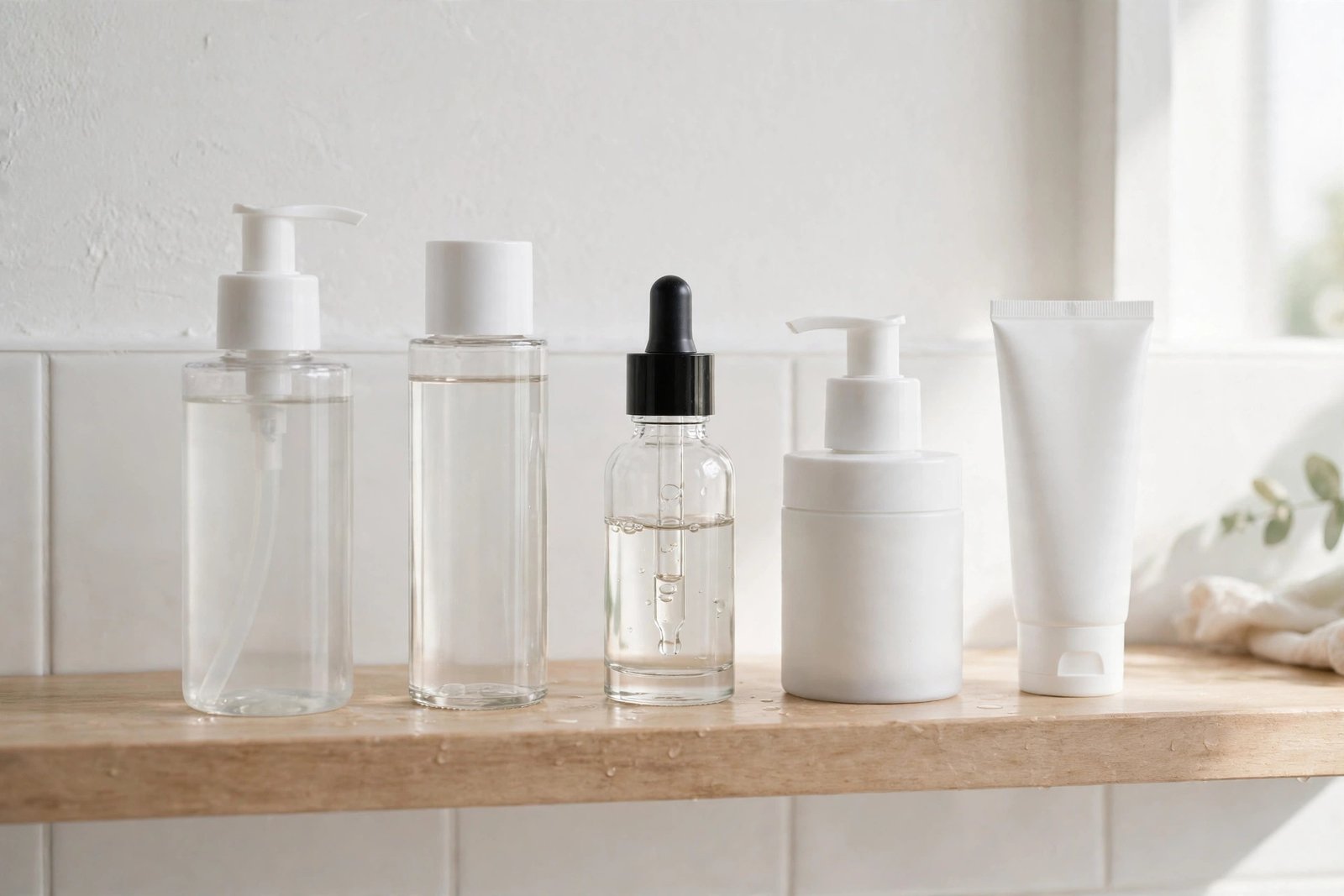
Your bathroom counter looks like a chemistry lab: cleanser, toner, three serums, moisturizer, eye cream, SPF, and a facial oil you’re not sure about. But what goes on first? Get the order wrong and you’re not just wasting product — you’re blocking absorption, causing pilling, and in some cases deactivating the expensive actives you paid for. Product order follows one simple physics principle, with a few important exceptions. Here’s the definitive guide.
The Core Rule: Thinnest to Thickest
Skincare layering follows molecular logic: apply products from thinnest, most watery texture to thickest, most occlusive. Thin products penetrate; thick products seal. Reverse the order and the heavy cream forms a barrier that blocks everything layered on top from reaching your skin — your $80 serum sits on top of moisturizer doing nothing.
The universal sequence: cleanser → toner/essence → water-based serums → treatments → eye cream → moisturizer → facial oil → SPF (morning only). Each layer gets 30–60 seconds to absorb before the next. This isn’t ritual for ritual’s sake — it’s absorption chemistry. A pea-sized amount of each is plenty; more product doesn’t mean more results, it means pilling and waste.
Morning Routine: Protection Focus
Morning is about defense — antioxidants, hydration, and sun protection. The exact order:
1. Cleanser (or lukewarm water rinse for dry skin — over-cleansing in the morning strips the barrier for no benefit).
2. Toner/essence (optional; hydrating toners prep skin to absorb serums better on damp skin).
3. Vitamin C serum. Morning is vitamin C’s shift — it neutralizes free radicals from UV and pollution, and studies show it boosts sunscreen’s effectiveness. Apply to dry skin, wait a minute. Note: vitamin C (ascorbic acid) can conflict with niacinamide in some formulations and shouldn’t be layered directly with strong acids.
4. Eye cream (ring finger, gentle patting — the eye area is the thinnest skin on your face).
5. Moisturizer matched to your skin type.
6. SPF 30+ — always last in the morning (except makeup, which goes over it). Sunscreen needs to form an even film on top of everything to work. Choosing the right sunscreen matters as much as the order — the best-layered wrong sunscreen still fails.
Evening Routine: Repair Focus
Night is for treatment — this is when retinoids, exfoliants, and heavy repair happen, because there’s no sun to conflict with and skin repair peaks during sleep:
1. First cleanse (oil cleanser or micellar water — dissolves sunscreen, makeup, and sebum).
2. Second cleanse (gentle water-based cleanser — actually cleans the skin).
3. Exfoliant (1–3x/week only, never on retinoid nights — pick one active per night).
4. Toner/essence (hydrating, to re-dampen skin).
5. Serums — thinnest first. If using multiple, wait 60 seconds between. Hydrating serums (hyaluronic acid) before treatment serums.
6. Retinoid or treatment (pea-sized, the famous “pea” — more causes irritation without more benefit).
7. Eye cream, moisturizer, facial oil (oil last — it’s the most occlusive; nothing penetrates through it).
The one-active-per-night rule prevents the conflicts beginners constantly create: retinoids and AHAs/BHAs on alternate nights, never together. Your skin can only process so much. Quality sleep multiplies the night routine’s payoff — cell turnover and barrier repair peak during deep sleep, so the routine and the rest work as a team.
The Exceptions and Conflict Rules
Order has fine print. Benzoyl peroxide and retinoids deactivate each other — use BP in the morning, retinoid at night, or on alternate days. Vitamin C and niacinamide can cause flushing when layered directly in certain formulations (modern stabilized formulas are often fine, but separate them AM/PM if you flush). AHAs/BHAs and retinoids go on alternate nights. Copper peptides and strong acids or vitamin C don’t mix — separate by 12 hours.
Wait times: the 30–60 second rule between layers is real but often overstated — you don’t need to set a timer, just don’t slap everything on simultaneously. The exception is prescription tretinoin on completely dry skin (wait 20 minutes after washing) to reduce irritation.
What doesn’t matter: the order of two similar serums (both water-based — either order is fine), whether eye cream goes before or after serum (it’s about the eye area, not layering physics), and brand matching (products don’t need to be from the same line — that’s marketing). Mayo Clinic’s skin care basics confirm that consistency and sun protection matter far more than product prestige or elaborate sequencing.
One more practical note for real bathrooms: you don’t need to wait for each layer to fully dry — damp layering actually improves absorption of water-based products. The 30–60 second guidance is about not diluting the next product, not about achieving complete dryness. On humid Chicago summer mornings, layers take longer to settle; on dry winter mornings, they absorb almost instantly. Let the skin’s feel guide you rather than a stopwatch.
Simplifying: The Minimal Effective Order
If the full sequence overwhelms you, here’s the version dermatologists actually recommend for most people. Morning: cleanser, moisturizer, SPF. Evening: cleanser, treatment (one active), moisturizer. Six products, correct order, 90% of the benefit. Everything beyond this is optimization, not necessity — and a simple routine in the right order beats a 10-step routine layered randomly. The American Academy of Dermatology’s routine guidance endorses exactly this streamlined approach for most skin types.
Chicago Seasonal Order Adjustments
Winter changes the equation: add a hydrating serum under moisturizer, consider a facial oil as the final PM seal, and switch to a richer moisturizer texture — the order stays the same, the products get heavier. Summer: drop the facial oil, switch to gel moisturizer, and make sure your SPF layer is generous (most people apply half the needed amount — a full finger-length for the face). Humidity doesn’t change order, but it changes how long each layer takes to absorb — give extra seconds between layers on muggy August mornings.
Conclusion
Skincare order is physics, not preference: thinnest to thickest, water before oil, treatments before sealants, SPF last in the morning. Morning protects (vitamin C, moisturizer, SPF), evening repairs (cleanse, one active, moisturize, seal). Respect the conflict rules — one active per night, BP and retinoids separated, acids and retinoids alternated — and simplify ruthlessly when in doubt. Get the order right and every product you own works harder; get it wrong and the most expensive serum in the world is just an expensive paperweight sitting on top of your moisturizer.
Frequently Asked Questions
What order should I apply skincare products?
Thinnest to thickest: cleanser → toner → serums → treatments → eye cream → moisturizer → facial oil → SPF (AM). Each layer absorbs 30–60 seconds before the next. Reversing the order blocks absorption of everything under the heavy layers.
Does vitamin C go before or after moisturizer?
Before — vitamin C is a thin water-based serum applied after cleansing/toning and before moisturizer. In the morning routine: cleanser, vitamin C, moisturizer, then SPF last.
Can I use retinol and vitamin C together?
Not at the same time — separate them: vitamin C in the morning, retinoid at night. This avoids irritation and pH conflicts while giving you both actives’ benefits across the 24-hour cycle.
Where does sunscreen go in the routine?
Always last in the morning skincare sequence (before makeup). Sunscreen must form an uninterrupted film over everything else to protect properly — layering products over SPF disrupts that film and reduces protection.