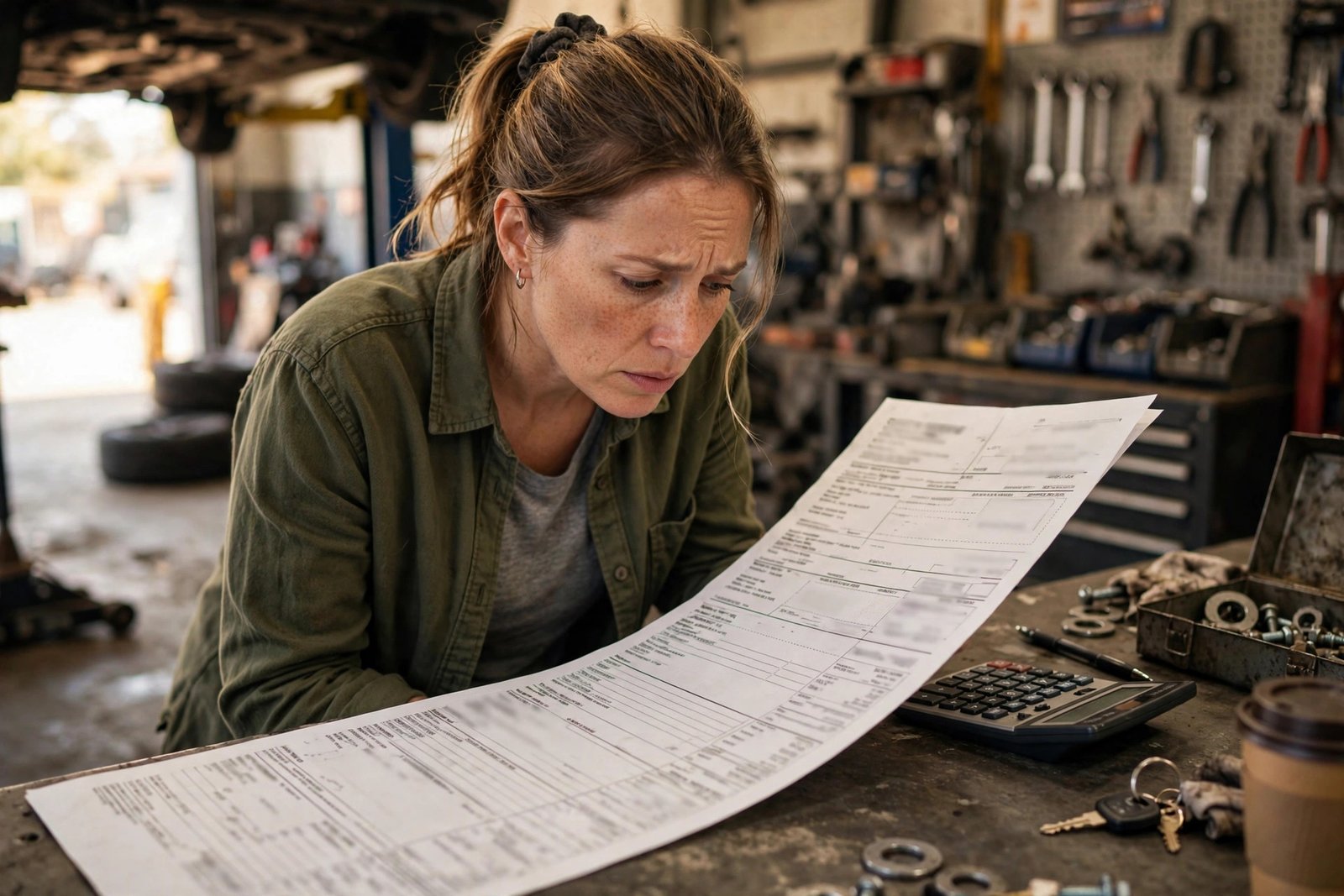
You expected the brake job to cost $400. The invoice says $1,150 — with line items you never approved, parts you didn’t ask for, and labor charges that don’t match the quote. Your stomach tightens: is this legitimate, or are you being taken for a ride? Disputing a car repair bill feels intimidating — the shop has your car, the jargon, and the home-field advantage. But you have more leverage than you think: Illinois consumer protection laws, the power of documentation, and a step-by-step process that resolves most disputes without lawyers. Here’s exactly how to fight a repair bill that’s too high.
Step 1: Don’t Pay Under Pressure (Yet)
First, understand the shop’s leverage: under Illinois law, repair shops can assert a lien on your vehicle for authorized work — meaning they can hold your car until paid. But that lien covers only work you actually authorized. Unauthorized charges are a different matter. So: stay calm, don’t sign anything new, and don’t pay the full disputed amount just to get your keys — paying can be construed as accepting the charges. If you must get the car (work commute, emergency), pay the undisputed portion and clearly state in writing that you’re disputing the rest. Get everything in writing from this moment forward.
Step 2: Audit the Bill Line by Line
Request an itemized invoice if you don’t have one — Illinois law requires shops to provide written estimates and itemized final bills for repairs over a threshold. Compare against:
- Your original estimate: Illinois requires written authorization before work begins, and final charges generally can’t exceed the estimate by more than 10 percent without your additional approval. A $400 estimate becoming $1,150 without your sign-off is a legal problem for the shop, not you.
- Authorized vs. unauthorized work: Highlight every line you didn’t approve. “While we were in there” repairs without your consent are the most common dispute — and the weakest legal ground for the shop.
- Parts pricing: Look up the parts online (RockAuto, dealer parts sites). A 30–50 percent markup over retail is normal shop practice; 200 percent is gouging.
- Labor rates and hours: Chicago-area labor runs $120–$180/hour at independents, $180–$250+ at dealers. Compare billed hours against standard labor guides (Mitchell, AllData) — a 2-hour book job billed at 5 hours is indefensible.
- Double charges and phantom items: Shop supplies fees, “diagnostic” charges on top of repair labor for the same issue, and parts that weren’t actually replaced (ask to see old parts — reputable shops keep them).
Step 3: Talk to the Shop — Strategically
Most disputes resolve here. Approach the service manager (not the advisor — go one level up) with a calm, factual case:
- State the specific discrepancy: “Your estimate was $400; the bill is $1,150. I never authorized the additional $750 in work.” Specifics beat emotions.
- Cite the authorization requirement: “Illinois requires my approval before exceeding the estimate. I wasn’t contacted.” Shops know this law — invoking it focuses minds.
- Propose a resolution: “I’ll pay the estimated $400 plus 10 percent. Let’s remove the unauthorized charges.” Leading with a reasonable offer beats demanding zero.
- Document the conversation: Follow up in writing (email/text) summarizing what was discussed and agreed.
What works: calm specificity, knowledge of your rights, willingness to compromise on gray areas. What doesn’t: yelling, threats, or disputing legitimate charges — pick your battles. Understanding repair economics helps: knowing how repair-vs-replace decisions work in other trades sharpens your instincts for when a car repair quote smells wrong.
Step 4: Escalate Through Official Channels
If the shop won’t budge:
- Illinois Attorney General’s Consumer Fraud Bureau: File a complaint at illinoisattorneygeneral.gov. The AG’s office tracks patterns — your complaint joins others against bad actors, and shops take AG inquiries seriously.
- Secretary of State / BBB: File complaints with the Better Business Bureau and post factual reviews. Reputation matters to shops; the credible threat of public review motivates settlement.
- Your credit card company: If you paid by card, dispute the unauthorized portion as a billing dispute. This is a powerful lever — chargebacks cost shops money and hassle.
- Small claims court: Illinois small claims handles disputes up to $10,000 — more than enough for most repair bills. Filing costs ~$100–$200, no lawyer needed, and shops frequently settle when served rather than appearing.
Step 5: Preventing the Next Dispute
- Always get written estimates before authorizing work — Illinois law is on your side, but only if there’s a paper trail.
- Set a spending cap in writing: “Do not exceed $500 without calling me.” This single sentence prevents most disputes.
- Ask for old parts back. It keeps shops honest about what was actually replaced.
- Get a second quote for anything over $500. Chicago has no shortage of shops — use that competition.
- Find your shop before the emergency. A trusted independent mechanic is worth more than any dispute tactic. Ask for referrals, check reviews for patterns (not outliers), and build the relationship with small jobs first.
- Keep records. Estimates, authorizations, invoices, and communications — filed where you can find them, like an organized home workspace for your car documents.
Know Your Illinois Rights: The Short Version
Illinois’ Automotive Repair Act requires: written estimates for repairs over $100, your authorization before work begins, notification and re-authorization if costs will exceed the estimate by more than 10 percent (or $100, whichever is less, depending on specifics), itemized final invoices, and return of replaced parts on request. A shop that skipped these steps has weakened its own position considerably. The Attorney General’s consumer protection resources detail these rights plainly.
Conclusion
Disputing a car repair bill that seems too high follows a clear ladder: don’t pay under pressure, audit every line against your written estimate and authorization, negotiate calmly with the service manager citing Illinois’ 10-percent/authorization rules, then escalate through the Attorney General, chargebacks, or small claims court if needed. Most disputes settle at step 3 — shops know the law and the math of fighting you. And the best dispute is the one that never happens: written estimates, spending caps, old parts back, and a trusted mechanic found before the emergency. Your car is fixed; now make sure the bill is fair.
Frequently Asked Questions
Can a mechanic charge more than the estimate in Illinois?
Generally no — Illinois requires shops to get your authorization before exceeding the written estimate (typically beyond 10 percent or $100). Unauthorized overages are disputable, and the shop bears the legal burden.
Can a repair shop keep my car if I dispute the bill?
Shops can assert a lien for authorized, completed work — but not for unauthorized charges. Pay the undisputed portion in writing-marked dispute, and the shop’s leverage shrinks to the genuinely owed amount.
How do I file a complaint against an auto repair shop in Illinois?
File with the Illinois Attorney General’s Consumer Fraud Bureau online. Also consider BBB complaints and factual public reviews. For monetary recovery, Illinois small claims court handles disputes up to $10,000 without a lawyer.
Should I pay a disputed repair bill with a credit card?
If you must pay to retrieve your car, credit cards are actually advantageous — you preserve chargeback rights for the disputed portion. Never pay disputed amounts in cash; it leaves no trail and no recourse.
What is a reasonable labor rate for auto repair in Chicago?
$120–$180/hour at independent shops, $180–$250+ at dealerships. Compare billed hours against standard labor guides — inflated hours are one of the most common (and provable) billing abuses.