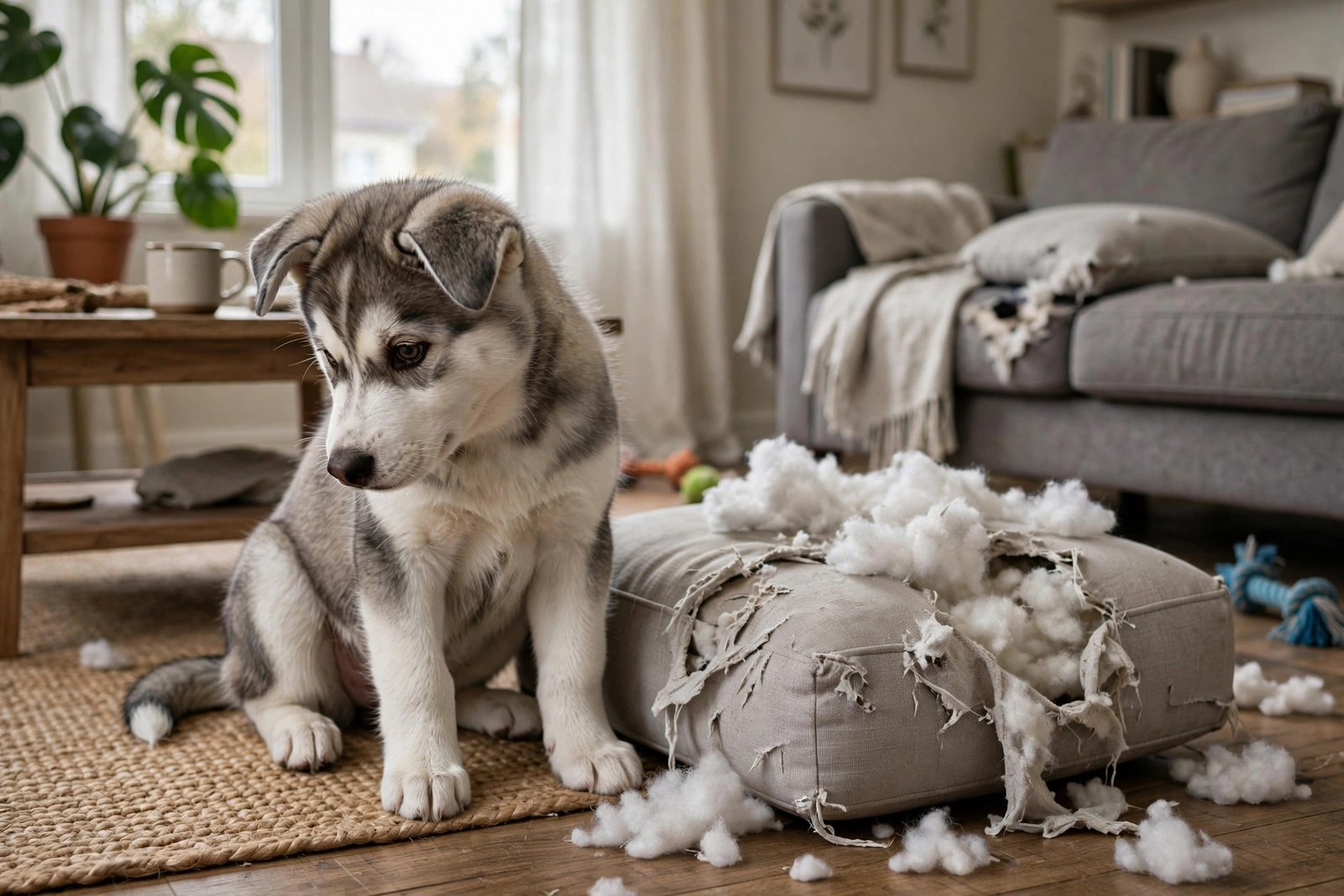
You come home to a crime scene: the couch cushion disemboweled, a shoe assassinated, the remote control missing buttons. Your dog greets you with a wagging tail and zero remorse. Destructive chewing when left alone is the top complaint of Chicago’s working dog owners, and the standard advice — “give them more toys” — fails because it misunderstands the cause. Dogs don’t destroy homes out of spite. They do it from anxiety, boredom, or unmet needs, and each cause needs a different fix. Here’s how to diagnose yours.
Diagnosis First: Anxiety, Boredom, or Puppy?
The treatment depends entirely on the motivation, and the evidence is in the pattern:
Separation anxiety destroys near exit points — door frames, windowsills, blinds. The dog isn’t chewing randomly; they’re trying to get out and find you. Other signs: drooling pools, howling/barking for hours (your neighbors know), house-soiling despite being housetrained, and destruction that starts within minutes of departure. This is panic, not mischief — and it’s the most urgent diagnosis because the dog is suffering.
Boredom/under-stimulation destroys broadly and opportunistically — shoes, remotes, cushions, trash. The dog was fine for hours, then got creative. These dogs are typically young, high-energy, and under-exercised. The destruction is a job they invented because you didn’t provide one.
Puppy teething/exploration chews everything mouth-accessible, including your hands. Puppies explore with their mouths and teething hurts until ~6 months. This is developmental, not behavioral — it needs management and redirection, not anxiety treatment.
Set up a camera for three days before doing anything else. The footage tells you which dog you have, and guessing wrong wastes months. The ASPCA’s behavior resources have a separation anxiety vs. boredom checklist that matches this diagnostic approach.
The Boredom Fix: A Tired Dog Is a Good Dog
If the camera shows a dog that naps for hours then gets destructive, the prescription is enrichment, not punishment. The formula Chicago trainers recommend:
Morning Depletion Is Non-Negotiable
A 30–45 minute real workout before you leave — fetch, running, flirt pole, training session — converts the morning from anxiety-rehearsal to nap time. Apartment enrichment routines that front-load exercise and mental work are the foundation; everything else is decoration without this.
Make Alone Time a Job
Scatter feeding (toss kibble across a room instead of bowl-feeding), frozen Kongs layered like lasagna (kibble, peanut butter, banana, freeze overnight), snuffle mats, and puzzle feeders turn 8 alone hours into a work shift. Rotate the puzzles — novelty matters; the same Kong daily becomes furniture. Leave a “destruction box”: a cardboard box filled with paper and treats the dog is explicitly allowed to shred. Legal destruction satisfies the urge.
Confinement as Kindness
A bored dog with whole-house access is a dog with a hundred bad options. A dog-proofed room or pen with enrichment limits the options to good ones. This isn’t punishment — it’s setting the dog up to succeed. And protect the irreplaceable: flooring and furnishings chosen for dogs survive the training period far better than pristine white couches.
The Anxiety Fix: Treating Panic, Not Mischief
If the camera shows panic — destruction at exits, drooling, vocalizing for hours — enrichment alone won’t cut it. Separation anxiety is a clinical condition needing a clinical protocol:
Desensitize departures: practice the departure cues (keys, shoes, bag) dozens of times without leaving, then leave for seconds and return before panic — hundreds of reps, building duration over weeks. This is slow, unglamorous, and it works.
Medication helps: for moderate to severe cases, vet-prescribed daily anti-anxiety medication (fluoxetine) plus situational support lowers the panic floor so training can work. There’s no prize for white-knuckling through a treatable condition.
Don’t crate a panicking dog unless the crate is already a safe happy place — anxious dogs injure themselves escaping crates, breaking teeth and tearing nails. And never punish destruction discovered after the fact; the dog can’t connect your anger to hours-ago chewing, so punishment just adds fear to anxiety.
Daycare or a midday companion can bridge the gap during training — not as a permanent crutch, but as welfare support while the protocol works. Many Chicago owners use daycare 2–3 days a week during the desensitization months.
Puppy-Proofing and Redirection
For the developmental chewer: manage the environment ruthlessly. Everything chewable goes up or away — shoes in closets, remotes in drawers, trash behind cabinet doors. The AKC’s expert advice library has puppy-proofing checklists room by room. Bitter apple spray on furniture legs helps some puppies. Provide a rotating cast of appropriate chews matched to chew style (power chewers need black Kongs and benebones, not plush toys they’ll eviscerate in minutes). Redirect every single time: trade the shoe for the chew, praise the chew. Puppies that learn “chew this, not that” through hundreds of reps become adult dogs with reliable chew habits.
Exercise the puppy appropriately for their age — overtired puppies chew hardest, so enforced naps in the crate (once crate-trained positively) prevent the witching-hour destruction sprees.
The 30-Day Turnaround Plan
Put it together as a month-long project. Week 1: diagnose. Set up the camera, log the patterns, identify anxiety versus boredom versus puppy, and order enrichment supplies. Week 2: build the foundation. Start morning depletion sessions, introduce food puzzles and the destruction box, set up the confinement zone — and for anxious dogs, begin departure desensitization at seconds-long absences. Week 3: add structure. Fixed daily schedule, rotating puzzle toys, short training sessions for mental work; anxious dogs extend absences gradually while bored dogs add daycare days. Week 4: evaluate with fresh camera footage. Most owners see 70–80% improvement by now. If anxiety persists despite a faithfully followed protocol, that’s the signal for vet-prescribed medication — not failure, just the next tool. Document everything along the way; if you eventually consult a behaviorist, your logs make their job vastly easier.
Conclusion
Dogs that chew everything when left alone are communicating, not misbehaving: the anxious dog says “I’m panicking,” the bored dog says “I need a job,” the puppy says “I’m teething and everything is a toy.” Camera-diagnose first, then match the fix — desensitization plus possible medication for anxiety, morning depletion plus enrichment jobs for boredom, management plus redirection for puppies. Most Chicago owners see dramatic improvement within a month of the right protocol. The couch cushions can finally rest.
Frequently Asked Questions
Why does my dog only chew things when I’m gone?
Because the cause is tied to your absence: separation anxiety (panic, focused on exits), boredom (under-stimulation, broad destruction), or puppy developmental chewing. A pet camera for three days reveals which pattern matches your dog.
How do I stop my dog from destroying the house while I’m at work?
First diagnose with a camera. For boredom: morning exercise, food puzzles, frozen Kongs, and confinement to a dog-proofed area. For separation anxiety: gradual desensitization protocol, possibly with vet-prescribed medication. Punishment never works — the dog can’t connect it to hours-ago behavior.
Should I crate my dog to stop destructive chewing?
Only if the dog already loves the crate. Crating a bored dog with enrichment inside works well; crating a panicking separation-anxiety dog causes self-injury. Match the tool to the diagnosis.
Will my dog grow out of destructive chewing?
Puppies usually do by 12–18 months with consistent redirection and management. Adult boredom chewing doesn’t self-resolve — it needs more exercise and enrichment. Separation anxiety never self-resolves and typically worsens without treatment.