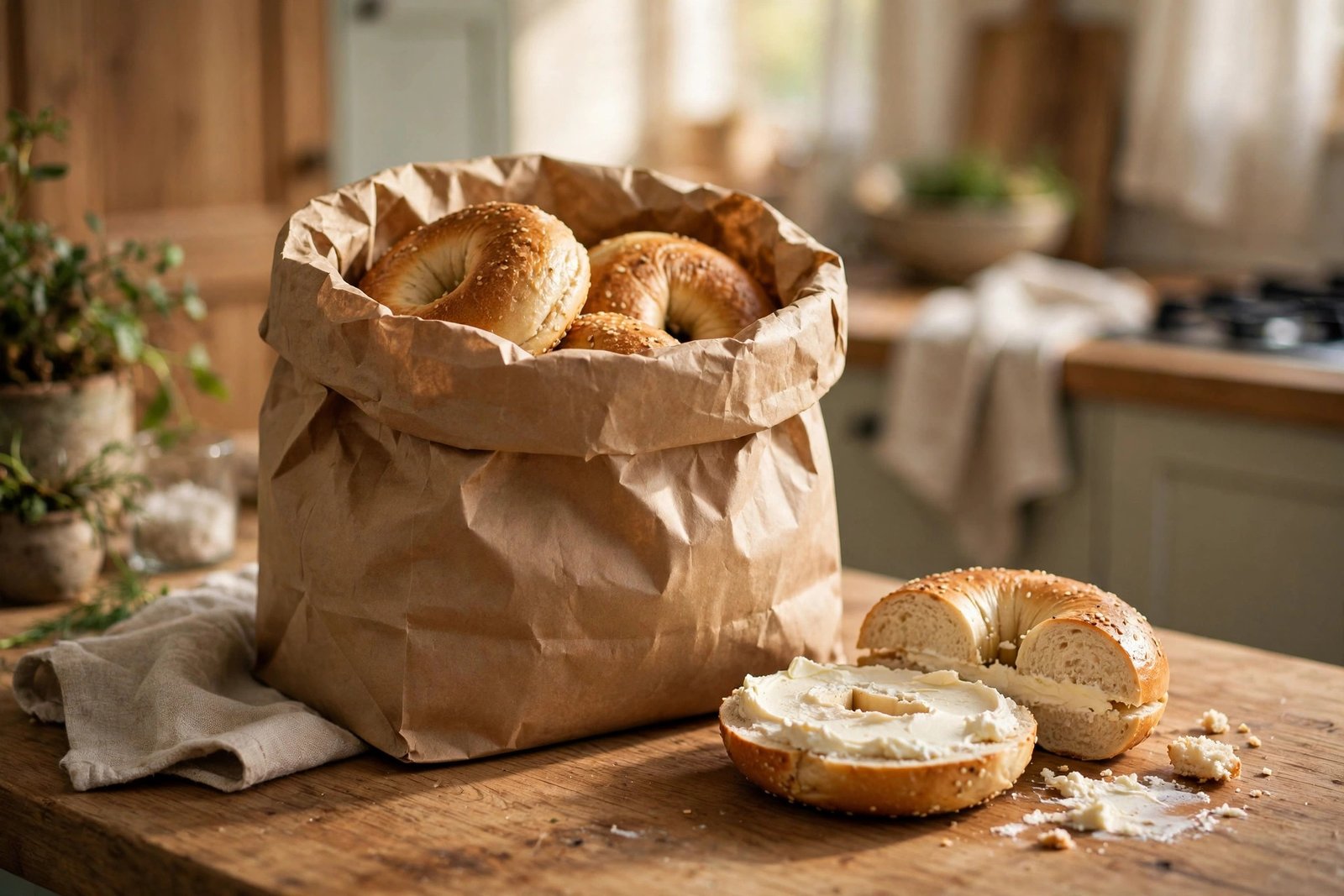
The best way to store bagels is at room temperature in a paper bag or bread box, and eat them within 2 days. Keep them unsliced until you’re ready to eat, and don’t refrigerate them — the fridge actually makes bagels go stale faster. If you can’t finish them in two days, slice and freeze them instead; they’ll stay good for up to 3 months.
Bagels are one of those foods people consistently store wrong. They’re chewy, dense, and seem sturdy, so it’s tempting to toss the bag in the fridge like you’d do with sandwich bread. That’s the single biggest mistake you can make. Here’s the method that actually works, why it works, and how to rescue a bagel that’s gone a little sad.
Quick Storage Rules for Bagels
- Days 1–2: Room temperature, in a paper bag or bread box. Unsliced.
- Never: The refrigerator. Cold air accelerates staling in bread products.
- Longer than 2 days: Slice, wrap tightly, and freeze for up to 3 months.
- Already stale? A quick toast or a sprinkle of water and a few minutes in a hot oven brings them back.
How to Store Bagels at Room Temperature (Step by Step)
This is your default move for bagels you’ll eat within a couple of days.
1. Leave them unsliced
Slicing a bagel exposes the soft interior crumb to air, and it dries out fast. A whole bagel has only its crust facing the world, which is much better at holding in moisture. Always slice right before toasting.
2. Use a paper bag or bread box
Paper breathes. It lets just enough moisture escape that the crust stays pleasantly chewy instead of going soggy, which is what happens in a sealed plastic bag. A bread box works the same way. If all you have is the plastic bag the bagels came in, crack it open or leave it loosely closed rather than sealing it tight.
3. Keep them away from heat and sunlight
Don’t park your bagel bag next to the stove or on a sunny windowsill. A cool, dry spot on the counter or in a cabinet is ideal. The USDA’s cold storage guidance applies the same logic broadly: room-temperature storage is fine for bread products for a short window, as long as the environment stays cool and dry — see the USDA’s safe food handling basics for the general principles.
Why You Shouldn’t Refrigerate Bagels
This surprises people, but refrigeration is the enemy of fresh bread. At fridge temperatures (around 35–40°F), the starches in bread recrystallize much faster than at room temperature — a process food scientists call starch retrogradation. Translation: your bagel gets firm, dry, and leathery in the fridge far quicker than it would on the counter.
The one exception is bagels with perishable toppings or fillings — cream cheese schmears, lox, egg salad, that kind of thing. Those need refrigeration for food safety, no question. But a plain bagel? Counter, always.
How to Freeze Bagels for Long-Term Storage
Bought a dozen and there’s no way you’ll eat them all by Wednesday? Freezing is genuinely excellent for bagels. They thaw and toast beautifully, sometimes even better than day-old fresh ones.
1. Slice them first
Slice each bagel in half before freezing. This does two things: it lets you pop a frozen half straight into the toaster, and it gives you the option to toast only what you need.
2. Wrap each bagel individually
Wrap each bagel (or each pair of halves) tightly in plastic wrap or foil, squeezing out as much air as you can. Then drop the wrapped bagels into a freezer bag and press out the remaining air before sealing. Double-wrapping is the difference between a bagel that tastes fresh in two months and one that tastes like freezer.
3. Label and freeze
Mark the bag with the date. Bagels keep well in the freezer for up to 3 months. Beyond that they’re still safe to eat, but the texture starts to suffer.
4. Thaw and toast
The easiest path: frozen bagel half straight into the toaster, maybe one extra cycle. Or thaw at room temperature for 20–30 minutes first. Either way, the result is a crisp-chewy bagel that rivals fresh.
How to Revive a Stale Bagel
Day-three bagel that’s lost its charm? Don’t throw it out. Run it quickly under the tap — yes, really, just a few seconds to dampen the crust — then bake it at 350°F for about 5 minutes. The moisture re-steams the interior while the heat re-crisps the outside. It won’t be a fresh-from-the-oven bagel, but it’ll be genuinely good, especially toasted with cream cheese. This trick works on most lean breads; King Arthur Baking covers similar revival techniques in their bread storage guide.
How Long Do Bagels Last?
- Counter (paper bag): 2 days at peak quality, up to 3–4 days if you’re toasting them.
- Refrigerator: Technically 5–7 days before mold risk, but texture degrades badly after day 1. Not recommended.
- Freezer: Up to 3 months with proper wrapping.
- With perishable toppings: Refrigerate and eat within 3–4 days.
Common Bagel Storage Mistakes
Storing them in a sealed plastic bag on the counter. Trapped moisture turns the crust gummy. Paper breathes; plastic doesn’t.
Freezing without wrapping. A bare bagel in the freezer is a freezer-burned bagel in two weeks. Wrap tightly.
Keeping bagels near the coffee maker or stove. Heat and steam speed up both staling and mold. Counter means a cool counter.
Much of this comes down to the same principles that govern storing any yeasted bread — if you’re into home baking, our guide on how long sourdough starter lasts in the fridge covers the cold-storage science for bread dough too. And if you’re prepping for a move or a long trip, the cold-packing tips in how to store dry ice are worth a read before you freeze anything in bulk.
FAQs
Can you store bagels in the fridge?
You can, but you shouldn’t. Refrigeration makes bagels go stale faster because cold temperatures accelerate starch retrogradation — the process that turns bread firm and dry. The only reason to refrigerate a bagel is if it has perishable toppings like cream cheese or lox.
How long do bagels stay fresh on the counter?
About 2 days at peak quality in a paper bag or bread box at room temperature. They’re still fine on days 3–4 if you toast them, but the chew starts to fade. For anything longer, freeze them.
What’s the best way to freeze bagels?
Slice them in half first, wrap each bagel tightly in plastic wrap or foil, then seal them in a freezer bag with the air pressed out. They’ll keep for up to 3 months and can go straight from the freezer to the toaster.
Should bagels be stored sliced or unsliced?
Unsliced, always — until you’re ready to eat or freeze them. Slicing exposes the interior crumb to air and dries the bagel out much faster. The one exception is pre-slicing before freezing, which makes thawing and toasting easier.
How do you know if a bagel has gone bad?
Mold is the clear signal — any fuzzy spots mean it’s done. A hard, dry bagel is just stale, not spoiled, and can usually be revived with heat. If it smells sour or off, though, toss it.