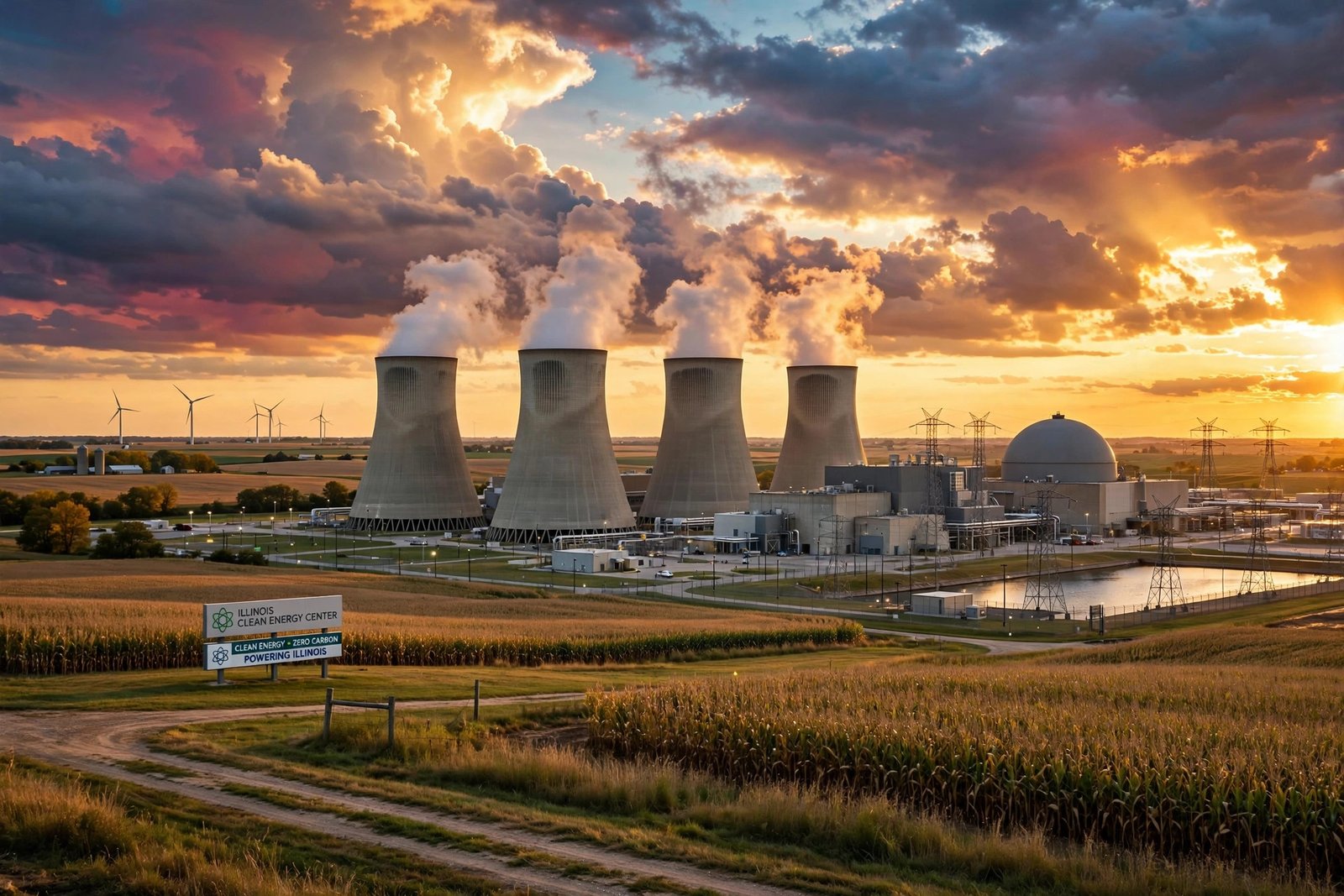
Ask a Chicagoan about nuclear energy and you’ll get a strong opinion — often formed by a mushroom cloud image from a 1980s movie rather than any actual data. Here’s the thing most people don’t know: Illinois already gets more than half its electricity from nuclear power, the most of any U.S. state. You’ve been living on nuclear energy for decades. So let’s set aside the movie imagery and ask the real question with real numbers: is nuclear energy actually safe compared to other sources?
This is an honest, data-driven comparison — deaths per unit of energy, waste, accidents, and climate impact — plus the Illinois angle that makes this question local, not abstract.
The Number That Settles Most Arguments
The fairest safety comparison is deaths per terawatt-hour of electricity produced, which accounts for the full lifecycle including mining, construction, and air pollution. The figures, compiled across major studies including UN and peer-reviewed sources: coal causes roughly 25 deaths per TWh, oil around 18, natural gas about 3, nuclear about 0.03 — and wind and solar around 0.04 and 0.02 respectively. Read that again: nuclear’s death rate is comparable to wind and solar, and roughly a thousand times lower than coal’s. The EIA’s nuclear energy explainer provides the production context behind these comparisons.
Why does nuclear feel dangerous while coal feels normal? Psychologists call it the availability heuristic: rare, dramatic events (Chernobyl, Fukushima) dominate memory, while the routine toll of fossil fuels — air pollution killing millions annually worldwide — is invisible because it’s diffuse. Coal’s victims don’t make headlines; they make hospital statistics.
What About the Big Accidents?
Honesty requires facing the worst cases directly. Chernobyl (1986) was a catastrophic failure of an inherently unstable reactor design operated recklessly without a containment structure — a combination modern Western reactors physically cannot replicate. It caused dozens of direct deaths and thousands of projected cancer cases, a genuine tragedy. Three Mile Island (1979) caused zero deaths and minimal radiation release, though it terrified the public. Fukushima (2011) killed no one from radiation — the deaths were from the tsunami and a panicked evacuation — though it displaced over 100,000 people and contaminated land.
The pattern: even including the worst accidents in history, nuclear’s total death toll is dwarfed by the routine, ongoing toll of fossil fuels. And reactor design has moved on — modern designs include passive safety systems that shut down without human intervention or external power, directly addressing Fukushima’s failure mode. Fear the old designs’ history; evaluate the current technology on its record.
The Waste Question, Answered Plainly
Nuclear waste is the strongest emotional argument against nuclear, and it deserves a straight answer. All of the used nuclear fuel ever produced by the U.S. commercial fleet would fit on a single football field stacked about 10 yards high — the total volume is astonishingly small because nuclear fuel is so energy-dense. High-level waste stays dangerous for thousands of years, which sounds terrifying until you compare: coal plants produce millions of tons of ash annually, including toxic heavy metals that never decay at all, plus the CO2 driving climate change.
The waste challenge is political more than technical: deep geological repositories (like Finland’s Onkalo, now operating) safely isolate waste, but the U.S. has stalled on a permanent repository for decades, leaving waste in secure dry-cask storage at plant sites. It’s a real unsolved policy problem — but “we haven’t built the permanent storage” is different from “no safe storage is possible.”
The Illinois Angle: You’re Already Nuclear
Illinois operates more nuclear reactors than any other state — plants like Braidwood, Byron, Clinton, Dresden, LaSalle, and Quad Cities — supplying over half the state’s electricity with near-zero carbon emissions. The U.S. Department of Energy on nuclear reliability notes nuclear runs at over 90% capacity factor, roughly double coal or gas and triple wind or solar — it’s the always-on backbone that lets renewables fluctuate. Illinois’s Climate and Equitable Jobs Act explicitly subsidized keeping these plants open precisely because closing them would have spiked both emissions and electricity prices, as happened when nuclear plants closed in other states and gas filled the gap.
This is worth sitting with: the state with America’s largest nuclear fleet also has some of its most ambitious climate goals, and that’s not a contradiction — it’s the strategy. If you’re weighing the environmental costs of running large AI systems, note that tech companies are now signing nuclear power deals for data centers for exactly this reason: massive, reliable, carbon-free electricity. And whatever powers your home, energy-efficient upgrades that cut your home’s power demand remain the cheapest clean energy of all.
What About Terrorism and Proliferation?
Two fears deserve direct answers. On terrorism: commercial reactors are among the most hardened civilian structures in existence — massive reinforced-concrete containment buildings designed to withstand aircraft impacts, with multiple layers of security. Security experts consistently rank attacks on nuclear plants as a far less plausible mass-casualty vector than attacks on chemical facilities or crowded venues. On proliferation: civilian power programs and weapons programs are technically distinct, though the knowledge overlaps. This is a genuine geopolitical concern managed through international inspection regimes, and it’s a legitimate factor in debates about exporting nuclear technology to unstable regions — but it has little bearing on whether existing Illinois plants should keep operating.
The Honest Downsides
A fair assessment includes real concerns: nuclear plants are expensive and slow to build in the U.S. (though costs vary enormously by country), uranium mining has environmental impacts, the waste repository question remains politically unsolved here, and nuclear weapons proliferation concerns are legitimate in a global context. These are serious issues — they’re just different issues than “will the plant explode.” Evaluate nuclear against the actual alternatives being built today, not against a perfect imaginary energy source.
Conclusion
By the numbers, nuclear energy is among the safest energy sources ever deployed — comparable to wind and solar in deaths per unit of electricity, vastly safer than fossil fuels, and the reliable carbon-free backbone already powering most of Illinois. The fear is understandable given the history, but the history includes the full context: even the worst accidents don’t approach fossil fuels’ routine toll. The honest debate about nuclear isn’t safety — it’s cost, speed of deployment, and waste policy. On safety, the data has been clear for decades.
Frequently Asked Questions
Is living near a nuclear plant dangerous?
Routine emissions from nuclear plants expose nearby residents to less radiation than a cross-country flight or even natural background variation. Multiple large studies have found no elevated cancer rates around Western nuclear plants.
What happens to nuclear waste long-term?
Currently it’s stored securely on-site in steel-and-concrete dry casks. The scientific consensus favors deep geological repositories — Finland has opened one — but the U.S. hasn’t completed a permanent site due to political, not technical, obstacles.
Could a U.S. plant have a Chernobyl-style disaster?
No — Chernobyl’s reactor design was inherently unstable and lacked a containment structure, a combination not used in Western plants. U.S. reactors have massive containment buildings and fundamentally different, more stable physics.
Why is Illinois so dependent on nuclear?
Illinois built a large nuclear fleet in the 1970s–80s, and the plants have proven economical and reliable. State policy now explicitly preserves them as the carbon-free foundation of the grid while renewables scale up.