Quantum computing is the technology everyone has heard of and almost no one can explain. Headlines alternate between “quantum will break all encryption tomorrow” and “quantum is decades away from doing anything useful,” leaving most people with a vague sense that it’s important and incomprehensible.
It doesn’t have to be. The core ideas behind quantum computing can be understood with no physics background — and understanding them matters, because quantum will reshape cryptography, drug discovery, and materials science within your lifetime. Here’s the plain-English version.
Start With the Problem: Why Normal Computers Hit Walls
Your laptop thinks in bits: tiny switches that are either 0 or 1. Everything — photos, videos, AI models — is built from billions of these binary choices. This works brilliantly for most tasks, but some problems explode beyond what bits can handle. Simulating a single molecule of caffeine, for instance, would require more classical bits than there are atoms in the universe, because molecular behavior involves tracking every possible configuration simultaneously.
These aren’t obscure problems. Designing better batteries, discovering new drugs, optimizing global logistics, breaking (or protecting) encryption — all involve searching unimaginably large possibility spaces. Classical computers check possibilities one at a time (or in parallel batches). Quantum computers, in theory, explore many possibilities at once. That’s the entire promise in one sentence.
Qubits: The 0-and-1-at-Once Trick
A quantum bit — qubit — exploits two strange quantum properties. Superposition means a qubit can exist as 0 and 1 simultaneously, not one or the other. Two qubits can represent four states at once; ten qubits, 1,024; three hundred qubits, more states than atoms in the observable universe. This exponential scaling is why quantum computers don’t need to be big to be powerful.
Entanglement links qubits so that measuring one instantly determines the state of another, no matter the distance. Combined with interference (quantum waves amplifying correct answers and canceling wrong ones, like noise-canceling headphones for math), these properties let quantum algorithms converge on solutions classical computers can’t reach.
The honest caveat: “0 and 1 at once” is a simplification physicists tolerate for beginners. The deeper truth involves probability amplitudes and complex numbers — but the simplification captures why quantum computing is powerful, which is what you need. If you want the AI-side parallel, our explainer on AI versus machine learning in simple terms uses the same no-jargon approach.
What Quantum Computers Will Actually Do
Quantum computers won’t replace your laptop — they’re terrible at everyday computing and likely always will be. They’re specialists for specific problem types:
Drug and materials discovery: Simulating molecules exactly as nature behaves, potentially designing new medicines, batteries, and catalysts atom by atom. This is the most promising near-term application.
Optimization: Finding best solutions in massive logistics, finance, and scheduling problems — the traveling-salesman problem at planetary scale.
Cryptography: The famous one. A large enough quantum computer could break RSA encryption, which protects banking, messaging, and government secrets. This is why the National Institute of Standards and Technology has been standardizing “post-quantum” encryption algorithms — the migration is already underway, years before the threat materializes.
What they won’t do: browse the web faster, run your apps better, or make AI obsolete. Quantum and classical computing are complementary tools, like a telescope versus a microscope.
Where Things Stand in 2026
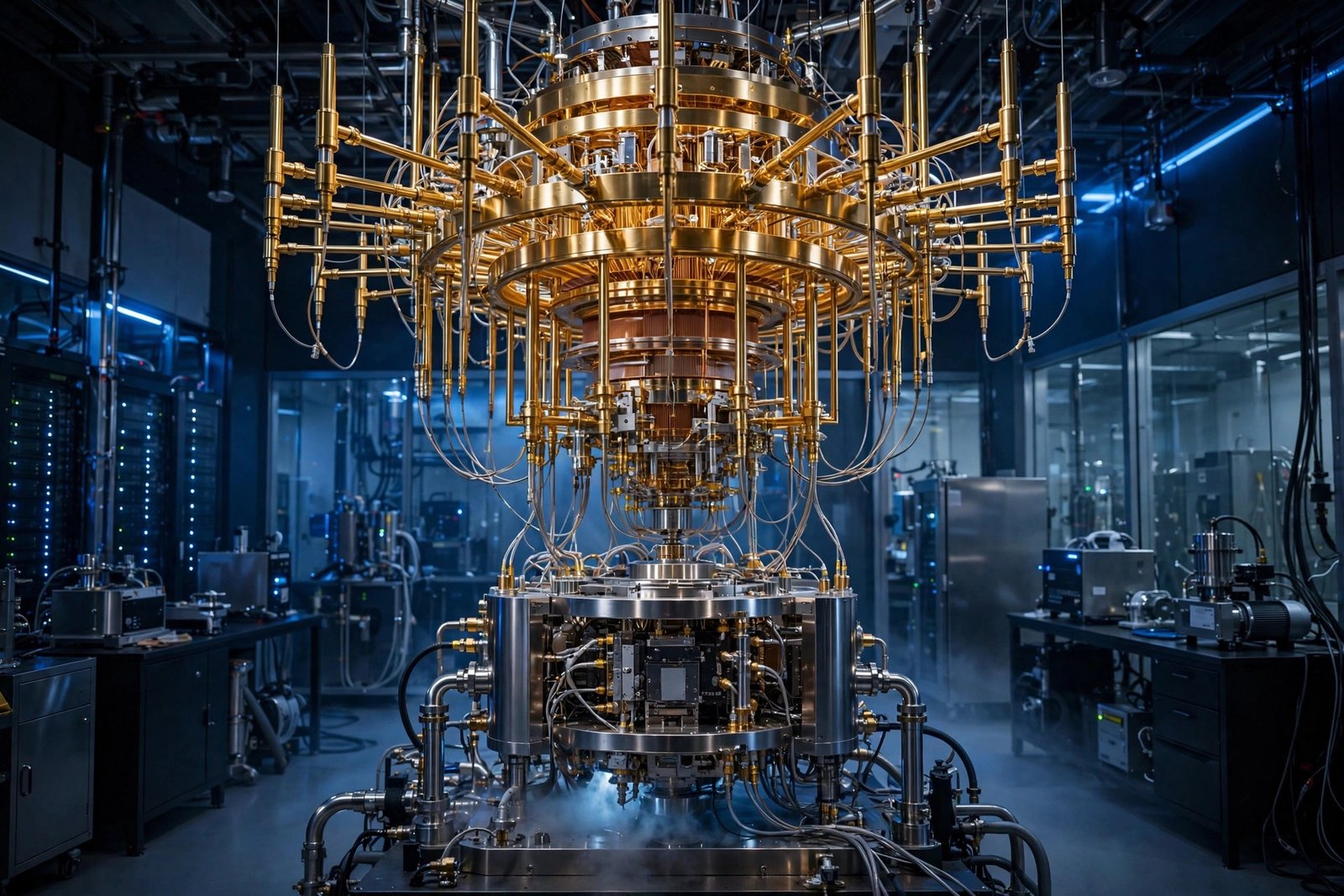
The field is past hype-peak and into serious engineering. Companies and labs have built machines with hundreds to thousands of physical qubits, but there’s a catch: qubits are incredibly fragile. Heat, vibration, and electromagnetic noise corrupt them in microseconds, requiring extreme cooling (colder than deep space) and elaborate error correction. Today’s machines are “noisy” — impressive physics demonstrations that can’t yet outperform classical computers on practical problems.
The race now is error correction: combining many fragile physical qubits into fewer reliable “logical” qubits. Experts’ timelines for truly useful, fault-tolerant machines range from the late 2020s to the 2030s — genuine uncertainty, not marketing. The U.S. Department of Energy’s Office of Science funds much of the foundational research, treating quantum as strategic infrastructure like the interstate highways. For the software side of the future, see our breakdown of what generative AI actually is — the two technologies will likely converge in scientific computing.
Why a Beginner Should Care
Three reasons. First, the encryption transition affects everyone — your bank, your messages, your medical records will all migrate to quantum-resistant cryptography; it’s the biggest invisible infrastructure project of the decade. Second, quantum-designed drugs and materials could meaningfully extend healthy lifespans and solve energy storage within your lifetime. Third, quantum literacy is becoming a genuine career edge in tech, finance, and policy — understanding the basics now puts you ahead of 99% of professionals.
Quantum vs. Classical: A Concrete Example
The abstract power of quantum computing clicks with a concrete comparison. Imagine planning delivery routes for 50 trucks across Chicago — a classic optimization problem. A classical computer tackles it by evaluating routes sequentially or in parallel batches, using clever heuristics to avoid checking every possibility (there are more possible routes than atoms in the universe). It finds good solutions, but can’t guarantee the best one.
A quantum approach encodes the problem so that quantum interference amplifies the probability of good routes and cancels bad ones — exploring the solution space in a fundamentally different way. In theory, it converges on optimal or near-optimal solutions for problems where classical machines stall. This isn’t magic: quantum computers need the right algorithm (like QAOA for optimization or Shor’s for factoring), careful error correction, and problems with the right mathematical structure. But for the specific class of problems where classical computing hits exponential walls, quantum offers a genuinely new kind of leverage — not a faster horse, but a different vehicle entirely.
Conclusion
Quantum computing in simple terms: computers that use qubits — which can be 0 and 1 simultaneously — to explore vast possibility spaces that overwhelm classical machines. They won’t replace your laptop; they’ll solve specific impossible problems in drug discovery, materials science, optimization, and cryptography. The hardware is real but noisy, with truly useful machines likely years away — and the encryption transition is already underway. You don’t need the math to grasp the stakes: a new kind of computer for a new kind of problem, arriving within the decade.
Frequently Asked Questions
What is quantum computing in simple terms?
Computing that uses quantum bits (qubits), which can represent 0 and 1 simultaneously, allowing quantum computers to explore many possible solutions at once — powerful for specific problems like molecular simulation and cryptography that overwhelm classical computers.
Will quantum computers replace regular computers?
No. Quantum computers are specialists for particular problem types (optimization, simulation, cryptography) and are worse than classical computers at everyday tasks. The two will work alongside each other.
Will quantum computing break all encryption?
A sufficiently large quantum computer could break current RSA encryption, but the threat is years away and the migration to quantum-resistant algorithms (standardized by NIST) is already underway.
When will quantum computers be useful?
Expert estimates range from the late 2020s to the 2030s for fault-tolerant machines solving practical problems. Current machines are important research tools but not yet practically superior to classical computers.
Do I need physics to understand quantum computing?
No — the core concepts (superposition, entanglement, and why they enable new computation) can be grasped intuitively. The deep mathematics matters only for researchers building the machines.