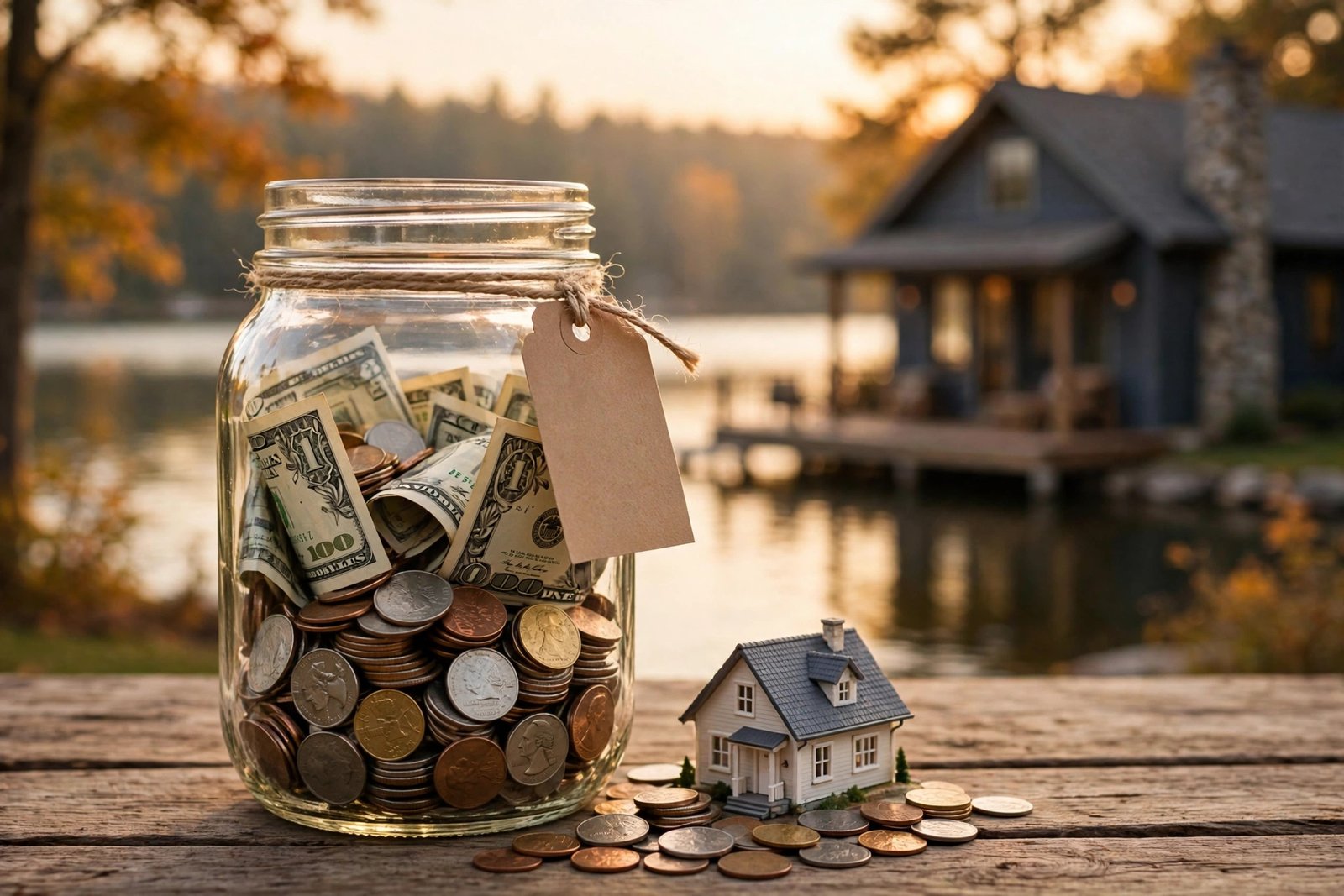
The median Michigan home costs roughly $250,000 — which means a 20% down payment is $50,000, a number that stops most first-time buyers cold. Even a 5% down payment ($12,500) plus closing costs feels like a mountain when rent keeps rising. But here’s what most Michigan buyers don’t know: you probably need far less than you think, the state will literally help you save it, and there’s a systematic way to get there faster than “save whatever’s left at month’s end.”
This guide covers the real down-payment math for Michigan buyers, the state programs that hand you thousands, and the savings system that turns an impossible number into a monthly plan.
How Much Do You Actually Need? (Less Than You Think)
The 20% figure is a myth for most buyers — it’s the threshold for avoiding PMI (private mortgage insurance), not a requirement. Michigan first-time buyers routinely purchase with 3–5% down through conventional loans, 3.5% through FHA loans, or 0% through VA loans (for eligible veterans) and USDA loans (for qualifying rural areas — much of Michigan outside the big metros qualifies). On a $250,000 home: 5% down is $12,500; add ~2–3% closing costs ($5,000–$7,500) and your real cash-to-close target is $18,000–$20,000 — substantial, but a different universe from $50,000.
The PMI tradeoff deserves honest math: putting 5% down instead of 20% means paying PMI (~$100–$200/month on this price range) until you hit 20% equity. That’s real money — but waiting five extra years to save 20% while home prices and rents rise usually costs more. Run both scenarios; for most Michigan buyers in 2026, buying sooner with PMI beats waiting years for 20%. The CFPB’s homebuying resources walk through these tradeoffs with calculators.
Michigan Programs That Pay You to Buy
This is the part national guides miss. The Michigan State Housing Development Authority (MSHDA) offers down-payment assistance up to $10,000 for qualifying first-time buyers — often as a zero-interest, deferred loan you don’t repay until you sell or refinance. Pair it with an MSHDA first mortgage (competitive rates, often below market) and your out-of-pocket plummets. Income limits apply (varying by county — higher in metro Detroit, lower elsewhere), and you’ll complete a homebuyer education course, which is genuinely useful anyway. Check current programs and find an approved lender at michigan.gov/mshda — availability changes, so verify before you plan around it.
Beyond MSHDA: many Michigan cities and counties run their own assistance programs (Detroit, Grand Rapids, and Flint have all offered local incentives at various times — check current availability), employers increasingly offer homebuyer assistance as a benefit (ask HR — Michigan’s big employers, hospitals, and universities often do), and federal options (FHA, VA, USDA) stack with state help. A buyer combining MSHDA assistance with an FHA loan can plausibly close with under $5,000 out of pocket. Talk to an MSHDA-approved lender early — they know every program you qualify for, and the consultation is free.
The Savings System: From Impossible to Automatic
A $20,000 target in 24 months is $833/month — daunting as a lump, manageable as a system. The method: open a dedicated high-yield savings account labeled “House” (separation prevents raiding; 4–5% APY in 2026 means your down payment earns while you save), automate a transfer on every payday before you see the money, and treat it like a bill — non-negotiable, not “whatever’s left.” Our 50/30/20 budgeting guide shows where the savings slice comes from; the down payment is its top priority until funded.
Accelerate with the big levers: tax refunds (the average Michigan refund is ~$3,000 — routing it straight to the house account is a 15% head start on a $20,000 goal), bonuses and side income (dedicate a percentage, not a fixed amount, so it scales), and temporary lifestyle compression (a 12-month “saving sprint” — roommate, cheaper car, paused subscriptions — can add $500+/month). Our tips on reducing monthly bills without lifestyle pain routinely free $100–$200/month — found money for the house fund. And keep the fund liquid and safe: no stocks, no crypto — a market dip right before closing is a catastrophe, not a buying opportunity.
Timeline Planning: When Will You Be Ready?
Work backward from your target date. Want to buy in spring 2028? That’s ~18 months: divide your target by 18 for the monthly number, add 10% buffer for surprises (inspection issues, rate changes), and sanity-check against your budget — if the monthly savings plus projected mortgage payment exceeds what you can sustain, extend the timeline rather than stretching thin. Michigan’s market is seasonal: listings peak April–June, competition (and prices) with them; buying in fall/winter often means less competition and more negotiating power — worth factoring into your target date.
While saving, do the parallel work: build credit (scores above 740 unlock the best rates — every 20 points can save thousands over the loan), pay down high-interest debt (lenders scrutinize debt-to-income ratios), avoid new credit applications in the 12 months before buying, and gather documents early (tax returns, pay stubs, bank statements — the paperwork drill). The saving period isn’t waiting; it’s preparation.
Mistakes That Delay Michigan Buyers for Years
Waiting for 20% while prices outrun savings — the most expensive mistake, as calculated above. Raiding retirement accounts — the penalties, taxes, and lost compounding dwarf any PMI savings. Keeping the down payment in volatile investments — a 2022-style drawdown delays you years. Ignoring assistance programs — MSHDA’s $10,000 is real money left on the table by buyers who never ask. And buying the maximum you qualify for rather than what fits your life — lenders approve payments that leave no margin; your budget, not theirs, should decide.
Conclusion
Saving for a Michigan down payment is a systems problem, not a willpower problem: know your real number (often $15,000–$20,000, not $50,000), claim every assistance dollar (MSHDA’s $10,000 changes the game), automate savings into a dedicated high-yield account, accelerate with windfalls and bill cuts, and prepare credit and paperwork in parallel. The mountain is climbable — thousands of Michigan first-time buyers do it every year, most starting exactly where you are now. Open the account this week. Future homeowner thanks you.
Frequently Asked Questions
What is the best way to save for a down payment in Michigan?
Calculate your real target (often 3–5% down plus closing costs, ~$18,000–$20,000 on a median home), claim MSHDA assistance (up to $10,000), automate monthly transfers to a dedicated high-yield savings account, and accelerate with refunds and bill cuts.
How much down payment do I need for a house in Michigan?
3–5% for most first-time buyer loans (FHA 3.5%, conventional 3–5%), 0% for VA/USDA eligible buyers. 20% avoids PMI but isn’t required — and waiting for it often costs more than PMI does.
What is MSHDA down payment assistance?
The Michigan State Housing Development Authority offers up to $10,000 in down-payment help for qualifying first-time buyers, often as a zero-interest deferred loan, paired with competitive first mortgages. Income limits and homebuyer education apply.
Should I keep my down payment savings in stocks?
No — keep it in a high-yield savings account. Market volatility can delay your purchase by years; the 4–5% HYSA yield with zero risk is the right tradeoff for money you’ll need within 2–3 years.
How long does it take to save for a down payment in Michigan?
At $800/month toward a $20,000 target, about two years — faster with assistance programs, tax refunds, and bill cuts. MSHDA assistance can effectively cut the timeline significantly.