
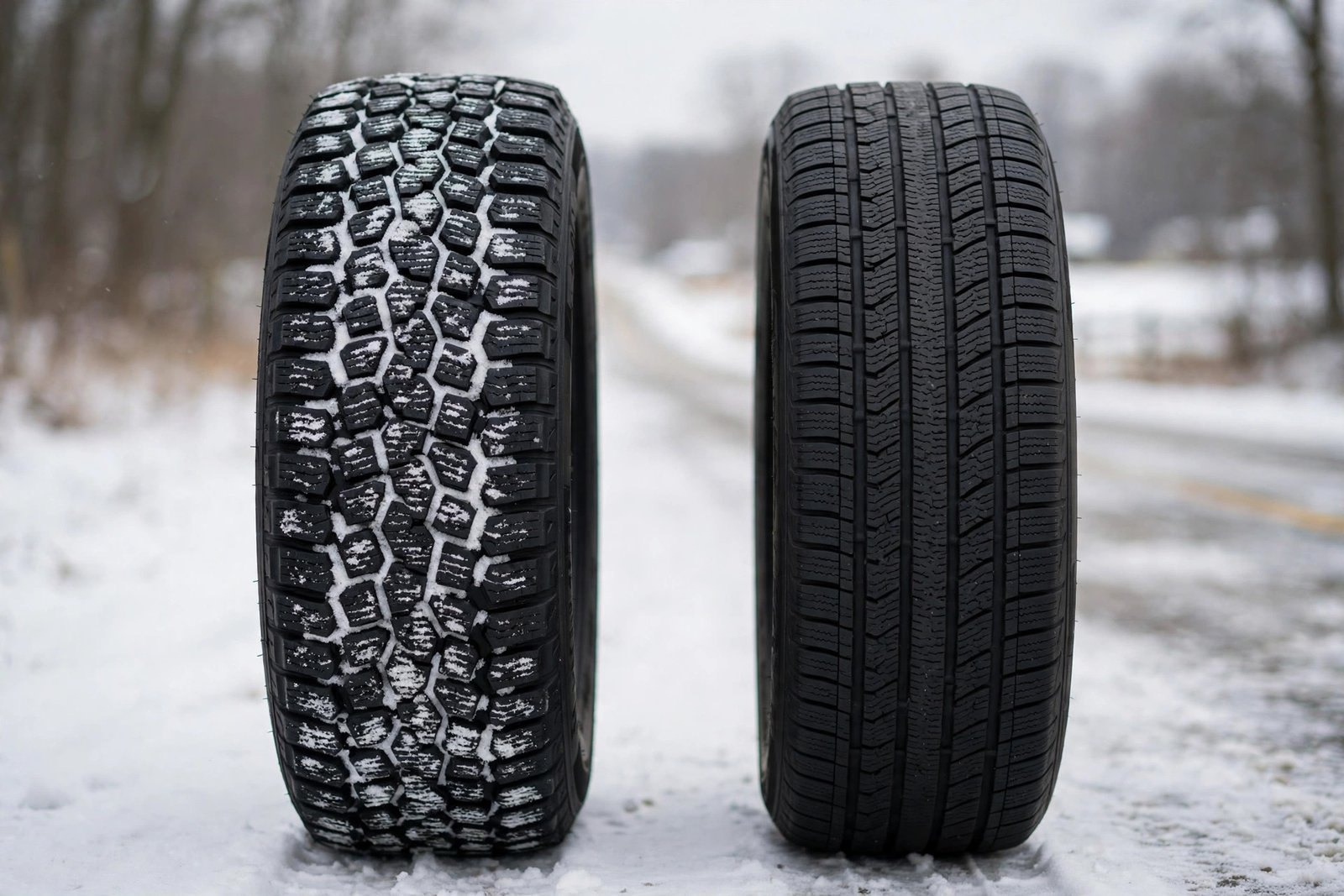
Every October, Ohio drivers face the same $800 question: spring for a set of dedicated winter tires, or trust the all-seasons already on the car? Tire shops push winters hard; your neighbor swears all-seasons are fine; and the internet argues about it endlessly. The truth is more nuanced than either camp admits — the right answer depends on where in Ohio you drive, what you drive, and how much winter risk you’re willing to carry. Here’s the evidence-based breakdown.
What Actually Differs: It’s the Rubber, Not Just the Tread
The critical difference isn’t the aggressive tread pattern — it’s the rubber compound. All-season tires use a compound optimized for moderate temperatures; below about 45°F, that rubber hardens like a hockey puck, losing grip even on dry pavement. Winter tires use a softer compound that stays pliable in cold, plus thousands of tiny slits (sipes) that bite into snow and ice.
The performance gap is dramatic and measurable: on snow, winter tires can cut braking distances by 30–50 percent compared to all-seasons. On ice, the difference is even starker. Tire Rack’s instrumented testing consistently shows winter tires stopping 30+ feet shorter from 30 mph on snow — roughly two car lengths, which is the difference between a scare and a collision. This isn’t marketing; it’s physics.
The Case for Winter Tires in Ohio
- Lake-effect snow belts: If you live in Cleveland’s east side, Ashtabula, or the snow belt stretching through Geauga and Lake counties — where annual snowfall tops 100 inches — winter tires aren’t optional equipment; they’re essential safety gear.
- Rural and hilly driving: Unplowed township roads and the hills of southeast Ohio punish all-seasons brutally. Winter tires are the difference between getting home and getting stuck.
- Rear-wheel-drive vehicles: RWD sports cars and trucks on all-seasons in snow are genuinely hazardous. Winter tires transform them.
- Long commutes: If you drive 30+ miles daily through winter, the safety margin compounds over thousands of cold-weather miles.
- You keep cars long-term: Running winters November–March means your all-seasons last nearly twice as long — the “extra cost” largely washes out over time.
The Case That All-Seasons Are Enough
- Urban Columbus/Cincinnati/Dayton: These cities average 20–30 inches of snow annually, with fast plowing on main routes. A quality all-season (not a worn one) handles typical conditions acceptably.
- All-wheel drive: AWD helps you go but does nothing for stopping — the most important winter function. Still, AWD plus good all-seasons is adequate for milder Ohio winters.
- Short, flexible commutes: If you can work from home on the five worst days of winter, you’ve dodged most of the risk all-seasons can’t handle.
- Budget reality: A winter set with steel wheels runs $700–$1,200. If that breaks the budget, fresh all-seasons plus cautious driving beats worn winters or bald all-seasons every time.
The Math: What Winter Tires Really Cost
A set of four winter tires on basic steel wheels: $700–$1,200 installed. Seasonal changeovers run $60–$100 per swap (or free if you buy a second set of wheels and DIY). But here’s the key insight: you’re not adding tire wear, you’re splitting it. Tires driven 5 months a year last roughly twice as many years. Over a 6-year horizon, the true extra cost is just the wheels ($300–$500) plus changeovers — maybe $100–$150/year for a massive safety upgrade. Framed that way, it’s among the cheapest safety improvements you can buy for a car. Budgeting for it is straightforward with budget-conscious car planning habits.
All-Weather Tires: The Third Option
There’s a middle path many Ohio drivers miss: all-weather tires (distinct from all-seasons) carry the three-peak mountain snowflake rating, meaning they meet winter traction standards while staying on year-round. Brands like the Michelin CrossClimate2 or Nokian WR series deliver perhaps 80 percent of a true winter tire’s snow performance with zero seasonal swaps. For urban and suburban Ohio drivers who want better winter safety without the hassle, all-weathers are often the sweet spot — a genuine upgrade over all-seasons with none of the logistics.
What About Studded Tires or Chains?
Ohio permits studded tires from November through April, but they’re overkill for most drivers — noisy, damaging to dry pavement, and worse-braking on clear roads than studless winters. Chains are legal when conditions require but impractical for daily driving. Modern studless winter tires outperform studs in most real-world conditions anyway.
Making the Decision: A Simple Framework
- Snow belt or 60+ inches annual snow? → Winter tires, no debate.
- Urban Ohio, moderate snow, AWD or FWD? → Quality all-weathers or good all-seasons are defensible; winters are still safer.
- RWD vehicle anywhere in Ohio? → Winter tires strongly recommended.
- Can you avoid driving on the worst days? → Flexibility reduces the need; inflexibility increases it.
- What’s on the car now? → Tread depth under 5/32″ means any new tire — winter, all-weather, or all-season — is the priority purchase.
If you travel in winter, remember that rental cars in snow country come with whatever tires the fleet chose — knowing what to check before renting a car includes asking about tires when heading into winter conditions.
Ohio’s Snow Belt: Where Winters Hit Hardest
Not all of Ohio experiences the same winter — and tire decisions should reflect that. The lake-effect snow belt east of Cleveland (Lake, Geauga, Ashtabula counties) averages 100+ inches of snow annually, with sudden whiteouts off Lake Erie; here, winter tires are as essential as brakes. Central Ohio (Columbus) sees 25–30 inches with efficient plowing — quality all-weathers suffice for most drivers. The Cincinnati-Dayton corridor is mildest, though ice storms (worse than snow for all tire types) strike periodically. The Tire Rack’s instrumented winter testing quantifies exactly how each tire category performs on snow and ice, and NHTSA’s winter driving guidance covers the techniques that matter regardless of rubber: longer following distances, gentle inputs, and knowing when to stay home. Match your tire investment to your county’s reality, not the state’s average.
Conclusion
For Ohio’s snow-belt drivers, rural commuters, and RWD owners, winter tires are essential safety equipment that pays for itself in split tire wear. For urban drivers in milder areas with good all-seasons and flexible schedules, quality all-seasons — or better yet, all-weather tires with the snowflake rating — are a reasonable choice. The wrong answer isn’t picking either option; it’s driving on worn tires while debating the question. Check your tread depth today: if it’s under 5/32″, your first job isn’t choosing a tire type — it’s buying new tires, period.
Frequently Asked Questions
At what temperature should I switch to winter tires?
When average daily temperatures consistently drop below 45°F — typically late October/early November in northern Ohio. The rubber compound difference matters on cold dry pavement, not just snow.
Can I just put winter tires on the front wheels?
No — never mix. Mismatched grip front-to-rear causes dangerous handling imbalances, especially in turns and braking. Always install four matching winter tires.
How long do winter tires last?
Typically 4–6 winter seasons (20,000–30,000 miles of winter driving). The soft compound wears fast on warm dry pavement, so remove them promptly in spring — driving winters through summer destroys them in one season.
Are all-weather tires as good as winter tires?
Not quite — they deliver roughly 80 percent of winter-tire snow performance. But they’re dramatically better than all-seasons and require no seasonal changeovers, making them ideal for moderate Ohio winters.
Do I need separate wheels for winter tires?
Strongly recommended. Steel wheels ($75–$125 each) protect your nice alloys from salt, make seasonal swaps cheap and fast, and pay for themselves by eliminating mounting/balancing fees twice yearly.


