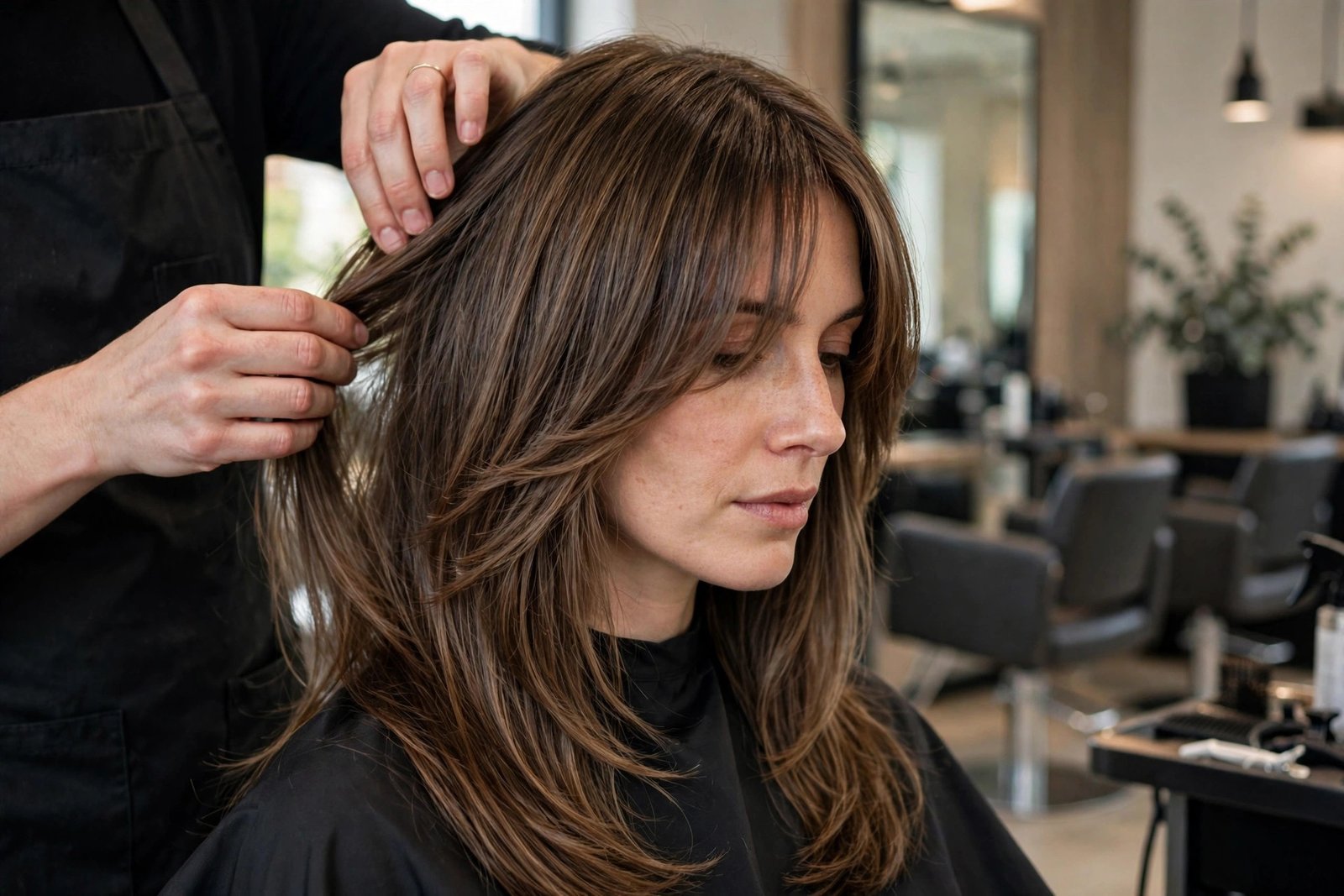
“Will this haircut make my face look rounder?” It’s the question every round-faced client asks, and the internet’s answer — a wall of contradictory rules about bobs, bangs, and “slimming” cuts — only confuses things. Here’s the truth stylists work from: there’s no single “best” haircut for a round face, because the goal was never to disguise your face shape. It’s to create balance, movement, and angles that complement your features. Here’s how that actually works.
Understanding Round Faces (Without the Pseudoscience)
A round face has roughly equal width and length, with soft angles at the jaw and full cheeks. The classic styling goal is elongation and definition — creating vertical lines and angles that contrast the face’s natural softness. But the modern approach is less rigid than the old “rules”: many stylists now focus on what you want to highlight (eyes, cheekbones, jawline) rather than what to “correct.” Your face isn’t a problem; the haircut is a frame, and frames should flatter, not hide.
Key structural principles: length below the chin generally elongates (long hair draws the eye vertically); volume at the crown adds height; volume at the sides at cheek level widens (usually avoided for round faces); and angular or textured elements (layers, asymmetry, side parts) contrast softness more effectively than blunt, symmetrical cuts.
The Cuts That Consistently Work
Long Layers
The safest, most versatile choice. Length past the shoulders elongates naturally, and long layers starting below the chin create vertical movement without adding cheek-level width. Face-framing layers that start at the collarbone or below slim visually while keeping the softness. This is the cut stylists recommend when clients want change without risk.
The Long Bob (Lob)
The lob — hitting between chin and collarbone — is the round-face bob that works, because the extra length (versus a chin-length bob) avoids the horizontal line at the widest part of the face. Worn with texture or waves, it’s modern and flattering. The chin-length blunt bob is the one that emphasizes roundness — length is the entire difference.
Side-Swept Bangs and Curtain Bangs
Bangs are not the enemy of round faces — straight-across blunt bangs are. Diagonal lines (side-swept, curtain bangs parted off-center) break up the face’s symmetry and add the angles that flatter. Curtain bangs are particularly good: they frame the eyes, blend into layers, and grow out gracefully.
Pixies With Height
Short hair works on round faces when it has crown volume and texture — a pixie with lift on top elongates, while a flat, rounded pixie emphasizes width. The difference is styling: root lift and piece-y texture versus smooth roundness. Discuss your styling commitment honestly with your stylist; pixies need daily styling to maintain the shape that flatters.
What to Avoid (and Why)
Chin-length blunt bobs (horizontal line at the widest point), center parts with flat, one-length hair (emphasizes symmetry and width — though a center part with volume and layers can work), blunt straight-across bangs (shortens the face visually), and rounded, bowl-like shapes with no texture. These aren’t “forbidden” — they’re just cuts that emphasize rather than balance roundness, and some people love that. The American Academy of Dermatology’s hair care resources remind that hair health underpins any cut — damaged hair won’t hold the shape that makes these styles work.
Curly and Textured Hair on Round Faces
Curls change the calculus beautifully — natural volume and texture do half the flattering work automatically. The principles adapt: keep volume up top rather than wide at the sides (ask for layers that remove cheek-level bulk while keeping crown fullness), and embrace length, since long curls elongate dramatically. Deva-style dry cutting, where the stylist cuts curls in their natural state, prevents the shrinkage surprises of wet cutting. Avoid the rounded “triangle” shape — too-short layers on top with heavy bottom weight — which is the curly equivalent of the unflattering blunt bob. Healthline’s curly hair care guides cover the moisture and cutting techniques that keep textured hair healthy enough to hold these shapes.
Growing It Out Gracefully
The best haircut includes an exit strategy. Ask your stylist how the cut grows: layered cuts grow out softly and need trims every 10–12 weeks; precision bobs and pixies need 4–6 week maintenance or they lose the shape that flatters. If you’re growing out a short cut, the awkward stages are real — headbands, texture spray, and strategic tucking get you through. Plan the grow-out with your stylist in advance rather than suffering through it; a good stylist can map transition trims that keep every stage wearable.
The Consultation: Getting What You Want
Bring photos — three you love, and be honest about your styling routine. “Wash and go” people need different cuts than “I heat-style daily” people, and a good Chicago stylist will tell you which inspiration photos match your maintenance reality. Ask specifically: “Where will the shortest layer fall?” (below chin for elongation), “How much crown volume can we build in?” and “How will this grow out?” A cut that looks great for two weeks then grows into a triangle isn’t a good cut.
Consider your lifestyle too: Chicago winters mean hat hair for months — cuts with built-in texture and layers survive hats better than precision blunt cuts. And winter layering that doesn’t add bulk follows the same visual principle as round-face cutting: vertical lines and strategic structure over uniform width.
Styling the Cut You Have
The right styling multiplies any cut’s effect. Root-lifting spray at the crown before blow-drying, a deep side part (instant asymmetry), waves or texture through the lengths (movement breaks up roundness), and tucking one side behind the ear (reveals the jawline). These take five minutes and transform how the same haircut reads. Healthy hair styles better — nutrition for hair health supports the shine and strength that make layers and texture look intentional rather than frizzy.
Conclusion
The best haircut for a round face isn’t one cut — it’s any cut built on the right principles: length past the chin or textured height on top, diagonal lines over blunt horizontal ones, layers and movement over uniform roundness. Long layers, lobs, curtain bangs, and textured pixies all work because they follow these principles. Bring photos, be honest about maintenance, and remember the goal was never to hide your face. It’s to frame it beautifully — and round faces, with their softness and symmetry, take framing beautifully.
Frequently Asked Questions
What is the most flattering haircut for a round face?
Long layers, lobs (long bobs hitting below the chin), curtain or side-swept bangs, and textured pixies with crown height. The common principles: elongation through length, angles through asymmetry and layers, and avoiding horizontal lines at cheek level.
Should round faces avoid bangs?
No — only blunt straight-across bangs, which shorten the face visually. Side-swept bangs and curtain bangs flatter round faces by adding diagonal lines that break up symmetry.
Does short hair suit round faces?
Yes, with the right shape: pixies need crown volume and texture (not flat roundness), and bobs should hit below the chin (lobs) rather than at it. Discuss daily styling commitment with your stylist — short cuts need consistent styling to hold their flattering shape.
How do I make my round face look slimmer with hair?
Styling tricks: deep side part, root volume at the crown, waves or texture through lengths, face-framing layers starting below the chin, and tucking one side behind the ear to reveal the jawline. These create the vertical lines and asymmetry that balance roundness.