Every time someone asks me about how can i improve my posture while working from home, I notice the same pattern: people either overthink it or wing it completely. Both approaches cost you. After years of trial and error, I’ve landed on a middle path that’s simple and actually works. Here’s everything I’d tell a friend over coffee.
I’ll keep the jargon to zero and the opinions to plenty. Some of what I say will contradict what you’ve read elsewhere, and that’s fine — I’ll tell you why I landed where I did, and you can decide for yourself.
This is the part most guides gloss over, and it’s the part that matters most.
How can I improve my posture while working from home: What You Should Actually Know
I should mention where I’m coming from: I’m not a doctor, and this isn’t medical advice — it’s practical guidance from research and lived experience. For anything serious or persistent, a professional beats an article every time. That said, the fundamentals below are the same ones professionals recommend first.
Working from home wrecks posture because the couch, the kitchen chair, and the bed were never designed as offices. The classic WFH slump — head forward, shoulders rounded, lower back flattened — loads your neck and spine for eight hours straight, and the ache you feel at 5 p.m. is the bill coming due.
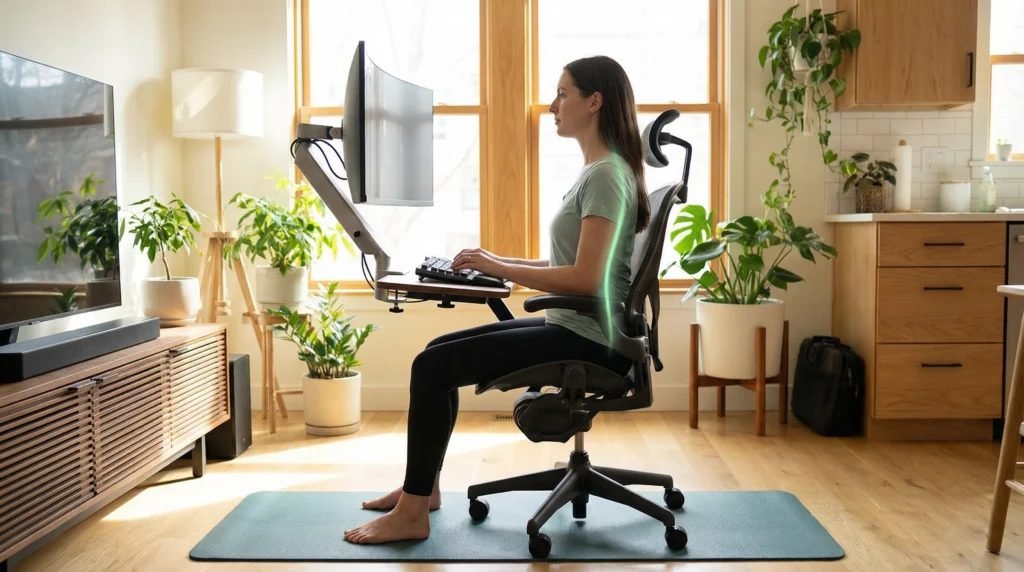
The fix isn’t a $1,200 ergonomic chair, though good seating helps. It’s mostly geometry: screen at eye level, elbows near 90 degrees, feet flat, and getting up regularly. I stacked my laptop on cookbooks for a year before buying a stand, and the cookbooks worked fine.
For the bigger picture, the CDC’s workplace health resources is worth a look — it backs up a lot of what I cover here.
Your body is built for movement, not for any single ‘perfect’ posture held all day. The best posture is genuinely your next posture — changing positions every 30 to 45 minutes beats sitting like a statue in an ergonomic throne.
What Actually Moves the Needle
This is the section to bookmark. Small, concrete actions beat grand plans every single time.
- Raise your screen to eye level with books or a stand — stop craning your neck down at a laptop.
- Get an external keyboard and mouse so your shoulders can relax.
- Sit with feet flat and knees roughly level with hips; a footrest helps if you’re short.
- Set a timer to stand and move for 2 minutes every half hour.
- Do chin tucks and shoulder-blade squeezes daily — two minutes reverses hours of slump.
- Alternate sitting and standing if you can; even a kitchen counter works for calls.
If this topic clicked for you, you’ll probably also get a lot out of our guide to How do I start meditating as a complete beginner, our guide to Why do I crave sugar so much in the evening, and our guide to Is it safe to exercise when you have a mild cold — they cover the adjacent questions people ask next.
Small Tweaks That Add Up Fast
Put a sticky note on your monitor that says ‘shoulders back, chin in.’ It sounds silly. It works — I catch myself mid-slump a dozen times a day because of a three-cent reminder.
If a tweak stops working, don’t abandon the goal — swap the tactic. Plateaus and friction are information, not verdicts. The people who succeed aren’t the most disciplined; they’re the most willing to adjust the plan until it fits.
One more resource I trust on this: the National Institutes of Health.
Mistakes Worth Avoiding
I’ve watched a lot of people (myself included) learn these lessons the hard way. Save yourself the trouble.
- Working from the couch or bed all day and wondering why everything hurts.
- Buying expensive gear before fixing the free stuff: screen height, breaks, movement.
- Holding one ‘perfect’ posture rigidly for hours — stiffness is the enemy, not just slouching.
Your First-Week Action Plan
Reading is nice; doing is better. Here’s a dead-simple seven-day ramp built from the tips above — no overwhelm, just one layer at a time. Each step takes minutes, not hours; the whole point is that a busy person can actually finish this.
- Day 1: Raise your screen to eye level with books or a stand — stop craning your neck down at a laptop. Get this handled first — it’s the foundation everything else builds on.
- Days 2–3: Get an external keyboard and mouse so your shoulders can relax. Give yourself a couple of days to make this feel normal.
- Day 4: Sit with feet flat and knees roughly level with hips; a footrest helps if you’re short. The basics are rolling now; time to add this next layer.
- Days 5–6: Set a timer to stand and move for 2 minutes every half hour. You’re in the groove — this is where momentum starts compounding.
- Day 7: Do chin tucks and shoulder-blade squeezes daily — two minutes reverses hours of slump. End the week by locking in this last piece, then run the whole week back.
Finally, give yourself permission to adjust. The plan that works in theory but not in your life is the wrong plan. Tweak timing, swap tactics, lower the bar temporarily — adaptation isn’t quitting, it’s how you build something that survives real life.
Quick Questions, Honest Answers
How long before I notice a difference with improve my posture while working from home?
Most people feel initial changes within two to four weeks of consistent effort, with meaningful results by eight to twelve weeks. The boring truth is that consistency beats intensity — small daily actions compound, while heroic one-week efforts fade.
Do I need to spend a lot of money on improve my posture while working from home?
No — and I’d argue spending more often slows people down, because it substitutes shopping for doing. The fundamentals here are mostly free or cheap: better habits, smarter food choices, and consistency. Spend money only on the bottlenecks you can’t solve free.
When should I talk to a professional about improve my posture while working from home?
When something persists despite four to six weeks of genuine effort, when symptoms are severe or worsening, or when you’re unsure what’s safe for your situation. A single visit can save months of guessing — professionals exist for exactly these questions.
The Bottom Line
You don’t need to do everything in this article. Honestly, nailing the basics will get you 80% of the way there. Start small, stay consistent, and revisit the rest when you’re ready. Future you will be glad you started today.