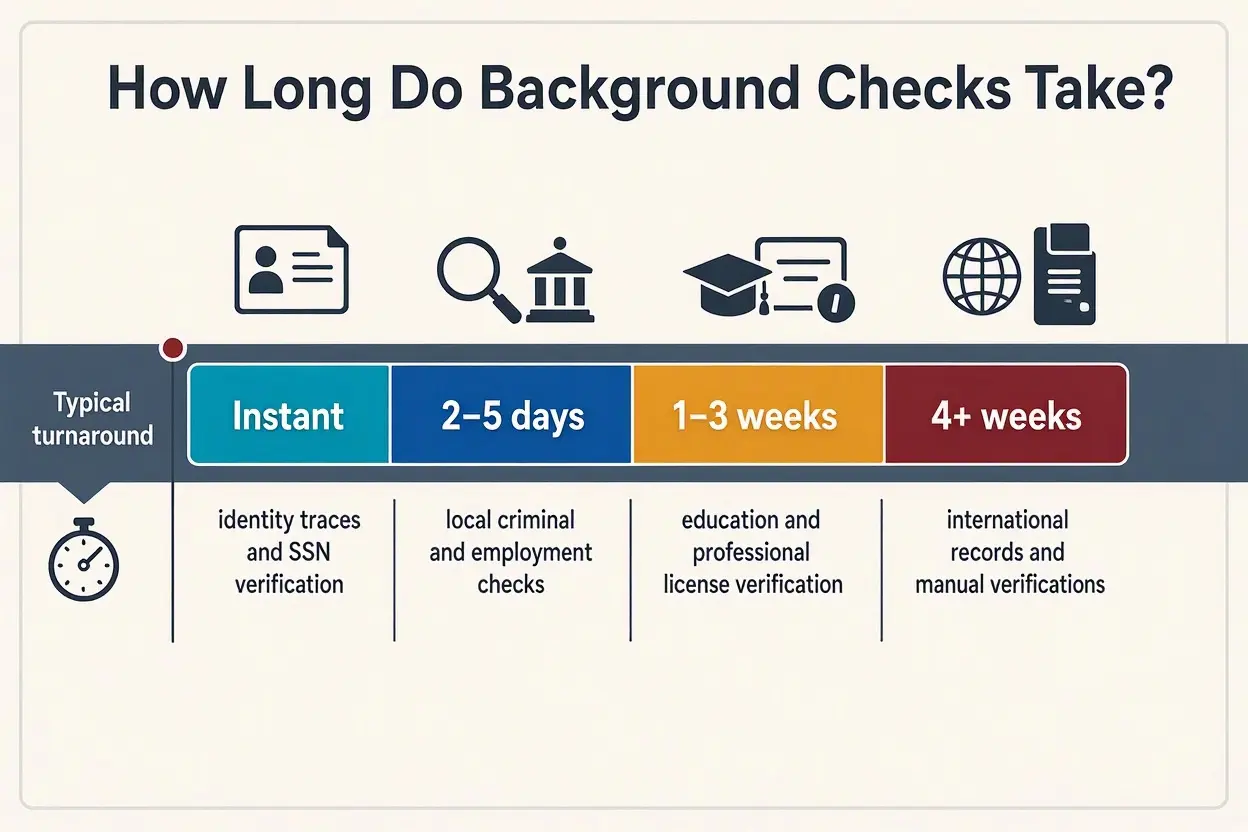
Most background checks take 1 to 5 business days. Simple checks can come back in 24 hours, while checks that involve multiple counties, international records or education and employment verification can take 7 to 14 days or longer. The exact time depends on what is being checked, who is running it, and how quickly outside sources respond.
The Quick Answer
| Type of background check | Typical turnaround |
|---|---|
| Instant online or database search | Minutes to 24 hours |
| Standard employment background check | 1 to 5 business days |
| County criminal record search | 1 to 3 business days (up to 2 weeks in slow courts) |
| Federal criminal record search | 1 to 3 business days |
| Employment verification | 1 to 5 business days |
| Education verification | 1 to 5 business days (longer during graduation season) |
| Professional license verification | 1 to 5 business days |
| Fingerprint (FBI) check, electronic | 24 to 72 hours |
| Fingerprint (FBI) check, mailed card | 2 to 6 weeks |
| International background check | 1 to 4 weeks or more |
| Gun purchase check (NICS) | Instant to 3 business days |
| Tenant or apartment screening | 1 to 3 days |
These are typical ranges, not guarantees. Your own timeline depends on the factors below.
What Affects How Long a Background Check Takes?
1. How many things are checked. A basic criminal search is fast. A full package with criminal records, employment history, education, references, credit and drug screening takes as long as the slowest item in it.
2. How many places you have lived. Criminal searches are usually run in each county (and sometimes state) where you have lived, worked or studied, often going back 7 years. More addresses mean more searches.
3. Court and records office speed. Many county courts are digital and respond within hours. Others still need a clerk to pull paper files by hand, which can take days or weeks.
4. Slow responses from past employers and schools. Verification depends on someone at your previous company or university replying. Small businesses, closed companies and schools that outsource verification are common bottlenecks.
5. Common names. If your name is common, the screening company needs extra time to confirm that a record actually belongs to you, usually by matching your date of birth or other identifiers.
6. International history. Records abroad depend on local laws and government offices. Some countries respond in days, others take a month or more.
7. Incomplete or incorrect information. A misspelled name, a wrong date of birth or a missing previous address can stall the process until it is corrected.
8. Holidays and peak seasons. Courts close on holidays, and schools are slow to respond during graduation and registration periods. Large hiring waves also create backlogs at screening companies.
9. The screening company. Different providers have different technology, court access and staffing. Some return most reports within one or two days, while others average longer.
Background Check Timeline by Type
Employment Background Checks
Most employers run a package that includes a criminal search, identity verification and sometimes employment and education checks. Expect 1 to 5 business days for most candidates. Some employers also bundle a drug test, which adds 1 to 3 days depending on the lab.
The employer usually starts the check after a conditional job offer. You will get an email from the screening company asking for your consent and personal details. Completing this quickly is the single best way to speed up the process, because the clock does not start until they have your information.
Criminal Background Checks
A county-level criminal search often finishes within 1 to 3 business days. A statewide database check can be faster but is sometimes less complete. A federal search covers federal court records and is also typically quick.
Delays happen when a county court has no online access and staff must search records manually.
Fingerprint and FBI Background Checks
Fingerprint-based checks are more thorough but can be slower.
- Electronic submission (for example, Live Scan): usually 24 to 72 hours, sometimes up to a week.
- Ink card submitted by mail: often 2 to 6 weeks, depending on how quickly the card is processed.
An FBI Identity History Summary requested directly can take longer than an employer or agency check because of volume.
Education and Employment Verification
These depend on third parties responding. Many verification requests are handled automatically through databases, so they can be done in a day. Manual requests to HR departments or registrars can take several days, especially if the school or employer is slow, closed, or no longer exists.
Credit, Drug and Reference Checks
- Credit report checks are usually instant.
- Drug screening results usually arrive in 24 to 72 hours after the sample reaches the lab.
- Reference checks depend on your references replying, typically 2 to 5 days.
Tenant and Apartment Background Checks
Landlords and property managers usually use online screening services that return results in a few hours to 2 days. Delays happen if your rental history or employer cannot be verified quickly.
Gun Purchase Background Checks
In the US, the NICS check is often completed within minutes. If the system cannot give an immediate answer, the seller may have to wait up to three business days before the sale can go ahead in many circumstances, and some states have longer waiting periods or their own rules. Check the rules in your state.
International Background Checks
These are the slowest. Timelines range from about a week to more than a month depending on the country, the records needed and whether in-country verification is required.
Why Is My Background Check Taking So Long?
If your check is past the usual window, the most common causes are:
- Pending verification from a past employer or school that has not responded.
- A county court with slow or manual record retrieval.
- A common name that requires extra identity matching.
- Incorrect or incomplete details in your application (name, date of birth, previous addresses).
- International records or multiple states to search.
- A possible record that needs additional review.
- A holiday, weekend or seasonal backlog.
- Your authorization or consent has not been completed.
Taking longer does not automatically mean something is wrong. In many cases, it means one source has not replied yet.
What to Do If Your Background Check Is Taking Too Long
- Check your email and spam folder. Screening companies often email you asking for extra details or consent, and the check may be waiting on you.
- Confirm your information is accurate. Verify your legal name, date of birth, Social Security number and address history.
- Log in to the screening company’s portal if one is provided and look for a status update or a pending item.
- Contact the recruiter or HR contact. They can see the status and sometimes nudge the process.
- Contact the screening company directly. The company name will be on the authorization form or email you received. They can tell you which part is pending.
- Help speed up verifications. If a former employer or school is slow, let them know a request is coming, or give the screening company a better contact.
- Wait a few more days before worrying. Five to ten business days is not unusual for a full-scope check.
Can You Speed Up a Background Check?
You cannot control court or employer response times, but you can avoid avoidable delays:
- Respond to screening emails the same day.
- Double-check spelling, dates and Social Security numbers before you submit.
- List every address you have lived at for the required period.
- Include full names of past employers and schools, with phone numbers or websites if you have them.
- Give accurate job titles and dates, since mismatches slow verification.
- Tell references to expect a call or email.
- Submit fingerprints electronically when that option exists.
What Is Checked in a Typical Background Check?
Depending on the job or purpose, a background check may include:
- Identity verification (Social Security number trace)
- Criminal records (county, state, federal)
- Sex offender registry search
- Employment history
- Education and degree verification
- Professional licenses
- Credit history (for certain roles, where allowed)
- Driving record (for driving jobs)
- Drug screening
- References
Employers usually only run what is relevant to the role, and they must follow laws such as the Fair Credit Reporting Act (FCRA) in the US.
How Far Back Does a Background Check Go?
Many checks look back 7 years, but it depends on the type of check, the state and the job. Some states limit how far back certain records can be reported. Convictions can often be reported for longer in some states, and certain senior or regulated roles, such as those involving children, healthcare or finance, may look back further. Federal law can also affect how far back some information is reported.
Your Rights During a Background Check
If you are in the US and an employer uses a third-party screening company:
- They must get your written permission before running the check.
- If they decide not to hire you based on the report, they must send you a copy of the report and a summary of your rights before making the final decision.
- You have the right to dispute inaccurate information, and the screening company generally must investigate within 30 days.
Rules vary by state and country, so check local laws for specifics.
Conclusion
Most background checks take 1 to 5 business days, with simple checks finishing in 24 hours and complex ones taking two weeks or more. The biggest factors are how many records are searched, how quickly courts, employers and schools respond, and how accurate your information is. To keep things moving, respond quickly to screening emails, provide complete and accurate details, and follow up with HR or the screening company if the check runs past the expected window.
FAQs
How long does a background check take?
Most take 1 to 5 business days. Basic checks can come back in 24 hours, and more detailed checks can take 1 to 2 weeks.
How long do employment background checks take?
Usually 1 to 5 business days after you submit your information and consent. Checks with education, employment or international verification can take longer.
Why is my background check taking so long?
Common reasons include slow responses from past employers or schools, county courts with manual records, a common name that needs extra verification, incomplete information, or international history.
How long does a criminal background check take?
Typically 1 to 3 business days. It can take longer if the court needs to retrieve records manually.
How long do fingerprint background checks take?
Electronic fingerprints often return in 24 to 72 hours. Ink cards sent by mail can take 2 to 6 weeks.
Does a long background check mean I did not get the job?
No. Delays are usually caused by slow records sources, not bad results. Ask the recruiter or screening company which part is pending.
How long does a background check take after a job offer?
Most candidates get results in 2 to 5 business days after they finish the authorization form. Employers may let you start work in the meantime or wait for the result, depending on company policy.
Can I start working before my background check is done?
Sometimes. Some employers allow a start date contingent on clearance, while others require the check to finish first. Check your offer letter or ask HR.
How long is a background check good for?
There is no universal rule. Many employers treat a check as valid for 30 to 90 days, but it depends on the employer, the screening company and the purpose.
How long can a background check take?
Most finish within a week, but international or court-delayed checks can take 2 to 4 weeks or more.
Can I check the status of my background check?
Yes. Use the portal link or email from the screening company, or ask the HR or recruiter contact who requested the check.
Do weekends count as business days for background checks?
No. Timelines are usually counted in business days, so weekends and public holidays do not count.