Those tiny needle teeth are no joke. Your new puppy lunges at your hands and feet with the enthusiasm of a furry piranha, and what starts as cute quickly becomes painful — especially when the kids are involved. Puppy biting is completely normal developmental behavior, but in a busy Chicago household it needs a clear training plan before those baby teeth turn into adult jaws. Here’s how to teach bite inhibition properly, without harsh methods that backfire.
Why Puppies Bite Hands and Feet in the First Place
Puppies explore the world with their mouths the way human toddlers use their hands. Mouthing is how they investigate texture, initiate play, and — critically — learn bite inhibition from their littermates. When one puppy bites another too hard, the bitten puppy yelps and stops playing. Over weeks, puppies learn the precise jaw control that lets an adult dog carry an egg without cracking it.
Puppies separated from their litter early (before 8 weeks, which is illegal in Illinois without cause) often missed these lessons and bite harder. Teething adds fuel: between 12 and 24 weeks, adult teeth push through, and chewing relieves genuine gum pain. Feet become targets because they move — dangling toes trigger the same chase-nip instinct that makes puppies pounce on fluttering leaves on a Chicago sidewalk.
The Yelp-and-Withdraw Method (Done Right)
The classic technique mimics littermate feedback, but most owners do it wrong. Here’s the precise protocol:
Step 1: Mark the Hard Bites Only
When teeth hit skin with real pressure, give a short, high-pitched “ow!” or “yip!” — then immediately go still. Fold your arms, turn slightly away, and withdraw all attention for 10–15 seconds. You’re teaching that hard biting ends the fun. Then resume play. The critical detail: only react to bites that actually hurt. If you yelp at every mouth touch, the puppy learns your feedback is meaningless noise.
Step 2: Shrink the Threshold Gradually
Over two to three weeks, start reacting to progressively softer mouthing. Week one: only hard bites end play. Week two: medium pressure. Week three: any teeth on skin. This graduated approach is how bite inhibition actually develops — you’re shaping softer and softer mouths, not demanding zero contact on day one. Most Chicago puppy-class trainers teach exactly this progression.
Step 3: Redirect, Don’t Just Punish
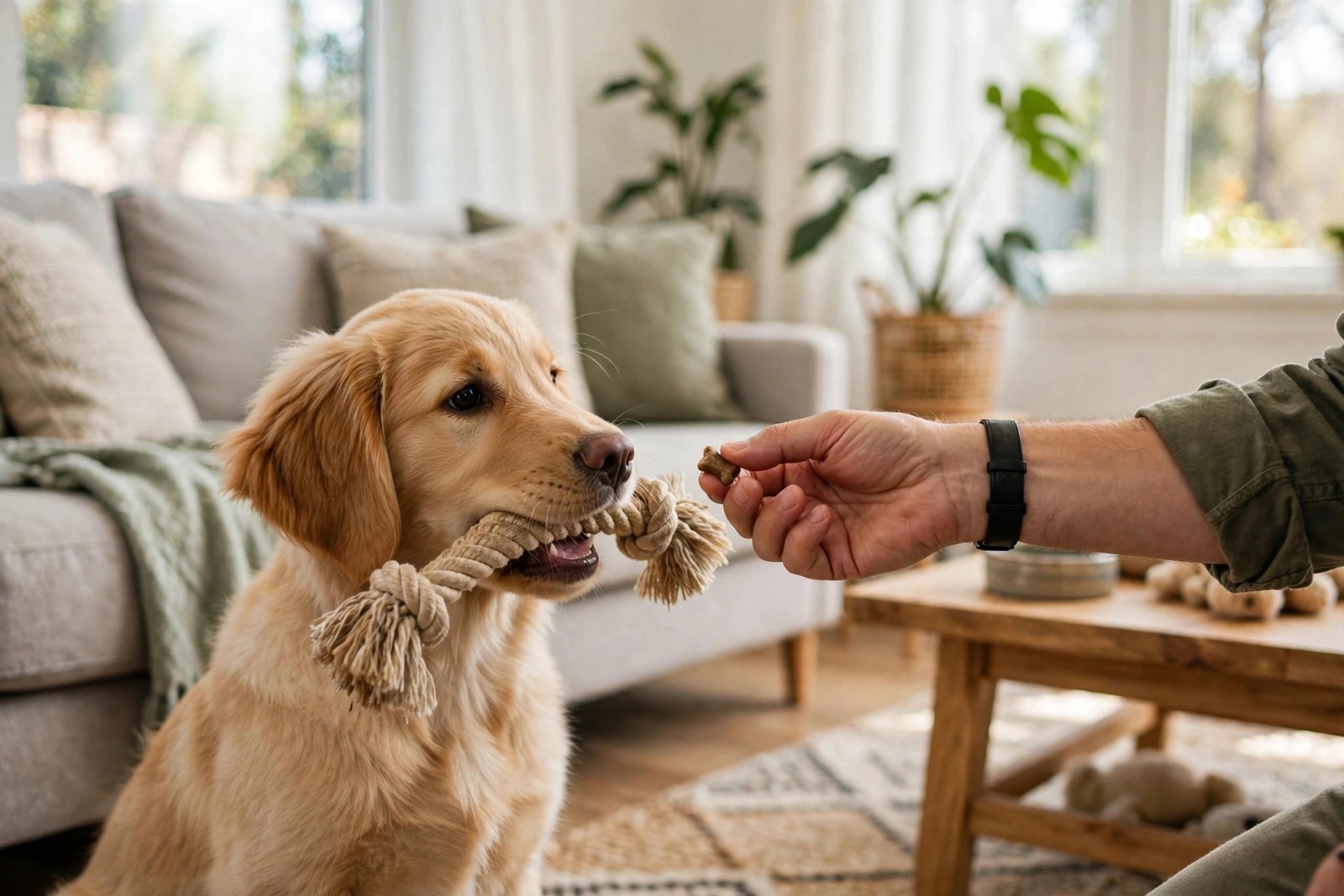
Withdrawal alone frustrates puppies. The moment you resume play, offer an appropriate chew — a bully stick, a frozen carrot, a rubber toy. You’re not just saying “not my hand,” you’re saying “this instead.” Puppies that learn what TO chew bite hands far less than puppies that only learn what not to chew. Stock up: teething puppies need constant legal chewing outlets, and if you’re setting up a dedicated puppy zone, flooring that stands up to dogs and kids is worth sorting before the chewing phase peaks.
The Feet Problem: A Special Protocol
Feet-biting is harder because movement is the trigger and you can’t stop walking forever. The protocol: the instant teeth touch your feet, freeze completely. Movement rewards the chase instinct; stillness is boring. Wait for the puppy to disengage (even for one second), then mark and reward the disengagement with a treat tossed away from your feet — which also repositions the puppy.
For persistent ankle-biters, especially herding breeds like Australian Shepherds and Corgis (hugely popular in Chicago), add structured impulse-control games: “leave it” with food on the floor, flirt-pole play with clear start/stop rules, and settle-on-mat training. Herding breeds nip because it’s literally in their DNA — they need an outlet like treibball or herding-style fetch games, not just scolding.
Management matters too. In the witching-hour evenings when Chicago puppies go feral (usually 7–9 p.m.), preempt with a frozen Kong or a sniff walk rather than waiting for the ankle ambush. And never play with your puppy using your hands as toys — wrestling with bare hands teaches exactly the lesson you’re trying to unteach. Keeping a small dog happy in an apartment all day starts with hands meaning petting and treats, never wrestling targets.
What Never Works (Stop Doing These)
Alpha rolls, muzzle grabs, nose flicks, and yelling “NO!” in the puppy’s face are still recommended on some corners of the internet. The evidence is clear: they don’t teach bite inhibition, and they measurably increase fear and defensive aggression. A 2009 University of Pennsylvania study found confrontational methods like these were the most likely to trigger aggressive responses. You’re not establishing leadership; you’re teaching your puppy that human hands are scary and unpredictable — the opposite of a soft mouth.
Similarly, don’t use bitter apple spray as your primary plan. It punishes without teaching, and many puppies cheerfully chew through it. And never, ever crate the puppy as punishment for biting — the crate must remain a safe happy place, or you’ll create a second problem on top of the first.
When Biting Signals Something More
Normal puppy mouthing is loose-bodied, wiggly, and paired with play bows. Concerning biting looks different: stiff body, hard stare, growling over resources, or biting that escalates in intensity over weeks despite consistent training. True aggression in puppies under 16 weeks is rare, but resource guarding can emerge early and needs professional intervention — not DIY dominance exercises.
If your puppy is over 5–6 months old and still biting hard with no improvement, or if anyone in the household is afraid, bring in a certified professional dog trainer (CPDT-KA) or veterinary behaviorist. Chicago has excellent force-free puppy programs, and a single private session often identifies the missing piece. The AKC’s puppy training guides align with this graduated, reward-based approach, and VCA’s Know Your Pet behavior library covers the full developmental timeline — it’s the professional consensus, not just one trainer’s opinion.
Conclusion
Puppy biting isn’t defiance, dominance, or a character flaw — it’s a developmental stage with a clear exit ramp, if you train it systematically. Yelp and withdraw for hard bites, shrink the threshold over weeks, redirect every time to legal chews, freeze for feet, and never use confrontation. Most Chicago puppies turn the corner between 5 and 7 months as teething ends and training compounds. Stay consistent through the land-shark phase, and you’ll end up with the adult dog every owner wants: one with a soft mouth, self-control, and hands they trust completely.
Frequently Asked Questions
How long does the puppy biting phase last?
Intense mouthing typically peaks during teething (12–24 weeks) and fades significantly by 6–7 months with consistent training. Without training, some dogs carry mouthy habits into adulthood — which is why the graduated yelp-and-withdraw protocol matters from day one.
Should I yelp when my puppy bites me?
Yes, but only for bites that genuinely hurt, followed by immediately withdrawing attention for 10–15 seconds. Yelping at every light mouth touch desensitizes the puppy to your feedback. Gradually lower your threshold over weeks to shape a softer mouth.
Why does my puppy bite my feet more than my hands?
Movement triggers the chase-nip instinct, especially in herding breeds. Freeze the instant teeth touch your feet — stillness is boring — then reward the moment the puppy disengages. Never keep walking, which rewards the chase.
Is it okay to put my puppy in the crate for biting?
Not as punishment — that poisons the crate’s safe association. A brief, calm crate break is fine if the puppy is overtired and can’t settle (overtired puppies bite hardest), but frame it as a nap, not a consequence. Enforced naps solve an enormous amount of evening biting.