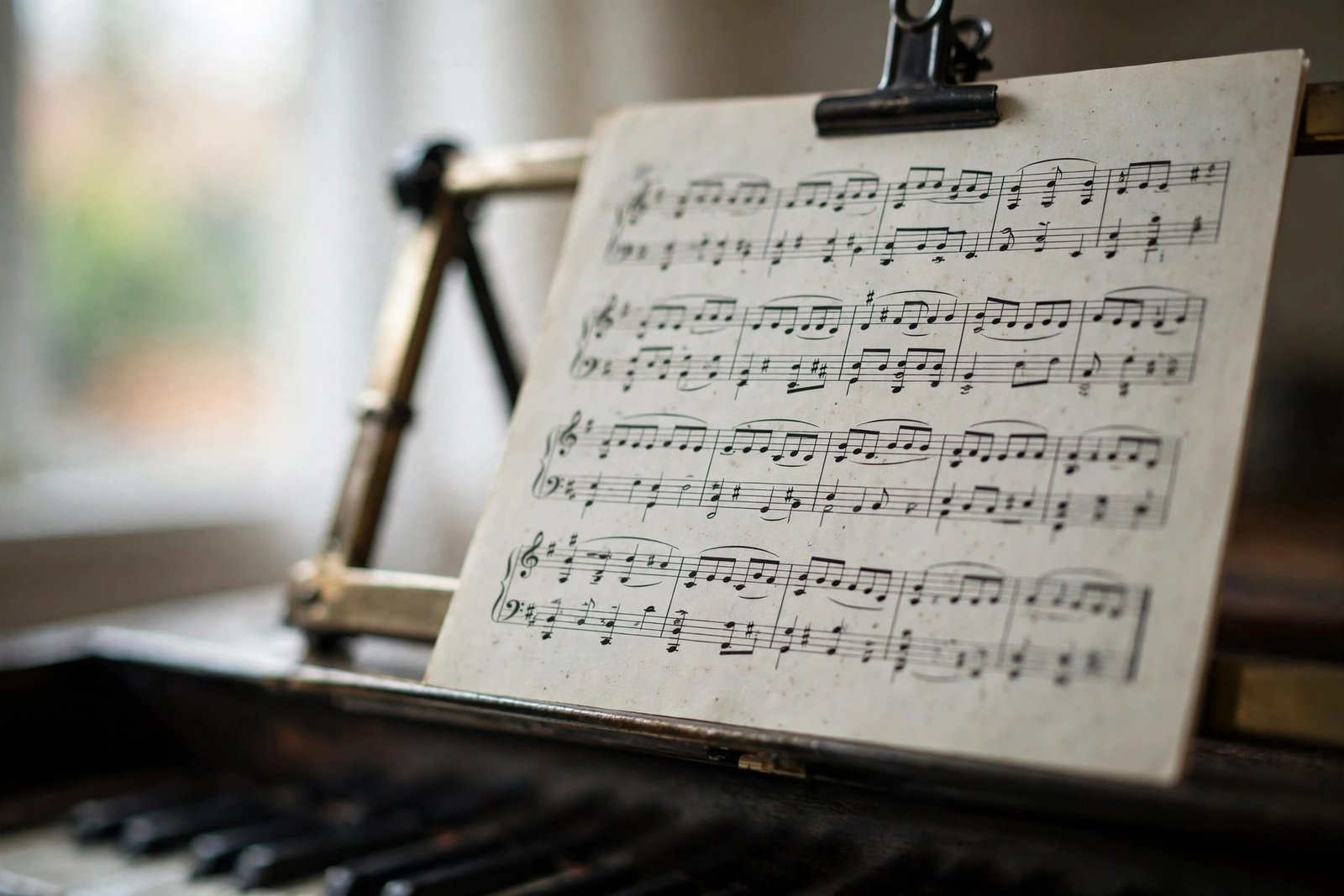
Sheet music looks like a secret code — dots and lines that musicians read effortlessly while you stare blankly. But here’s what musicians know: it’s not a talent, it’s a literacy. Nobody is born reading music, and the system is far more logical than it appears. With the right sequence, a complete beginner can read basic sheet music within weeks.
This guide teaches it step by step, in the order that actually builds understanding: the staff, note names, rhythm, and key signatures. No prior knowledge assumed.
Step 1: The Staff and Clefs (Your Map)
Music is written on a staff: five horizontal lines with four spaces between them. Each line and space represents a specific pitch — higher on the staff means higher in pitch. That’s the entire conceptual foundation.
The clef at the beginning tells you which pitches the lines represent. The two you’ll meet: the treble clef (𝄞, the swirly one — for higher instruments and the right hand on piano), where the bottom line is E and spaces spell F-A-C-E bottom to top; and the bass clef (𝄢, for lower instruments and piano left hand), where lines are G-B-D-F-A. Mnemonics help at first: treble lines “Every Good Boy Does Fine,” bass lines “Good Boys Do Fine Always.” You’ll outgrow the mnemonics within weeks — they’re scaffolding, not the building.
Step 2: Note Names and Values (What and How Long)
Notes are named A through G, repeating. On the treble staff, memorize two landmarks: the bottom line is E, the top space is F — everything else sits alphabetically between or extends by steps. Notes above or below the staff use short ledger lines; just count outward from your landmarks.
Note shape tells you duration. A whole note (open oval) = 4 beats. Half note (open oval + stem) = 2 beats. Quarter note (filled oval + stem) = 1 beat. Eighth notes (filled + stem + flag/beam) = half a beat. The Library of Congress’s sheet music collections let you see these symbols in centuries of real music — the notation system has been stable for hundreds of years, which means learning it unlocks everything from Bach to Broadway.
Step 3: Rhythm and Time Signatures (When)
Rhythm is where beginners actually struggle — not note names. The time signature (two numbers at the start, like 4/4) tells you the beat structure: top number = beats per measure, bottom = which note gets one beat. 4/4 (“common time”) means four quarter-note beats per measure — the backbone of most popular music. 3/4 is waltz time (three beats), 6/8 has a rolling compound feel.
Practice method: clap rhythms before playing them. Count “1-and-2-and-3-and-4-and” for eighth notes in 4/4. Use a metronome from day one — rhythm precision is the skill that separates readers from guessers. Start with simple rhythms (quarter and half notes), add eighth notes, then tackle dotted notes and ties. If you’re learning an instrument alongside, our guide to learning guitar as an adult beginner covers building the practice habits that make reading stick.
Step 4: Key Signatures and Accidentals (The Fine Print)
Sharps (♯) raise a note a half-step; flats (♭) lower it; naturals (♮) cancel them. A key signature — the cluster of sharps or flats after the clef — applies to the whole piece: one sharp means every F is F♯ unless marked otherwise. This is how music communicates its “home base” key efficiently.
You don’t need to memorize all key signatures immediately. Learn C major (no sharps/flats) and G major (one sharp) first — they cover a huge amount of beginner repertoire. Add keys gradually as you encounter them. The National Endowment for the Arts’ music resources highlight how this 400-year-old system remains the universal language letting musicians worldwide play together on sight.
Step 5: Putting It Together (Your First Real Reading)
The method: scan first (clef, key signature, time signature — 10 seconds that prevent 90% of errors), clap the rhythm of the first line, name the notes slowly, then play or sing at half speed. Speed comes last, always. Beginners who rush produce confident wrong notes; beginners who go slow build the neural pathways that eventually feel automatic.
Start with melodies you already know — “Ode to Joy,” “Twinkle Twinkle,” folk songs. Familiar tunes let your ear correct your eyes, which accelerates learning enormously. Then graduate to simple method books, which sequence difficulty deliberately. To keep inspiration high, follow new album releases and try reading along with sheet music for songs you love — motivation is the best teacher.
Common Beginner Mistakes to Avoid
Five traps catch nearly every beginner. 1. Ignoring the key signature: forgetting that one sharp means every F is sharp, not just the first one — the most common reading error, fixed by the 10-second pre-scan. 2. Counting inconsistently: changing your counting speed mid-measure destroys rhythm; the metronome is the cure. 3. Staring at your hands instead of the music: train yourself to read ahead — your eyes should be a beat or two ahead of what you’re playing, which only comes from slow practice.
4. Playing too fast too soon: speed is a byproduct of accuracy, never the goal. If you can’t play it perfectly slowly, you can’t play it fast — you can only play it fast and wrong. 5. Neglecting rhythm for notes: beginners obsess over right pitches and fudge timing, but audiences forgive a wrong note and never forgive lost rhythm. When in doubt, prioritize the beat over the pitch. Every professional reader made all five mistakes; the difference is they corrected them instead of practicing them.
Conclusion
Reading sheet music from scratch is five steps: learn the staff and clefs (your pitch map), note names and values (what and how long), rhythm and time signatures (when), key signatures and accidentals (the fine print), then combine them slowly on familiar songs. Give it 15 focused minutes daily and basic reading clicks within a month; fluency builds over 6–12 months. It’s not a gift — it’s a literacy, and like any literacy, it yields to steady practice. The dots will stop being mysterious. They’ll start being music.
Frequently Asked Questions
How do I read sheet music from scratch?
Learn in order: the staff and clefs (pitch map), note names and durations, rhythm and time signatures, then key signatures. Practice on familiar melodies, clap rhythms first, and always start at half speed.
How long does it take to learn to read music?
Basic reading (simple melodies) typically clicks within 4–8 weeks of daily 15-minute practice. Comfortable fluency takes 6–12 months of consistent work.
What’s the difference between treble and bass clef?
Treble clef covers higher pitches (right hand on piano, violin, flute); bass clef covers lower pitches (left hand on piano, cello, bass). They use the same staff with different pitch assignments.
Do I need to memorize all key signatures?
Not at first. Start with C major (no sharps/flats) and G major (one sharp), which cover most beginner music. Add keys gradually as you encounter them in real pieces.
Is reading music necessary to play an instrument?
Not strictly — many great musicians play by ear. But reading unlocks centuries of written music, accelerates learning new pieces, and is essential for classical, jazz, and ensemble playing.