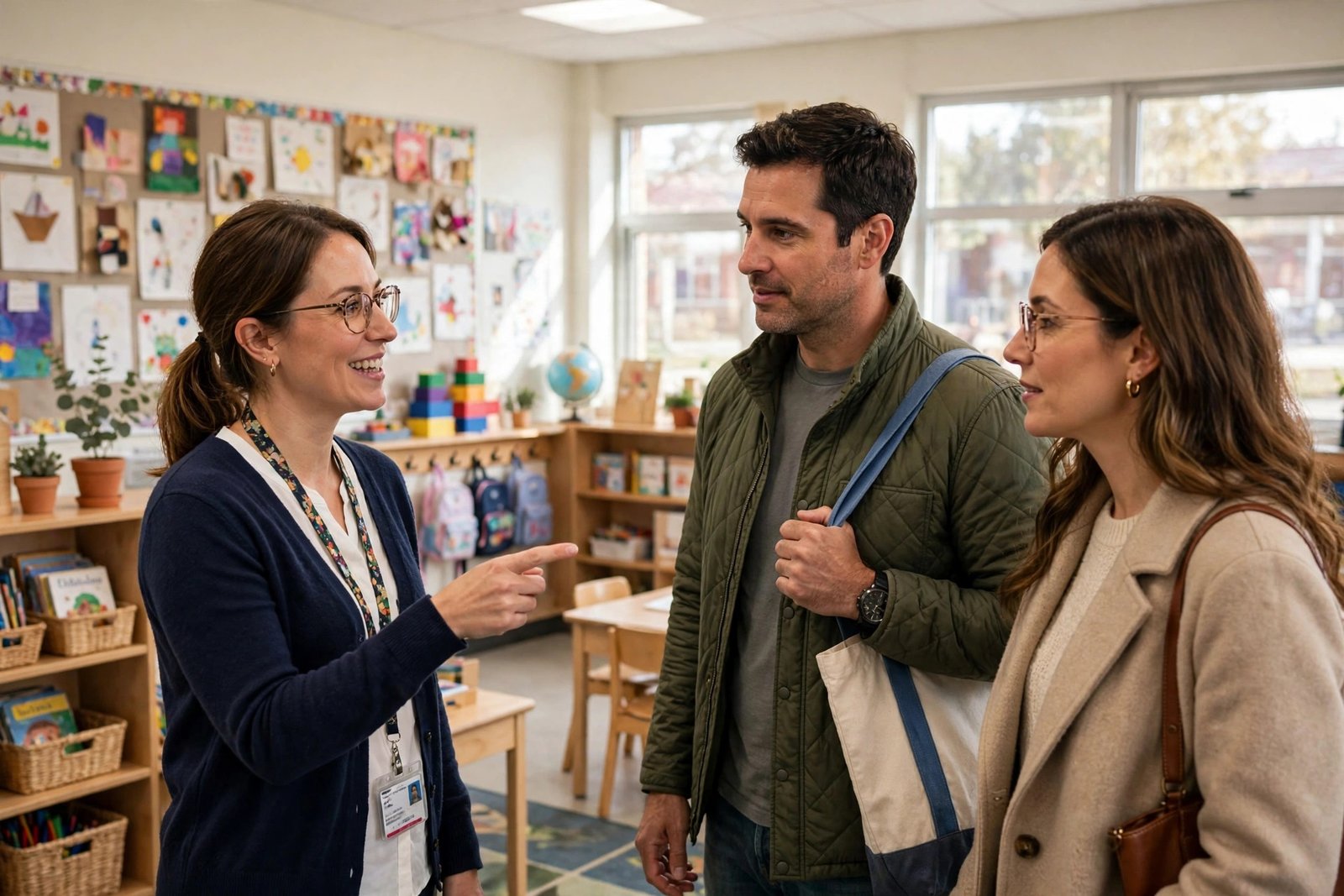
The school tour: 45 minutes that are supposed to tell you where your child will spend 1,000 hours a year for the next six years. Most parents walk in unprepared — charmed by the art on the walls, reassured by a confident principal, and out the door without having learned anything that actually predicts their child’s experience. A school tour is a sales presentation; your job is to see past it.
This guide tells you what to look for, what to ask, and the subtle signals that separate genuinely great elementary schools from polished facades — so you choose with eyes open.
Before the Tour: Do Your Homework
Walk in informed: check the Illinois Report Card (test scores, growth data, demographics, teacher retention) for every school you are considering — data first, vibes second. Read parent reviews on GreatSchools.org with a critical eye (patterns across reviews matter more than any single rant or rave). Know your priorities beforehand: academics, diversity, arts, special services, commute — rank them, because no school is perfect and you will be trading off. And prepare your questions in writing; tours are overwhelming and you will forget half of what you meant to ask.
What to Observe: The Classroom Visit
Insist on seeing real classrooms in session — a tour that only shows hallways and the gym is hiding something. Student engagement: Are children actively participating, or passively sitting? Look for hands up, discussion, movement — not silent rows. Teacher-student interaction: Warm but structured? Do teachers know students individually? Watch for the tone — respectful, encouraging, or authoritarian? Differentiation: Are advanced students challenged and struggling students supported, or is everyone doing the identical worksheet? Ask how they handle the range. Classroom environment: Student work displayed (not just commercial posters), organized materials, evidence of current learning — versus bare walls or months-old decorations. Behavior: Are transitions smooth? Do students seem happy and purposeful, or chaotic and checked out?
What to Observe: The Whole School
Hallways and common areas: Clean, maintained, student work celebrated — physical environment reflects institutional pride (and budget priorities). The lunchroom: If you can observe lunch — noise level, supervision, food quality — it reveals school culture fast. Specials: Art, music, PE, library — are they robust programs or afterthoughts? Ask about frequency (weekly? biweekly?) and staffing (certified specialists or classroom teachers covering?). Playground: Equipment condition, supervision ratios, and whether recess is actually protected (some schools quietly erode recess — a red flag for developmental priorities). Diversity: Does the student body — and the staff — reflect the community? Do you see inclusive materials and practices, or a monoculture?
Questions That Reveal the Truth
Academics: “How do you support students who are ahead? Who are behind?” (Listen for specifics, not platitudes.) “What curriculum do you use for reading and math?” (Research-aligned programs are a good sign.) “How do you measure and share student progress?” Culture: “How do you handle bullying?” (Ask for the actual process, not “we have zero tolerance.”) “What does discipline look like here?” (Restorative practices vs. purely punitive — the philosophy matters.) Teachers: “What is teacher turnover like?” (High turnover is the single biggest red flag — great schools retain teachers.) “How do teachers collaborate?” Logistics: “What is the homework policy?” “How does communication with parents work?” “What are the before/after-school options?” The killer question: “What is the school working to improve right now?” — honest answers reveal self-awareness; defensive non-answers reveal the opposite.
Red Flags and Green Flags
Red flags: No classroom observations allowed; principal cannot answer basic curriculum questions; high teacher turnover; emphasis on test prep over learning; dirty or unsafe facilities; evasive answers about bullying or special education; pressure to decide immediately. Green flags: Transparent data sharing; teachers who speak enthusiastically about the school; visible student joy; strong arts and enrichment; active parent community (but not a cliquish one); honest acknowledgment of challenges with concrete improvement plans; children who make eye contact and say hello — school culture is visible in its students.
Bringing Your Child on the Tour
For kindergarten, your child can come along — watch how they react to the classrooms, the playground, the other children. Do they light up or shrink? For older elementary transfers, give them real agency: let them ask a question, notice what they notice afterward (kids fixate on revealing details — “the art room was locked” or “everyone looked bored”). A child who feels chosen-by rather than assigned-to a school starts with ownership. Afterward, ask open questions: “What did you like? What felt weird?” — their answers often cut through adult rationalization to the heart of fit.
After the Tour: Deciding
Debrief immediately — impressions fade fast. Compare notes against your priority list, not against other parents’ opinions. Visit your top two choices a second time, ideally at a different time of day (morning drop-off energy differs from afternoon). Talk to current parents outside the school’s orchestrated events — the pickup line, the local playground. And trust the combination of data and gut: the numbers tell you about outcomes, but your sense of whether your specific child would thrive there matters enormously. A school that is perfect on paper but feels wrong usually is — for your family.
Remember that the school is only half the equation — your involvement matters as much. Once enrolled, the strategies in supporting homework effectively and building reading habits at home will shape your child’s experience as much as any classroom.
Chicago-Specific Notes
Chicago’s elementary landscape includes neighborhood schools, magnets, charters, and selective enrollment — each with different admissions processes and timelines. CPS application deadlines fall in winter for the following year — miss them and options narrow dramatically. Tour broadly across types; many parents discover their neighborhood school is stronger than its reputation, while some sought-after programs disappoint up close. The Illinois Report Card is your objective starting point for every CPS school.
Conclusion
Touring elementary schools well means: research data before visiting, observe real classrooms (engagement, differentiation, warmth), inspect the whole school (specials, lunch, playground), ask revealing questions (turnover, bullying process, improvement areas), watch for red and green flags, and decide using both numbers and instinct. The right school is not the highest-ranked one — it is the one where your child will be known, challenged, and happy. Forty-five minutes, used well, can tell you exactly that.
Authoritative source: See the Illinois Report Card for expert guidance on this topic.
Frequently Asked Questions
What should I look for when touring an elementary school?
Real classroom engagement (not just hallways), teacher-student warmth, differentiation for different levels, robust specials (art/music/PE), teacher retention, honest answers about challenges, and whether students seem happy and purposeful.
What questions should I ask on a school tour?
How they support advanced and struggling students, the reading/math curriculum, teacher turnover rate, the bullying process, discipline philosophy, homework policy, and what the school is currently working to improve.
How important are test scores when choosing an elementary school?
Moderately — growth scores (how much students improve) matter more than absolute scores (which largely reflect demographics). Combine data with observations; a school’s culture and teaching quality don’t appear in test numbers.
When should I start touring elementary schools in Chicago?
Fall before the enrollment year — CPS applications and many private-school deadlines fall in winter. Start researching in early fall, tour October–December, and apply before deadlines close.