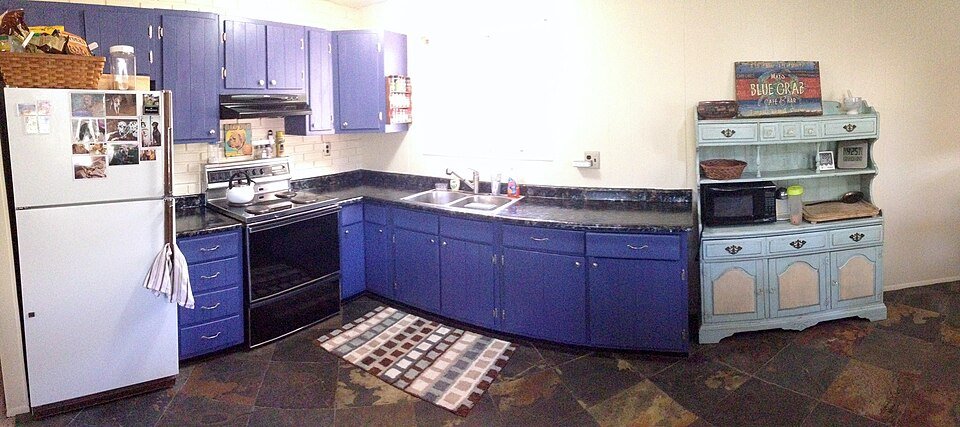
Before you price new cabinets, look at yours with fresh eyes. If the boxes are solid and the layout works, the answer to how can I make my old kitchen cabinets look new without replacing them is almost always yes, and for a fraction of replacement cost. Dated cabinets are usually a finish problem, not a cabinet problem.
I’ve transformed two kitchens’ cabinets without replacing a single box. Here’s every method that actually works, from cheapest to most dramatic.
Paint: the total transformation
Cabinet painting is the heavyweight champion of cabinet makeovers. The process: remove doors and hardware, degrease thoroughly (this step makes or breaks the job), sand lightly, apply bonding primer, then two coats of quality cabinet enamel with a sprayer or high-density foam roller. Cost: $150-$400 DIY, $3,000-$6,000 professional.
Color choice matters enormously. White, warm greige, and soft sage transform oak cabinets from dated to current. Avoid trendy dark colors unless your kitchen has great light. And use real cabinet paint, not wall paint; the hardness difference is what survives daily abuse. My detailed method is in the cheapest ways to update an outdated kitchen.
How can I make my old kitchen cabinets look new without replacing them with hardware
Never underestimate hardware. Swapping 1990s brass knobs for modern matte black or brushed brass bar pulls ($2-$5 each) updates every door and drawer in an afternoon. It’s the fastest, cheapest cabinet facelift in existence.
While you’re at it, add soft-close hinges and drawer dampers ($30-$80 total). The solid, silent close feels luxurious and modern regardless of the cabinet’s age. Fill old hardware holes with wood filler before drilling new ones if the spacing changes; mismatched hole patterns are the telltale sign of a rushed job.
Refacing, veneer, and deeper refreshes
Cabinet refacing, new doors and drawer fronts plus veneer on the boxes, costs $4,000-$10,000 and delivers a genuinely new-cabinet look while keeping your layout. It’s the right move when paint won’t fix the door style (deeply routed 90s arches, for example) but the boxes are good.
Smaller moves add up too: replace worn shelf liners, add pull-out organizers to deep cabinets ($20-$50 each, life-changing for lower cabinets), install under-cabinet lighting to make everything glow, and re-caulk where cabinets meet walls. A deep clean and declutter inside the cabinets completes the like-new illusion.
Knowing when replacement is actually right
Be honest about the boxes. Particleboard that’s swelling from water damage, doors that won’t stay aligned, drawers that fall apart, these are structural failures paint can’t fix. If the layout makes you miserable daily, pretty doors on a bad layout just delay the inevitable.
Also consider: if the cost of professional painting approaches half the cost of new stock cabinets, and the boxes are mediocre, replacement may be smarter long-term. Run both numbers honestly. But for solid wood cabinets with good bones, refinishing almost always wins on value.
Cabinet refresh essentials
- Degrease religiously: Kitchen grease prevents paint adhesion. TSP substitute and elbow grease before any paint.
- Use cabinet enamel: Real cabinet paint cures hard. Wall paint chips within months on cabinets.
- Upgrade hardware: Modern pulls plus soft-close hinges: the fastest facelift in kitchen history.
- Consider refacing: New doors on good boxes beat full replacement on cost and disruption.
- Add interior organizers: Pull-outs and dividers make old cabinets function like new ones.
- Light it up: Under-cabinet LEDs make any cabinets look expensive and intentional.
Cabinet refresh mistakes
- Painting over grease: The number one cause of peeling cabinet paint. Degrease like you mean it.
- Wrong paint type: Wall paint on cabinets is a six-month solution. Cabinet enamel or nothing.
- Skipping primer: Bonding primer is what makes paint stick to old finishes. Don’t skip it.
- Ignoring damaged boxes: Swollen particleboard and broken drawers need replacement, not paint.
- Rushing the cure: Cabinet paint needs days to fully harden. Rehang too soon and it sticks and peels.
Paint vs. refacing: making the call
Paint transforms color; refacing transforms style. If your door style is fundamentally dated (deep 90s arches, for instance), paint makes them a different color of dated. Refacing swaps the doors entirely, delivering a genuinely current look. Assess honestly: is it the finish or the form that bothers you?
The cost gap matters: professional painting $3,000-$6,000, refacing $4,000-$10,000. DIY painting $300. If the budget forces a choice, DIY paint plus new hardware gets you 70% of refacing’s impact for 5% of the cost. Spend the savings on the countertops or lighting that complete the transformation.
Updating old cabinets: your questions answered
How long do painted cabinets last?
With proper prep and quality cabinet enamel, 8-12 years in normal use. High-wear areas (around handles, trash pullouts) show wear first and can be touched up. The prep quality determines the lifespan more than the paint brand.
Should I spray or brush cabinet paint?
Spraying gives the smoothest factory-like finish but needs equipment and masking skill. High-density foam rollers plus quality brushes give excellent results for DIYers. Either way, thin coats and proper cure time matter more than the application method.
Can I change cabinet hardware placement?
Yes; fill old holes with wood filler, sand smooth, and drill new ones. It’s standard in hardware updates when switching styles (knobs to pulls). The filled holes disappear under paint. Measure twice and use a template for consistent placement.
What’s the best paint finish for cabinets?
Satin or semi-gloss: durable, wipeable, with a soft sheen that looks professional. Avoid flat (marks easily) and high-gloss (shows every imperfection). Cabinet-specific enamels in satin are the sweet spot for 99% of kitchens.
The bottom line
Paint with proper prep, swap hardware and add soft-close, consider refacing for dated door styles, and upgrade interiors with organizers and lighting. Solid cabinets with a bad finish are a $300 paint job away from looking new, not a $15,000 replacement away. Judge the boxes honestly, then refresh with confidence. You might also like cost to replace kitchen cabinets on a budget. The Family Handyman’s cabinet refinishing guides has authoritative detail on this topic.